
INCETTA. – It is the taking over, entirely or in substantial quantity, of goods available on a given market, in order subsequently to resell them on advantageous terms or to use them later, when they will be difficult to obtain.
This may occur at any time and with regard to every kind of goods, giving rise to the phenomenon of monopoly. It usually occurs, however, during periods of actual or feared scarcity (especially in times of war, social disturbances, etc.) and with regard to goods of widespread consumption and great necessity (above all raw materials and foodstuffs), producing the well-known phenomena of war profiteering or profiteering from favorable market conditions.
The social importance of this fact has led all governments to intervene. Their action has proceeded in two directions: a) preventing the emergence of i. either by removing the goods in question from free private contracting through compulsory stockpiling, or by guaranteeing citizens a minimum quantity of them through rationing; b) eliminating it by imposing severe penalties on the hoarder. Experience has shown that such measures achieve their purpose when the authorities genuinely guarantee at least what is indispensable and demonstrate real firmness in punishing major hoarders: two things that, unfortunately, have occurred only rarely.
(phot. Gab. fot. nat.)
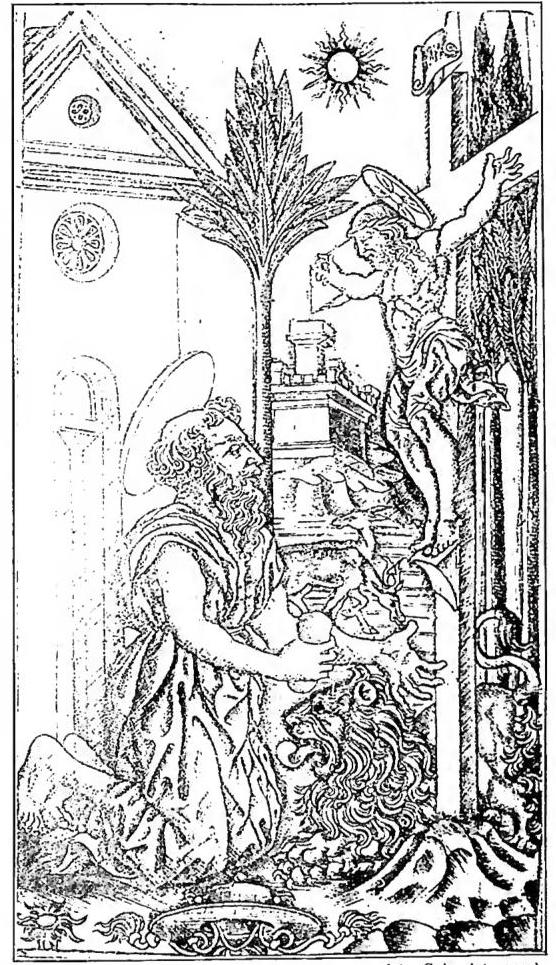
INCISION—St Jerome in contemplation before the Crucifix, by an anonymous Florentine artist of the 15th century (engraving)—Florence, Uffizi Gallery.
The hoarding of indispensable goods for profit is condemned by morality. For it violates not only the law of charity, which obliges each person to love others as himself, but also the law of social justice, which obliges each person to contribute to the common good to the extent of his abilities. The judgment seems less severe in the case of hoarding luxury goods or hoarding for the purpose of “personal or family provision.” In these cases, in fact, there is neither the harm to others nor the manifestation of selfishness observed in the first case.