
NYERI, APOSTOLIC VICARIATE OF. - It is located in the north-central-eastern part.
part of Kenya, and it is entrusted to the Fathers of the Missionary Institute of the Consolata (v.), who arrived in Kenya on June 6, 1902, under the jurisdiction of the apostolic vicariate of Zanzibar.
They pushed on among the Kikuyu, at the foot of Mount Kenya, and then among the Ameru, a tribe of Nilotic race. On Sept. 14, 1905, with a small territory detached from the apostolic vicariate of Zanzibar (v.), the "missio sui iuris" of Kenya was erected, raised on July 12, 1909, to an apostolic vicariate, whose territory was later enlarged thanks to successive boundary changes with the apostolic vicariate of Zanzibar (July 7, 1916; Feb. 20, 1922; Feb. 23, 1930). On March 10, 1926, it changed its name to that of the vicariate of N., when the apostolic prefecture of Meru (v.) was detached from it, likewise entrusted to the Fathers of the Consolata.
In 1940, because of the war, the Italian missionaries were interned and the vicariate was administered by a delegated vicar of Dutch nationality from the Congregation of the Holy Spirit. The Italian missionaries began to return in 1944, but under the direction of the aforementioned delegated vicar, until the arrival of the current apostolic vicar Msgr. Carlo Cavallera J. M. C. (1947).
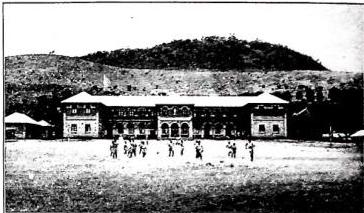
In the city of N., besides a well-equipped hospital, there is a school for nurses with 15 students, just as several industrial activities have been developed, especially through the work of the lay Brothers of the Consolata: numerous natives have there learned the trade of carpenter, mason, blacksmith, shoemaker and generally the art of leatherworking. According to the latest statistics from 1950, the vicariate of N. has an area of about 280,000 sq km; out of 750,000 inhabitants there are 40,180 Catholics, of whom only 1,320 are foreign and 184 of mixed stock, 4,455 catechumens, 45,000 Protestants, 600 Muslims, 500 Indians; 8 native priests and 44 foreign, 3 native lay brothers and 20 foreign, 67 native sisters and 75 foreign (Italian, of the Institute of the Consolata), 1 intervicarial major seminary and 1 minor seminary; 87 catechists and 11 catechist women; 240 male teachers and 38 female teachers; 18 quasi-parishes, 2 main mission stations and 1 secondary; 20 churches and 6 chapels; 2 hospitals; 16 dispensaries; 4 nurseries; a printing press that prints books in numerous African languages, as well as in Latin and English, and a periodical with a print run of 3,000 copies; 93 elementary schools; 2 middle schools; 17 vocational; 1 normal. There are flourishing associations of Catholic Action. In 1950 the baptisms of adults numbered 1,675.
Bibliography5 works
Carlo Corvo