
SCHOLASTICISM
of its ultimate destiny. Historians agree in dividing medieval Scholasticism into three periods: the preparatory or "early Scholasticism" (Frühscholastik), the period of realization or "high Scholasticism" (Hochscholastik), and finally the decline or "late Scholasticism" (Spätscholastik). This division is justified both from a methodological, critical, and doctrinal standpoint.
1. The preparatory or early Scholasticism
This period spans the time from the end of antiquity (5th–6th centuries) to the 13th century. From the patristic era, figures such as Augustine (v.), the pseudo-Dionysius, and Boethius (v.) emerge as "masters" of Scholasticism, serving as ecclesiastical sources; yet strictly philosophical doctrinal sources also come to the fore, such as certain Platonic dialogues (Phaedo, Meno, fragments of the Timaeus with the great Commentary on the same dialogue by Calcidius), especially Aristotle’s *Organon* in the translation and commentaries of Boethius, and other minor sources like the Neoplatonist Marius Victorinus, Porphyry, Macrobius, and Apuleius (cf. M. De Wulf, op. cit., 28: the treatment is due to A. Pelzer). From this indication, the character of this early Scholasticism can be discerned: it is marked by the predominance of Platonism (or Neoplatonism) in content and by a tendency toward dialectical procedures of subdivisions and distinctions in method. Evidently, the process is long and arduous, subject to doctrinal crises often quite severe, which have direct repercussions on dogma itself (controversies over predestination, the Trinity, the Incarnation, the Sacraments, especially the Eucharist), provoking what has been termed the "winter" of the Church. In the 9th century, the Neoplatonic speculation (inspired by the pseudo-Dionysius) of John Scotus Eriugena (v.) stands out almost suddenly as a self-contained block; he came under suspicion of pantheistic monism and was condemned for his doctrine of predestination (Denz-U, 320 ff.). In the 11th century, Tours (v.) appears, who, placing too much confidence in dialectical reasoning, compromised the doctrine of transubstantiation, incurring condemnation at various councils (Vercelli 1050, Rome 1059, Poitiers 1074, and Bordeaux 1080: Denz-U, 355). Dialectic also ran rampant in Roscelin (v.), provoking the indignation of St. Peter Damian (v.). The most notable figure of this period is St. Aosta (v.), the first systematic theologian who, proceeding from Scripture and ecclesiastical teaching, advanced to theological reflection and contemplation with a Platonic-Augustinian background, in accordance with the motto found in the title of the *Proslogion* (and taken from chapter 1: PL 158, 227 BC: ... “Credo ut intelligam”), which remained orthodox throughout Scholasticism: *Fides quaerens intellectum*. The 12th century is notable for the flourishing of grammar and logic schools and is characterized by an unexpected and sudden development of the arts and letters of the Trivium and Quadrivium, in which the School of Chartres stands out with Clarembald of Arras (v.), William of Conches (v.), Bernard (v.), and Thierry of Chartres, as well as Bernard of Tours, a contemporary of Thierry, also called Silvestris; CHAMPLEVE (v.), John of Salisbury, and Gilbert de la Porrée stirred up the controversy over universals; finally, Abelard (d. 1142) presented the first scientific methodology of Christian theology, strongly opposed by the mystic St. Bernard. At the same time, in the Parisian monastery of St. Victor, the first systematic treatises on theology and mysticism began to take shape (Richard [v.] and Hugh of St. Victor [v.]). The end of the century saw a fervor for translations of Greek and Arabic texts, particularly in Toledo, Palermo, and Naples, which provided the foundations and materials for the great leap forward in the following century.2. The realization or high Scholasticism
In the 13th century, the synthesis of reason and faith reached its complete and definitive form in Christian thought; the first half of the century is marked by the arrival in the West, through Latin translations, of Avicenna, Averroes, Avicebron, and above all the works of natural philosophy and metaphysics by Aristotle.a) The entrance of Aristotle. — This would provoke the most significant revolution in Christian thought in the West.
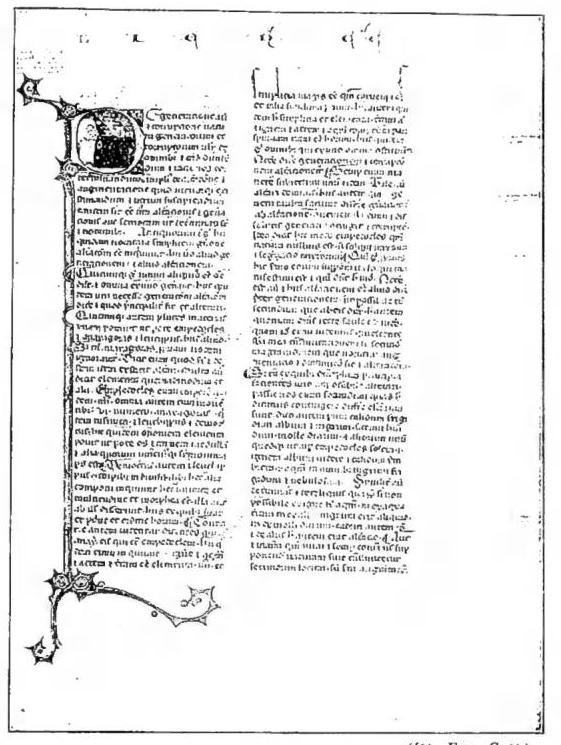
Scholasticism — Incipit of the *Liber de generatione et corruptione* by Aristotle, with interlinear and marginal annotations and corrections. Vatican Library, cod. Vat. lat. 2083, f. 157 (1284).
*Liber de anima*, *Liber de generatione*, *Liber de sensu et sensato*, *Liber de memoria et reminiscentia*, as well as, of course, the books of logic and the *Ethica* as far as the four books, i.e., the *Ethica nova* and the *Ethica vetus* (cf., regarding the question of conciliar prohibitions, which reappeared in a letter of Pope Urban IV to the University of Paris of January 13, 1263, and the relationship with the Statutes cited, M. Grabmann, *The Ecclesiastical Prohibitions of Aristotle under Innocent III and Gregory IX*, Rome 1941, pp. 7 ff., 113 ff., and 132. Grabmann did not have time to complete his research, and perhaps the only plausible solution thus far to the contradiction between the prohibitions and the Statutes is that proposed by Cardinal Ehrle, according to which the attitude of ecclesiastical authority in these prohibitions was one of “prudent waiting”: the ecclesiastical prohibitions ceased and lost their validity through desuetude, the purpose of the law and the situation to which it referred having ceased to exist (Fr. Ehrle, *Augustinianism and Aristotelianism in 13th-Century Scholasticism*, in *Xenia Thomistica*, III, Rome 1925, pp. 521 and 538).
b) The principal schools of high Scholasticism. — The entrance of Aristotle into Western Christendom provoked reactions of various kinds. Some, especially among theologians and not only in the Franciscan Order but also in the early Dominican school, fearful of any novelty, continued to adhere to tradition and did not intend to depart from the doctrine of St. Augustine; others, however, resolutely advanced along the new path and embraced Aristotle’s vision of the world within the Christian synthesis. For convenience of nomenclature, after the studies of Fr. Ehrle and P. Mandonnet, the two opposing currents have been designated by the terms “Augustinianism” and “Aristotelianism.”
Augustine’s Influence. In this approach, St Augustine remains the principal master, though not the exclusive source (it should be noted that he is also the common source of the other masters of this period, only that his doctrines are incorporated into types of metaphysics of differing inspiration). The metaphysics of the Augustinian approach proceeds rather, and certainly was able to consolidate itself, from the exaggerated realism of Neoplatonic type, and has as its principal source the great metaphysical dialogue *Fons vitae* AVENCEBROL (v.), translated at the end of the 12th century Gundisalvi (v.), who spread its doctrines in his little works *De Anima*, *De divisione philosophiae*, *De immortalitate animae*, *De processione mundi*, etc. (cf. the substantial observations of E. Gilson, in *Mediaeval Studies*, II, 1940, pp. 23-27). This doctrinal approach is already clearly visible in the first Franciscan masters, HALLEL (v.), but it was consolidated especially through the work of St Bonaventure and his disciples (Matthew of Aquasparta, Vital du Four, Peter John Olivi). From the letters of John Pecham, his disciple and emulator of St Thomas at Paris, the liveliness of the opposition between the two approaches is known, as well as the main points of controversy: in a letter of 10 June 1285 the doctrines of St Augustine are mentioned («...quidquid docet Augustinus de regulis aeternis et luce incommutabili [or doctrine of illumination], de potentis animae [identity of soul and faculty], de rationibus seminalibus inditis materiae et consimilibus innumeris»); in another letter of 7 December 1284 the thesis that caused the greatest stir in the antinomian controversy unleashed by this school is touched upon, namely the unity of the substantial form of man: «In homine existere tantummodo formam unam...», whereas traditional doctrine firmly held to the plurality of forms, which seemed necessary to explain the condition of Christ’s body in the tomb and the diversity of man’s various operations (cf. for the full text of the letter: M.-H. Laurent, *Fontes vitae s. Thomae Ag.*, fasc. VI, St Maximin Var 1937, pp. 639 ff., esp. pp. 644 ff.). The true metaphysical origin of this latter doctrine, however, was the thesis, taken wholesale from Avicebron, of universal hylomorphism (v.), according to which every creature, because finite in its being, is composed of matter and form: bodies of corporeal matter and spirits of spiritual matter (cf. E. Kleineidam, *Das Problem der hylomorphen Zusammensetzung der geistigen Substanzen im 13. Jahrhundert bis Thomas von Aquin*, Lilienthal 1930, p. 7 ff.).
The second Franciscan school, led by Duns Scotus (v.), remains faithful to the spirit of Augustinianism but elaborates metaphysical problems with greater adherence to the Aristotelian text, which is interpreted preferably along the lines of Avicenna (the great critical edition of the works, directed by Fr C. Balic [Rome 1950, so far 2 vols.], will enable the genuine thought of the «Subtle Doctor» to be distinguished from the additions or deductions of his disciples).
Thomistic Aristotelianism. The fortune of Aristotle in the West is principally linked to the boldness and authority of Albert the Great and to the penetration of his disciple St Thomas Aquinas. The Angelic Doctor came into direct contact with the philosopher’s work in his early youth at the University of Naples with the masters Peter of Ireland and Martin of Dacia, but he continued to deepen his understanding of the text throughout his life, making use of the translation work of his confrere William of Moerbeke (v.), first for Aristotle’s text itself and then for some important commentaries by Alexander of Aphrodisias, Simplicius, Ammonius, Porphyry, Themistius, and the *Elementatio theologica* of Proclus. While Albert often remains hesitant in his ultimate determination of Aristotle’s doctrines and remains under the influence of Neoplatonism, which he in turn transmits to his direct disciples (Ulrich of Strasbourg, Berthold of Moosburg, etc.), St Thomas digs into the Aristotelian principles in their genuine potentialities and adopts them without hesitation in his interpretation of the structure of reality and in the elaboration of theological truth. The most recent studies on the essence of Thomism, however, have warned against the simplistic interpretation that St Thomas reduced himself to opting for Aristotelianism against Platonism and classical Neoplatonism and patristic thought: in reality, the Angelic Doctor produced a new synthesis in which the Platonic notion of participation seems to constitute the key to the solution of fundamental problems such as creation, causality, the composition of finite being, and analogy. Towards the end of his life, St Thomas could proclaim, through an exegesis unique in the whole Middle Ages and which represents the higher viewpoint he had reached, that in this perspective of participation Plato and Aristotle are in agreement (cf. the little work *De substantiis separatis seu de angelorum natura*, ch. 3; ed. J. Perrier, *Opuscola philosophica*, I, Paris 1949, pp. 133 ff.). For the development of Aristotelianism in the synthesis of St Thomas, as for the manifold significance of Thomism, V. Tommaso d’Aquino.
Averroistic Aristotelianism. The claim to an absolute fidelity to the Aristotelian text was certainly the programme of the «Commentator» par excellence, Averroes (v.), and from him it passed in the second half of the 13th century to a group of able masters of the Faculty of Arts at Paris who, under the pretext of interpreting Aristotle, aroused serious concerns for Catholic orthodoxy. This school was given the name of «Averroism» (*Averroici, secta Averroica*), and its fortune depended in large part on having at its head a strong thinker like Siger of Brabant (v.). The principal and direct antagonist of Averroism was St Thomas himself in the little work *De unitate intellectus contra Averroistas* (of 1270); he does not hesitate to qualify Averroes as a corrupter of Aristotelian thought: «... qui non tam fuit Peripateticus, quam philosophiae peripateticae depravator» (ed. L. W. Keeler, Rome 1936, p. 38). The culminating episode is the repeated condemnation by the bishop of Paris, Stephen Tempier, on 7 March 1277 of no less than 219 theses (cf. the text in M.-H. Laurent, *Fontes...*, ed. cit., pp. 598-614), inspired for the most part by the new philosophy, though its supporters professed to be believers inasmuch as within the sphere of faith they submitted to revealed doctrine even when it appeared contrary to what reason demonstrated (theory of the «double truth»). The explicit appearance of Averroism does not seem to predate 1265, the year in which polemical reactions began; its history extends throughout the Middle Ages into the Renaissance, where the Averroist current is particularly visible and represents, with the cumbersome baggage of its distinctions, the most intractable and decadent (B. Nardi has identified not a few exponents of this revival of Averroism; cf. *Enciclopedia Cattolica*, XI).
The current associated with the position of Henry and Scotus is termed “neo-Augustinianism.” The term “decadence” is applied to nominalism (v.) with the same reservations, namely, with regard to the abandonment of the Thomist synthesis of reason and faith, of physics and metaphysics..., in favor of the predominance of subjectivity or intuitive experience in both natural and supernatural knowledge. In particular, not only G. Ockham (v.) but many among the theologians and philosophers, Ailly (v.) and especially Nicholas of Autrecourt, deny the probative value of the principle of causality. This Nicholas abandoned Aristotelianism even in natural philosophy, expressly inclining toward the atomism of Democritus (v.), as is evident from the recent edition of his principal work (cf. J. Reginald O'Donnell, N. of Atticourt, in Mediaeval studies, I, New York-London 1939, p. 222 sq.; id., The philos. of N. d'A. and his appraisal of Aristotle, ibid., IV, 1942, p. 97 sqq.). The causal skepticism of d’Ailly was the object of ecclesiastical censure (cf. Denz-U, 553-70). Nominalism soon gained the upper hand, penetrating almost everywhere, even among the religious orders, e.g., in the Augustinian Order (Gregory of Rimini [v.]); among the Dominicans themselves are cited R. Holkot and Durand of St. Pourçain. There was therefore in these centuries within the Church ample freedom in doctrinal approaches: in the great universities, alongside the “cathedra Thomae” there stood with equal right the chairs of Scotus, Gregory of Rimini, and Durand. Thomism as such never prevailed.
A beneficial consequence of the search for certainty by the nominalist “via moderna” (though already present in the previous century, e.g., in R. Kilwardby; cf. M.-D. Chenu, Aux origines de la science moderne, in Rev. des sciences philo. et théol., 29 [1940], p. 206 sq.) was the ferment it aroused for scientific inquiry: mention must be made of J. Buridan (v.), N. Oresme, and Albert of Saxony (v.). Though observation and calculation in the modern, i.e., Galilean, sense were still distant, motion was studied from a strictly physical standpoint and quantitative treatment of qualities was given an important place. Physical reality was seen as subject to measurement, so that the first hints of infinitesimal and algebraic calculation appear, as when Oresme enunciates the principle: “Omnis res mensurabilis imaginatur ad modum quantitatis continuae” (De uniformitate, Paris, Bibliothèque nationale, cod. lat. 7371, fol. 18°, cited in M. De Gandillac, Le mouvement doctrinal du IXe au XIVe siècle, Paris 1951, p. 461). Careful investigations in this field, especially through the work of P. Duhem, have shown that the fourteenth century was already familiar with the concepts of “volume” and “mass,” albeit with uncertainty and fluctuation; “motion” was regarded as an intensive magnitude or “variable quantity,” and N. Oresme attempted a graphic exposition of it which, though not yet analytic geometry in the Cartesian sense, constitutes in some way a surprising anticipation and stimulus at a distance; in Buridan, moreover, we find a notion of “absolute and mathematical time,” i.e., time freed from any dependence on motion or conscious thought, which four centuries later Newton would explicitly define (cf. A. Maier, Scholastische Diskussionen über die Wesensbestimmung der Zeit, in Scholastik, 26 [1951], p. 554). The very concept of “function,” not certainly in its modern formulation which belongs only to the late seventeenth century, is clearly outlined, e.g., in the Tractatus proportionis of 1322 by T. Bradwardine (v.) and by his followers (cf. A. Maier, Der Funktionsbegriff in der Physik des 14. Jahrh., in Divus Thomas (Frib.), 24 [1946], p. 147 sqq.). For this reason it has been rightly maintained that Buridan and his school were “precursors of Galileo,” even though it must be acknowledged that this century, so imbued with a zeal for the knowledge of empirical reality, remained entangled in a mass of particulars without rising by induction to general laws. The result was that the noteworthy achievements obtained by these scholastics fell into oblivion without any direct influence on the new physics of the sixteenth century, which rediscovered them anew on its own (cf. A. Maier, Das Problem des Kontinuums in der Philos. des 13. und 14. Jahrh., in Antonianum, 20 [1945], p. 368). In any case, the progress made was considerable: these results, which discredited Aristotelian physics, undoubtedly stirred the unrest that set modern science on its new path.
Finally, another title of merit for this late Scholasticism, which redeems it considerably from the epithet “decadent,” is the exceptional development that mysticism (v.) undergoes in the fourteenth and fifteenth centuries in the northern countries, especially in the Low Countries and Germany. Not unlike the turn toward physical-mathematical knowledge, to which reference has been made, the growth of mysticism was likewise prompted by weariness of the exhausting dialectical disputes that set the various schools against one another, fomenting rivalry and division even in the external life of Christendom. The mystical current took shape in all the schools of Scholasticism. The Franciscan Order found its master in none other than St. Bonaventure, who gave substance in his mystical works to the funeral longing that had manifested itself in his religious family after the death of St. Francis. In harmony with theological tradition, Franciscan mysticism is predominantly affective and directs its devotion toward the Passion of Christ.
The ripest fruit of medieval mysticism, the *De imitatione Christi*, resists every attempt to discover its author and remains outside any particular school (v. CRISTO). Dominican mysticism developed especially in Germany with Meister Eckhart (v.) and his disciples Johannes Tauler (v.) Suso (v.), CAUSA (v.), who form the so-called “Rhenish school.” Following in their wake came the great Ruysbroeck (v.) and perhaps also the anonymous author of the *Theologia deutsch*, said to be from Frankfurt (der Frankfurter), a work so dear to Luther. In this mysticism the intuitive and contemplative element predominates, clearly derived from Neoplatonism (Proclus and Pseudo-Dionysius), in the aspiration to penetrate the boundless sea of divine wisdom. The characteristic doctrine is that of the “scintilla animae” (die Füncklein der Seele; cf. H. Wilms, *De scintilla animae*, in *Angelicum*, 14 [1937], pp. 194 ff.; H. Hof, *Scintilla animae*..., Lund-Bonn 1952).
It is well known that controversy arose, not so much from Eckhart’s theological writings as from his preaching, which brought the preacher before an ecclesiastical tribunal and resulted in his condemnation by the bull *In agro dominico* of March 27, 1329 (Denz-U, 501–29; the critical edition in: M. H. Laurent, *Autour du procès de Maître Eckhart*, in *Divus Thomas* [Piacenza], 39 [1936], pp. 435–44). Yet the question of Eckhart’s orthodoxy is far from settled. If Denifle’s (v.) attempt to reduce Eckhart’s thought to pure Thomism cannot fully satisfy—since Thomism at that time had already developed many nuances—the claim that Eckhart was a founder of modern pantheism must be dismissed as anachronistic and exaggerated. The citation from Hegel (Religionsphilosophie, ed. G. Lasson, Leipzig 1923, 1, p. 257) adduced in support of this view is insufficient, especially since Hegel does not appear to have known more of the Dominican’s thought than what he found in Franz von Baader. Even if a continuity of motifs could be shown in German spirituality from Eckhart and his school to the heterodox mysticism of Sebastian Franck, Valentin Weigel, Böhme (v.), and through them to idealist pantheism (cf. G. Della Volpe, *Eckhart o della filosofia mistica*, Rome 1952, pp. 232 ff.), this would at most attest a vague spiritual affinity and not yet demonstrate a rigorous derivation of doctrines.
IV. The Second Scholasticism — This designation, intended to denote the Scholasticism of the sixteenth and seventeenth centuries, is likewise conventional. Humanism and the Renaissance did not extinguish Scholasticism but confined it largely to ecclesiastical and especially theological schools, without saying that both movements remained connected by many threads to the spiritual problems and interests that had nourished, albeit in diverse forms, the various systems (or ways) of Scholasticism.
The disintegration of Scholasticism reached a veritable chaos in the period of decline, of which the writings of the time—now made accessible to research by the investigations of the most expert specialists (Denifle, Ehrle, Mandonnet, Grabmann, Glorieux, Pelster, Pelzer, etc.)—are an impressive document. This bewilderment is undoubtedly to be linked to the campaign against Thomism; its most characteristic theses—the moderate realism in the question of universals (v.) with the doctrine of the active intellect and abstraction, the concept of potency, and the distinction between essence and act of being—were the first to be abandoned. The probative value of demonstrations concerning the substantial union of soul and body, the immortality of the soul, and the existence of God was denied, and these truths were made the exclusive object of faith. No internal force could halt the decline. Only with the upheaval of the Reformation—whose connection with nominalism has been generally acknowledged after Denifle’s studies (cf. F. Vignaux, *Luther commentateur des Sentences*, Paris 1935)—was the importance of unifying the spiritual forces of Christendom recognized.
The significance of this “rebirth,” truly providential for Scholasticism, lies above all in the guiding position assumed by the thought of St. Thomas for Catholic schools. The principal architect of this belated yet well-deserved recognition of the Angelic Doctor’s doctrinal work was the Dominican Order. Yet one must also recall the doctrinal activity of the Society of Jesus (founded at that time with the express purpose of countering heresy), which sent some of its best students to the universities of Paris and Salamanca to study under the most celebrated Dominican masters. Around these centers the new Christian springtime took shape, its fruits ripening at the Council of Trent (1545–63).
### The Dominican School
After some uncertain phases, evident in the heated controversies between the Dominicans and the double front of the sceptics and nominalists in the 14th century, the doctrinal synthesis of the Angelic Doctor was firmly established in his Order in greater fidelity to its original inspiration. In the first half of the 15th century, the monumental *Defensiones theologicae* of St Thomas Aquinas by the Toulousan G. Capreolus (q.v.) appeared; the peculiar value of this work lies in the demonstration of knowledge of almost all the writings of the Angelic Doctor and in the firmness of its polemic against the legion of his adversaries (cf. the list in vol. I of the new edition by C. Paban-T. Pèques, Tours 1900, pp. xxiii-xxxv). In the second half of the century, Dominic of Flanders emerged for his great commentary on metaphysics (*Quaestiones metaphysicales*; an edition was published in Bologna in 1570); in these, the qualities of Capreolus (who is cited in them) emerge with a marked sympathy for St Albert the Great, which has led some to think of a connection with the so-called ‘Albertist school’, which flourished through the initiative of secular masters in the first half of the century (cf. G. Meersseman, *Gesch. des Albertismus*, fasc. I: *Die Pariser Anfänge des Kölner Albertismus*, Paris 1933; fasc. II: *Die ersten Kölner Kontroversen*, Rome 1935), though this did not have lasting influence. Dominic’s dependence on the secular master John Versor or Versorius seems clearer; in his commentaries on Aristotle, Versorius shows himself very favourable to the doctrine of St Thomas (cf. L. Mahieu, *Dominique de Flandre. Sa métaphysique*, Paris 1942, p. 23 ff.).
The great revival of Thomism had two centres of expansion: Italy and Spain. The leading Italian Thomists are considered to be Cardinal Cajetan, Francis Sylvester of Ferrara, known as *Ferrarisius*, and a profound but independent thinker, C. Javelli, who fought not only against Scotus and his school but also against Pomponazzi (especially Javelli). The sceptical school was strong in Italy with A. Andrea (d. 1320) and Trombetta (a direct opponent of Cajetan in Padua), while the Augustinian school had risen in the 15th century with Giles of Viterbo (q.v.) and in the first half of the 16th century with the great Seripando (q.v.), who played a significant role at the Council of Trent. But it seems that the largest share of this revival of Thomism belongs to Spain, thanks to the Dominican masters who illuminated Salamanca, such as Francisco de Vitoria, Mancio, Peter and Dominic Soto (q.v.), D. Bañez (q.v.) and John of St Thomas (q.v.); the positive theology had its master in Melchior Cano (q.v.) with his treatise, which became a classic, *De locis theologicis*.
A special mention should be made (for Spain) of the work that contributed to the revival of Thomism in the Thomist direction of the Carmelite Order: while in the 14th and 15th centuries it had followed an eclectic approach, choosing its own master in the Englishman John Baconthorpe, of Augustinian tendencies, in the 16th century it adopted integral Thomism, producing two very extensive *Cursus* of philosophy and theology which perhaps better than any other work of the time reflect the character of this ‘second Thomism’.
### The Jesuit School
While it fell to the Dominicans to investigate Thomist doctrines within the context of their overall synthesis, the masters of the Society of Jesus were the principal agents of the spread of Thomism in the 16th century in the main universities of Europe. St Ignatius (q.v.), in his solid, albeit late, theological formation, had understood that the doctrine of St Thomas constituted the strongest bulwark against the errors of the Reformation, and therefore ordered that in the Order the doctrines of the Angelic Doctor be faithfully followed: ‘In theologia legatur Vetus et Novum Testamentum et doctrina scholastica divini Thomae’ (Const., part 5, ch. 5). The decree of the General Acquaviva (q.v.) reiterates the injunction: ‘Nostri ornino s. Thomam ut proprium doctorem habeant eumque in scholastica theologia teneant’; but it is followed by a declaration that would have decisive consequences for the doctrinal orientation of the Society: ‘Non sic tamen s. Thomae adstricti esse debere intelligantur, ut nulla prorsus in re ab eo recedere liceat, cum illi ipsi, qui se thomistas maxime profitentur, aliquando ab eo recedant’ (in Fr. Ehrle, *Die Scholastik...*, Italian trans., Turin 1935, p. 47, n. On St Ignatius’ position regarding St Thomas, cf. P. Mandonnet, *Sur le thomisme des premiers temps de la Compagnie de Jésus*, in *Rev. thomiste*, 22 [1914], p. 667). The Jesuit masters who most distinguished themselves, and whose doctrine is now linked to every discussion concerning the problems of Thomism, are Toledo (q.v.), Pereira, Fonseca, Molina (q.v.), Vázquez (q.v.), Arriaga (q.v.), Suárez (q.v.), Bellarmine (q.v.) and Mariana (q.v.). A notable place is held by the *Cursus Conimbricensium* of the Jesuits of Coimbra, edited under the direction of Fr. Fonseca, in which one observes the novelty (adopted by Fonseca himself in his great commentary on Metaphysics) of the Greek text of Aristotle placed at the beginning of the commentary itself.
If the Jesuit approach can be described as ‘moderate Thomism’, it is not difficult to point out, case by case, how in the key theses of the theory of knowledge, metaphysics, psychology, etc., these masters of the Society abandoned St Thomas to adopt positions already held by his Augustinian or nominalist adversaries. Thus, while one cannot deny Suárez a great respect for St Thomas, there are not a few divergences from Thomist metaphysics. What distinguished the Jesuit current was especially the juridical field, where Suárez, Bellarmine and Mariana made contributions that lie at the foundation of modern law. The famous controversy *De auxiliis divinae gratiae*, provoked by Molina (q.v.) with his *Concordia liberi arbitrii cum gratiae donis* (1595), which set the Dominican Order and the Society into sharp contention, is in itself an evident sign of the eclectic and independent direction assumed by the new school. Another merit of the Jesuit *Ratio studiorum* was the return to the study of Greek and Latin classics, which proved effective not only for the revival of ‘Christian humanism’ but also for the efficacy and precision in the exposition of doctrines.
### Protestant Thomism in the 17th-18th Centuries
While Luther (q.v.) often launched invectives against Thomism and the school inspired by Aristotle, alongside him Melanchthon (q.v.) defended the necessity of using philosophy in the defence of Christian truth and the advantage of even resorting to Aristotle; and although he placed Cicero almost on the same level as the Philosopher, there is no doubt that his philosophy can be described as a true ‘Aristotelianism’ (cf. P. Petersen, *Gesch. der aristotelischen Philos. im protestantischen Deutschland*, Leipzig 1921, p. 106). Alongside Melanchthon, supporters of Thomism can be counted as E. Sarcerius (1501-1559), George Major (1502-1574), Jacob Camerarius (1500-1574), Jodocus Willich (1501-
It was precisely in the following century that Protestant Scholasticism unfolded with unexpected richness, as recent research by Max Wundt and H. E. Weber demonstrates: initially, for example, in Cornelius Martini, who from 1592 was a professor at Helmstedt, a faithful adherence to the Aristotelian text is observed with evident Thomistic influences, while in the 18th century, especially in metaphysics, the influence of Suárez’s *Disputationes metaphysicae* becomes visible (cf. M. Wundt, *Die deutsche Schulmetaphysik des 17. Jahrhunderts*, 1939, especially pp. 171 ff.). A similar movement occurred among Lutheran Reformed theologians: for them, as for orthodox Catholic Scholasticism, the will is preceded by the intellect, and the movement of love by the knowledge of being, so that there is a specialized knowledge of God (natural theology) which is equivocal with respect to the knowledge of God’s “saving will” as given by Revelation. The limit imposed, clearly, in the natural knowledge of God is expressed by these Protestant theologians, as in Catholic Scholasticism, through the doctrine of analogy ([V. ] cf. H. E. Weber, *Reformation, Orthodoxie und Rationalismus*, Gütersloh 1951, pp. 19 ff.).
This Scholastic-inspired thematics was not without influence on modern philosophy, first on Descartes, as Gilson has shown, and then on Spinoza, Locke, and more broadly on the great Leibniz (v. ) and the school of Wolff. A methodical study of modern philosophy would show how it was often variously contained and stimulated by themes and concepts deriving from Scholasticism in its principal directions, especially those of nominalism and mysticism.
Among the French, the movement was promoted by such figures as Chieco, Posse, Grandelande, Sauve, and Thuault; in Germany, with Kleutgen, the work of Albert Stöckl (v.) stood out for the scope and diligence of his historical and doctrinal research.
Even in Rome, the direction advocated by *Aeterni Patris* (v.) overcame the last resistances in ecclesiastical institutions. The Collegio Romano counted among its most active supporters of Neo-Scholasticism, besides Cornoldi, M. de Maria and V. Remer (1843–1910), P. De Mandato (v.), and P. Geny, authors of noteworthy manuals in a Thomistic direction, while the Spaniard G. Urraburu (1844–1904) wrote a monumental synthesis of philosophy inspired by Suárez. Great impetus was given to speculative problems by L. Billot (v.) and G. MATTIUSSI, GUIDO (v.), whose work influenced the doctrinal direction of the Pontifical Gregorian University (whose organ is *Gregorianum*, 1920 ff.), continued by C. Boyer (b. 1884) and P. Dezza (b. 1901). At the Apollinare, which later became the Pontifical Lateran Athenaeum, Neo-Scholasticism encountered lively opposition from Francesco Segna (later a cardinal), but it was decisively followed by the theologians P. R. Tabarelli (d. 1909) and L. Buonpensiero (d. 1929). A vigorous impulse was given to Neo-Scholasticism at the Urban Athenaeum of Propaganda Fide in theology by Fr. CARTOLLO (v.), A. LEPIDI, ALBERTO (v.), P. Parente (b. 1891), and in philosophy by B. Lorenzelli (1853–1915), later a cardinal. The journal *Euntes docete* is the organ of the Faculties of Theology, Philosophy, and Missiology (1948 ff.).
The historic Collegio di S. Tommaso at the Minerva, founded in 1577 and transformed in 1909 into the Pontifical Institute Angelicum, acted as a promoter, as the vanguard of the doctrinal mission of the Dominican Order in Rome, of the traditional *corpus* in which figures such as Cardinal T. Zigliara (v.), A. GEPIDI (v.), T. Pèques (v.), E. UGONOTTI (v.), A. ZACCHIOLO (v.), R. Garrigou-Lagrange (b. 1877), and M. Cordovani (1883–1950) distinguished themselves. The Dominican Athenaeum has as its organ the journal *Angelicum* (1923 ff.).
In Italy in 1921, the Catholic University of the Sacred Heart was founded in Milan through the initiative of Fr. A. Gemelli, O.F.M. (b. 1878), and Dr. Necchi (v.), with the aim of demonstrating the modern vitality of traditional thought in the face of the lingering positivism and the idealism of Croce and Gentile, then dominant in Italian culture. Particularly valuable contributions, both in theoretical and historical research, were made by E. Chiocchetti (1880–1951), A. Masnovo (b. 1876), F. Olgiati (b. 1885), G. Bontadini (b. 1903), M. Campo (b. 1902), L. Pelloux (b. 1906), S. Vanni-Rovighi (b. 1908), and C. Mazzantini (b. 1895). The rector, Fr. Gemelli, founded and directed the Laboratory of Experimental Psychology, which dedicated itself especially to the study of perception and psychotechnics; it publishes the series *Contributi dei laboratori di psicologia* and the *Archivio di psicologia, neurologia e psichiatria* (1940 ff.). Closely aligned with the school of Lovano, Mons. G. ZAMBONI, GIUSEPPE (v.) and U. A. Padovani (1894) in Padua promoted the insertion into modern thought of the *philosophia perennis*, with particular contributions from Padovani to the treatment of moral and religious problems. The philosophical activity of N. Petruzzellis (b. 1910) is also inspired by the defense of Thomism. The *Rivista di filosofia neo-s.* founded in Florence in 1909 by A. Gemelli and G. CANCELLO (v.) was later taken over by the Catholic University of Milan and became the principal organ of Italian Neo-Scholasticism; noteworthy are the commemorative volumes on Kant (1924), Hegel (1931), Cardinal Gaetano (1932), Spinoza (1934), Descartes (1937), and Malebranche (1938), as well as the jubilee volume for the twenty-fifth year of the journal (1934).
Active centers for the study of Neo-Scholasticism include the *Aloisianum* in Gallarate, where the “Centro di studi dei filosofi cristiani” (Center for the Study of Christian Philosophers), promoted by C. Giacom (b. 1900), also has its seat and holds annual conferences, and the Pontifical Salesian Athenaeum in Turin with its Faculties of Theology, Philosophy, and Pedagogy (publisher of *Salesianum*, 1941 ff.). Of particular note is the Alberoni College in Piacenza, which publishes *Divus Thomas* (3rd series, 1924 ff.), the first journal to sponsor Neo-Scholasticism.
In Belgium, the decisive affirmation of Neo-Scholasticism owes much to the work of Cardinal D. MERCIER, DÉSIRÉ (v.), who, at the behest of Leo XIII, founded at Lovain the “École de philosophie de St Thomas,” later becoming the “Institut supérieur de philosophie,” which constituted an international center for studies, especially in the fields of theory of knowledge, psychology and philosophy of science, history of philosophy, and social sciences. Among those associated with it were D. Nys (1859–1927), M. De Wulf (v.), C. Sentroul (1876–1933), A. Pelzer (b. 1876), L. Noël (b. 1876), R. Kremer (1887–1934), L. de Raeymaeker (b. 1895), F. van Steenbergen (b. 1904), A. Manson (b. 1882), and A. Michotte, who directs the Institute of Psychology. The organ of the Lovain School was the *Rev. de philos. néosc.* (1898; from 1946 *Rev. de philos. de Louvain*). Also at Lovain, the work of Fr. J. Maréchal (v.), who promoted an approach to Thomist gnoseology based on Kantian principles, and the fruitful research on medieval thought conducted at the Benedictine Abbey of Mont César under the guidance of D. O. Lottin (b. 1886) should be noted.
In the *Netherlands*, too, Neo-Scholasticism flourishes vigorously: initially promoted by the Thomists J. V. de Groot (1848–1922), T. Beysens (1864–1945), and J. H. Hoogveld (1878–1943). It now has its center at the Catholic University of Nijmegen; chairs of Scholastic philosophy have been introduced in the state universities of Amsterdam, Leiden, and Utrecht. The principal organ of Dutch Neo-Scholastic activity is the Flemish journal *Tijdschrift voor Philos.* (1939 ff.), published by the Flemish Dominicans at Lovain. The Jesuit College of Valkenburg publishes *Scholastik* (1926 ff.).
In France, Neo-Scholasticism gradually established itself in Catholic faculties at Lyon (1875), Angers (1875), Toulouse (1877), Strasbourg (1875), and especially at the Catholic Institute of Paris (1875), founded by Monsignor M. d’Hulst (d. 1896), where Thomists such as A. Sertillanges (q.v.), A. Blanche (b. 1874), Peillaube (d. 1937), and J. Maritain (b. 1882) distinguished themselves. The Institute publishes the *Revue de philosophie*. French Dominicans have two centers of study around their journals, the *Revue thomiste* (1893 ff.) and the *Revue des sciences philosophiques et théologiques* (1907 ff.); French Jesuits publish the *Archives de philosophie* (1929 ff.). In the history of Scholasticism, research by P. Mandonnet (1858–1940), G. Théry (b. 1891), and the academician E. Gilson (b. 1884)—who founded the “Institute of Medieval Studies” in Canada—holds a prominent place. Notable historical studies have also been contributed by A. Forest (b. 1898), P. de Gandillac, P. Vignaux (b. 1904), and P. Glorieux (b. 1892).
In Germany, for the theoretical side, G. Kleutgen (q.v.), C. Gutberlet (q.v.), and A. Stöckl stand out, while decisive contributions to the history of Scholasticism were made by K. Werner (d. 1888), Cl. Baeumler, G. von Hertling (d. 1919), M. Baumgartner (q.v.), B. Geyer (b. 1881), J. Koch (b. 1885), M. Grabmann (q.v.), F. Ehrle (q.v.), and F. Pelster (b. 1886). A master of medieval historiography was the Dominican E. Deniffe (q.v.), who discovered the unpublished works of Eckhart and, with E. Chatelain (1851–1933), published the *Chartularium Universitatis Parisiensis*. The principal organ of German Neo-Scholasticism is the *Philosophisches Jahrbuch*. An important center of German Neo-Scholasticism was the Jesuit College of Maria-Laach (which published the *Philosophia Lacensis*; 1897 ff.), succeeded by the “Berchmanskolleg” in Pullach (Munich), which began publication of the series *Mensch, Welt, Gott* (Freiburg im Breisgau, 1938).
In Austria, the University of Innsbruck deserves mention for its publication of the series *Philosophie und Grenzwissenschaften* (1929 ff.), directed by Austrian Jesuits. The University of Salzburg has a more open approach, where A. Mayer and D. Feuling taught. In natural philosophy, A. Mitterer (b. 1887) distinguished himself.
In the United States of America, Neo-Scholasticism has its main center at the Catholic University of Washington, which publishes *The New Scholasticism* (1927 ff.) and promotes the *American Catholic Philosophical Association*, which annually publishes a volume of *Proceedings*. Neo-Scholasticism also inspires the teaching at numerous Jesuit-run universities (Fordham, Georgetown, Marquette, St. Louis, where the journal *The Schoolman* [1924 ff.] is published), while the Dominicans direct the journal *The Thomist* (1900 ff.).
In Spain, Neo-Scholasticism forms part of the curriculum in faculties run by the Dominican and Jesuit Orders (Salamanca, Comillas, etc.) and plays a significant role in the program of the Consejo Superior de Investigaciones Científicas in Madrid, under which the Instituto Luis Vives de Filosofía operates, publishing the *Revista de filosofía*.
In Switzerland, the study of Neo-Scholasticism is conducted within the framework of rigorous Thomism at the Catholic University of Fribourg (1889), through the efforts of the Dominicans who teach in its faculties of theology and philosophy. Its organ is *Divus Thomas* (Fribourg, 1923 ff.), which continues the *Jahrbuch für Philosophie und spekulative Theologie*, founded by Monsignor E. Commer (d. 1928).
In Latin America, Neo-Scholasticism is taught in many universities in Argentina and in the Catholic universities of Brazil, Colombia, and Chile. In England, the activity of Stonyhurst College (S.J.) and the Dominicans of Oxford should be noted (cf. for a general overview of contemporary Neo-Scholasticism, *La situation actuelle de la philosophie parmi les catholiques dans les divers pays*, Utrecht-Brussels, n.d. [1948]).
The new phase of Neo-Scholasticism, having moved beyond its initial consolidation, is characterized by three fields of research: a) the historical study of the ancient masters of Scholasticism, conducted directly from manuscript sources; b) updating in light of scientific progress, thereby distinguishing the genuine theoretical substance of Scholasticism from the now outdated theories of Aristotelian physics; c) the deepening of the critical problem of knowledge. The results gathered in these fields have not always found Catholic scholars in full agreement, but certain points seem established: in history, a more precise understanding of the differentiation among the various directions of Scholasticism, with particular attention to Thomism; in the sciences, a deeper appreciation of the significance of hylemorphism in relation to modern physics and biology; in the theory of knowledge, a greater recognition of the demands of modern philosophy regarding the spontaneity of knowledge and the contribution that the subjectivity of the finite spirit makes to the proper forms of human knowledge and thought (q.V. also: TOMMASO D’AQUINO).
BIBL.:
1. General expositions: Überweg, II, edited by B. Geyer with collaborators, Berlin 1828: a fundamental work (repr. 1951) that extends to Humanism (with extensive bibliography, pp. 637–791). However, the earlier edition edited by Matthias Baumgartner (1915) should also be consulted; M. De Wulf, *Histoire de la philosophie médiévale*, 3 vols., Louvain-Paris 1934, 1936, 1947; Italian trans. Florence 1944–49 with updated bibliography by A. Pelzer; B. Romeyer, *La philosophie chrétienne jusqu’à Descartes*, 3 vols., Paris 1935, 1937; E. Gilson – P. Böhner, *Die Geschichte der christlichen Philosophie*, Paderborn 1937; E. Bréhier, *La philosophie du moyen âge*, Paris 1938: a compilation and not always reliable; P. Vignaux, *La pensée au moyen âge*, ibid. 1938; E. Gilson, *La philosophie au moyen âge*, ibid. 1938.
95. General expositions: E. Gilson, *La philosophie au moyen âge*, ibid. 1939.