
VOLCANO. — In the common sense, volcanoes are elevations of the earth’s crust through which, during periods of eruption, incandescent materials such as lava, ash, and lapilli are poured onto the surface. More generally, all discontinuities of the earth’s crust through which, in various manifestations, the products of endogenous magmatic activity make their way toward the surface should be understood as volcanoes.
Volcanoes are in fact direct evidence of the existence, in the deeper zones of the lithosphere, of natural molten silicate masses called magmas (v. ROCCE). Because of the grandeur of their manifestations and their sometimes deleterious effects, volcanic phenomena attracted the attention of scholars from antiquity onward. Ancient philosophers soon concerned themselves with finding an explanation for them, and their theories sometimes impress one with the felicitous intuitions they contain. Thus Plato (Phaedo) admitted the existence of an underground river of fire, the Pyriphlegethon, which was said to find an outlet through volcanoes. Seneca thought that earthquakes and eruptions were caused by the penetration of water into the subsoil, where, coming into contact with incandescent materials, it would generate high-tension vapor: «Ignem causam motus quidam et quidem non eamdem indicat... videmus aquam spumare, igne subiecto. Quod in hac aqua facit inclusa et angusta multo magis illum facere credamus quum violentus et vastus, ingentes aquas excitat». In Aristotle, the connection between eruptions and earthquakes is clearly asserted. Classical is the description given by Pliny the Younger of the famous eruption of Vesuvius which in A.D. 79 buried Pompeii, Herculaneum, and Stabiae, and in which Pliny the Elder heroically met his death.
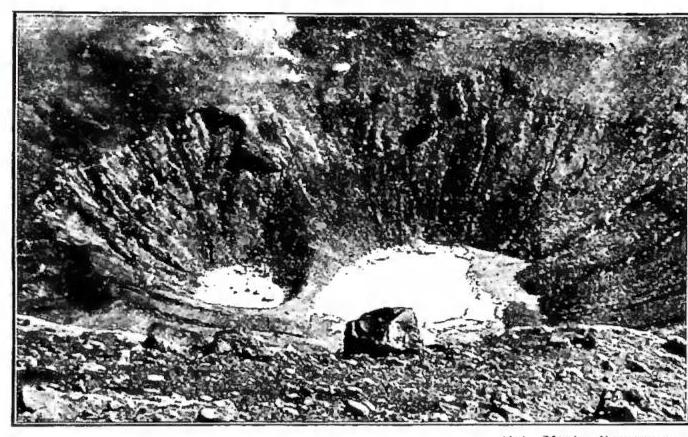
(Mario Fornasei) VULCANO – Two explosion craters on the Island of V. (Lipari Islands).
The type of volcanic apparatus varies according to the type of activity and the material emitted. Purely explosive activity may produce explosion channels or funnels, or volcanoes (cones) of ash. Purely effusive activity produces shield-type lava volcanoes, domes or stagnation mounds, and extrusion spires, depending on the degree of fluidity of the magma. Mixed activity, partly explosive and partly effusive, gives rise to stratovolcanoes, or composite volcanoes, formed alternately of lava flows and incoherent materials, with varying degrees of complexity.
The origin of volcanoes, their various types of activity, and the various forms and structures of volcanic apparatuses are essentially to be related to the manner in which magma consolidates. The essential components of magmas, whose quantitative proportions may vary, are the oxides of silicon, aluminum, iron (in its divalent and trivalent forms), calcium, magnesium, potassium, sodium, and titanium. These represent the so-called fixed components of magma, to which are added elements or combinations of elements characterized, even at ordinary temperatures, by a high vapor pressure. The latter consequently tend to assume the gaseous state and are called volatile components. Water predominates among them, but there are numerous others, such as carbon dioxide, hydrochloric acid, hydrogen sulfide, and so forth. When, as a result of cooling, the consolidation of magma begins, predominantly silicate minerals separate from it; since these generally contain the volatile components only in traces, it is clear that the latter will become increasingly concentrated in the residual melt, whose vapor pressure will progressively increase. It is evident that when the vapor pressure of the residual melt exceeds the external pressure—the atmospheric pressure plus the load of the masses overlying the magma reservoir—the explosive phenomenon will occur, and the magma will begin to boil. A new volcano may thus originate through what is commonly called an initial perforation, or an ancient dormant volcano may resume its activity, long interrupted, with an initial eruption. This was the case with the eruption of Vesuvius in A.D. 79. If the explosion occurs at an early stage of magmatic crystallization, the activity will be predominantly effusive, with abundant lava outpourings and the formation of lava volcanoes. The shield-type volcanic apparatuses of Iceland and Hawaii are typical examples. If, on the other hand, the explosion occurs at a very advanced stage of magma consolidation, the activity will be predominantly explosive, with the formation of cones of incoherent materials or, in extreme cases, explosion channels or funnels. Under intermediate conditions, stratovolcanoes will form, of which Vesuvius and Etna are examples.
Volcanoes are distributed in various ways over the earth’s surface, where typically volcanic zones are known to exist (Japan, the Cordilleras, the Mediterranean); but more than their geographical distribution, it is important to consider their distribution in relation to tectonic structure. It is thus possible to distinguish the volcanism of oceanic zones—parts of the lithosphere lacking or poor in Sial—which is predominantly effusive; the volcanism of continental massifs, characterized by repeated lava outpourings from fractures that give rise to extensive and powerful basaltic coverings (the Deccan, Siberia, Abyssinia); and, finally, the volcanism of orogenic zones (Japan, the Cordilleras, the Aegean), which tends to be explosive in character.
The activity of a single volcano may persist for highly variable periods, from a few days to more than several tens of thousands of years; it may be held that volcanism as a whole has been active on earth since the most remote ages.