
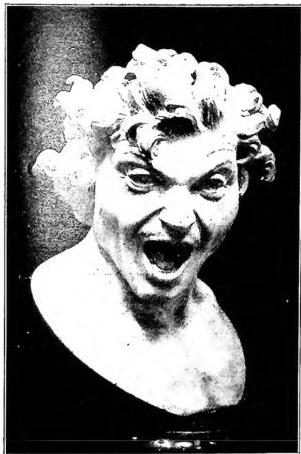
ANIMA — The blessed soul. Sculpture by G. L. Bernini for the Montoja tomb — Rome, church of S. Maria in Monserrato.
The pseudo-Bede’s De Elementis Philosophiae: « Anima mundi secundum quosdam est Spiritus Sanctus, divina ac voluntate et bonitate, quae Spiritus Sanctus est... omnia vivunt quae in mundo vivunt. Alii dicunt animam mundi esse naturalem vigorem rebus a Deo insitum... Tertii dicunt animam mundi esse quandam incorpoream substantiam quae tota est in singulis corporibus quamvis propter quorumdam corporum tarditatem, non idem in omnibus operetur. Igitur in homine sunt duae animae... » (PL 90, 1130: similar statements in William of Conches’s Mundi Constitutio: PL 90, 902; and in Bernard Silvestris’s De Mundi Universitate libri duo, ed. C. S. Barach and Jo. Wrobel, Innsbruck 1876, p. 31). The theory of the « a. mundi » enjoyed free circulation in the early schools of Arabic philosophy, as the researches of Fr. Dieterici, Die Lehre von der Weltseele bei den Arabern im X. Jahrhundert, Leipzig 1872, have demonstrated.
Investigations into the penetration of Aristotle’s natural, metaphysical, and ethical doctrines, unknown in the West until the beginning of the thirteenth century, have made it clear that this took place through versions both directly from the Greek text and indirectly from the text of the Arabic versions. A decisive impulse, as far as the doctrine of the a. was concerned, came from the translation of the major commentaries written on the Aristotelian treatise by the two greatest Arab philosophers, Avicenna (v.) and Averroes (v.); to them is due the enormous interest taken in psychological problems, as well as a large part of the responsibility for the first condemnations and prohibitions of Aristotle’s books by the Council of Sens (1210) and shortly afterward by the papal legate Cardinal De Courçon (1215). No less important a role must be assigned to the Arab-Jewish philosopher Avicébron, who in his Fons Vitae, translated by Domenico Gundissalvi, who also disseminated its doctrines, offered a complete metaphysical elaboration of the universality of matter, thereby providing the defenders of the materiality of the a. and of the angels with a speculative foundation which they would skilfully employ to resist the penetration of Aristotelianism.
At the same time, it must be borne in mind that the De Anima which the Arabs offered to the West, especially Avicenna and Averroes, represents the culmination of an intense process of assimilation of the Stagirite’s doctrine, in which Neoplatonic principles played a leading role, particularly at its crucial moments. Avicenna’s and Averroes’s positions on the unity of the separate intellect (agent or even possible) are Neoplatonic at root; these positions would unleash the most acute intellectual drama of medieval Christendom, and perhaps of all time. Worthy of note for its originality is Avicenna’s proof of the existence of the a., which brings to mind the Cartesian « cogito »: « Dicemus igitur quod aliquis ex nobis putare debet quasi subito creatus esset et perfectus, sed velato visu suo ne videat exteriora. Et creatus esset sic quasi moveretur in aere; aut inani ita ut eum non tangeret spissitudo aeris quam ipse sentire posset; et quasi disiuncta essent membra eius, ita ut non concurrerent sibi, nec contingerent sese. Non enim dubitaret affirmare se esse; non tamen affirmaret exteriora suorum membrorum, nec occulta suorum interiorum, nec animum, nec cerebrum, nec aliquid talium, sed extrinsecus affirmabit se esse... Tu scis quod id quod affirmatur aliud est ab eo quod non affirmatur, et concessum aliud ab eo quod non conceditur. Et quoniam essentia quam affirmabat esse, est propria illi eo quod illa est ipsamet; et est praeter corpus eius et membra eius quae non affirmabat esse. Ideo experfectus habens viam evigilandi ad sciendum quod esse animae est aliud ab esse corporis : immo non eget corpore ad hoc ut sciat animam et percipiat eam. Si autem fuerit stupidus, opus habet converti ad viam » (Avicenna, De Anima qui sextus Naturalium dicitur, 1st part, chap. 1, Venice 1508, fol. 2 rb). The argument recurs more extensively in the 5th part, chap. 7, fol. 27 rb-va: this text is reproduced in full by E. Gilson, Les sources gréco-arabes de l’angustinisme avicennisant (Archives d'histoire doctrin. et littér. du M. Age, 4), Paris 1930, pp. 40–42, with indications of the medieval masters who made use of II. Could some echo of it have reached Campanella or Descartes through one of these intermediaries?
The Jewish philosopher Isaak Israeli (845–940), in his Liber de Definitionibus, compares Plato’s and Aristotle’s definitions of the a., while showing his preference for the former and accepting Neoplatonic developments, as appears from his notion of the human a.: « Sublimiore animarum gradu et meliore ordine est anima racionalis, quoniam ipsa in horizonte intelligenciae et ex umbra eius generata est » (ed. J. T. Muckle, Arch. d'hist. doctr. et litt. du M. A., 9 [Paris 1938], p. 313). The Scholastics preferably recall the formula from De Cassis (prop. 2): « Anima est in horizonte aeternitatis inferius et supra tempus », which condenses what is read in Proclus’s Elementatio Theologica (prop. 191; cf. s. Thomas, Comm. in lib. De Cassis, lect. II, Opera omnia, XXI, Parma 1866, pp. 720–21).
Aristotle’s influence begins to be felt at the beginning of the thirteenth century, and it is the definition of the a. that gives notice of it: some follow the version from the Greek, others that from the Arabic. The first category includes Hermann of Carinthia: « Aristoteles vero (in opposizione a Platone) in libro de Anima sic : Anima est, ait, perfectio corporis naturalis instrumentalis potentia agentis. Et, alibi : Anima est perfectio corporis agentis et viventis potentia » (in Ch. E. Haskins, History of Medieval Science, 2nd ed., New York 1927, p. 62). A more precise formulation appears in Alfred of Sareshel (De motu cordis, chap. 1, ed. Baeumker, in Beiträge zur Geschichte der Theologie und Philosophie des Mittelalters, 23 [1923], pp. 3 ff., 93 ff.), who precedes it with a definition of unmistakably Platonic flavor, but likewise attributes it to Aristotle: «In se considerata (anima) substantia est incorporea, intellectiva, illuminationum quae a primo sunt ultima perceptiva, ut Aristoteles in Metaphysica capitulo quod K inscribitur; a qua diffinitione nec Areopagita in terarchia sua dissentit» (p. 2, lines 7–10). This last definition is reproduced in full by Chancellor Philip (d. 1236) in the Quaestiones De Anima of his Summa de Bono (ed. L. W. Kaeler, Münster i. Vestf. 1937, p. 20), and by the Franciscan Giovanni de la Rochelle (Summa de Anima, 1st part, chap. 2, ed. T. Domenichelli, Prato 1882, p. 106). The second category includes the group of Arabizers whose center of diffusion was Spain. In the De Anima, now generally attributed to Gundissalvi himself, we find the definition: «Anima est prima perfecto corporis naturalis, instrumentalis, viventis potentialiter» (ed. A. Loewenthal, Berlin 1891, p. 130); noteworthy here is the presence of «prima», which is lacking in the citations from the ancient Greek version just mentioned and is also omitted by some witnesses of the same Arabic version, such as the physician Costa ben Luca (De differentia spiritus et animae, chap. 3, ed. C. S. Barach, Innsbruck 1878, p. 134). The Platonizing definitions of Calcidius, s. Augustine, and a certain «magister Remigius» (probably Remigius of Auxerre) continued to circulate as well; a genuinely Aristotelian theory of the a. would not appear until the second half of the thirteenth century, when the De Anima was able to enter the university classrooms as an official teaching text (1252).
This required an explicit dissociation, within the current theories, of the Platonic and Neoplatonic elements incompatible with the principles of Aristotelian naturalism. The author of such an uncompromising doctrinal renewal, compromises which Alberto Magno did not always succeed in avoiding, was his disciple Tommaso d'Aquino, according to the principles set forth in the doctrinal part of this article. Aristotelian psychology, generally shared also by the Averroists and which became traditional in the Dominican Order, was opposed in various ways and forms by Augustinianism (v.), on the part of the theological tradition of the preceding generation and subsequently of the Franciscan school, which was able to achieve some success, though only briefly, with the condemnation of Paris (7 March 1277), immediately renewed at Oxford by the Augustinian Dominican R. Kilwardby (18 March 1277), and repeated later by his successor in the episcopal see, the Franciscan G. Peckam (29 Oct. 1284), a contemporary opponent of s. Tommaso at Paris. The points on which Augustinian psychology seems to have resisted Aristotelian positions most strongly were the following: 1) the composition of the a. (and of angels) from matter and form; 2) the plurality of forms in man; 3) the identity, or at least consubstantiality, of a. and faculties; 4) the theory of the two faces of the a. (ratio superior et ratio inferior); 5) the assimilation of the nature of the a. to light (Lichtmetaphysik). In the pressure of polemics these doctrines underwent further complications; some were abandoned or at least diluted in favor of others newly advanced; but on the whole the opposition between Aristotelian and Augustinian psychology has been maintained by the two schools down to our own day. The aberration reached by Augustinian psychology with P. G. COLIVI (v.) was, as already indicated, the object of an explicit condemnation by the ecumenical Council of Vienna (1311). The innumerable commentaries, treatises, and «quaestiones» on the De Anima written in the 13th-16th centuries mostly focused discussion upon the Averroist controversy, to which the Alexandrist controversy was added in the Renaissance: never as in this century did the problem of the a. hold the attention of scholars so enthralled, when, at the opening lecture of every new professor of philosophy, the entire student body flocked to hear him, loudly demanding «Anima, Anima!».
While the Aristotelians were battling at Padua, Platonic doctrines were being brought into honor at Florence under the impetus of the Greeks who had gone there to take part in the ecumenical Council (1439), among whom emerged Gemisto Pletone, his disciple Crisolora, and Bessarione: they ardently defended Plato's superiority over Aristotle, especially regarding the doctrine of the a. Pletone complains that «while the Greeks and Romans have admired Plato more, Westerners, deceived by Averroè, lose themselves in celebrating Aristotle as the greatest intellect produced by nature: even if he were so in his other doctrines, he certainly is not in those concerning the a., which he makes mortal; is this not madness?» (Giorgio Gemisto Pletone, De Platonis et aristotelicae philosophiae differentia, Prologus: PG 160, 889; V. al cap. 9, coll. 600-601 la dottrina sull'a. e la critica all'a. principio immobile secondo Aristotele). The claims of Aristotelianism were upheld by Giorgio di Trivisonda (Scholarios), a sincere admirer and translator of certain works of s. Tommaso, who in his Comparatio Platonis et Aristotelis (ed. veneta 1523) replied point by point and vigorously to Pletone. Bessarione responded to him, no less violently, with his In calumniatorem Platonis (II, 8; ed. L. Mohler, in Kardinal Bessarius als Theologe, Humanist und Staatsmann, II, [Quellen und Forschungen aus dem Gebiete der Geschichte, 22], Paderborn 1926, p. 139 sgg. The history of the controversy is illustrated in vol. I [20 of the collection], p. 346 sgg.).
With greater serenity and moderation of language, Ficino took up again the Plotinian theory of the a. The a. stands midway in the scale of beings between God and the angels on the one hand, and qualities and bodies on the other, and participates in the nature of both: «Dum divinis haerer, quia spiritualiter illis unitur et spiritualis unio gignit cognitio, illa cognoscit. Dum implet corpora, intrinsecus illa movens, illa vivificat. Est igitur divinorum speculum, vita mortalium, utrorumque connexio... ut merito dici possit centrum naturae, universorum medium, mundi series, vultus omnium, modusque et copula mundi» (Theologia platonica. De immortalitate animorum, ed. III, 2, Parigi 1359, foll. 43 b, 45 a). More eclectic was Pico della Mirandola, who, while wishing to reconcile Plato and Aristotle, in reality defended the most uncompromising Neoplatonism to the utmost, judging from the commentary on the Concise di Amore del Beniveni (ed. Garin, Firenze 1942, p. 462 sgg.) and from prop. 10 of the Conclusiones Cabalisticae LXXI: «Qui negat coelum esse animatum ita ut motor eius non sit forma eius, non solum Aristoteli repugnat, sed potius philosophiae fundamenta destruit» (Opera Omnia, ed. veneta 1537, fol. 1555b). Outside Italy, those who did not share in the fervor of its spiritual life confined themselves to favoring one or another of the theories of the ancients concerning the a., unless, with Agrippa di Nettersheim, they went so far as to declare the vanity of all human thoughts, seeking aid from divine truth (v. : De vanitate scientiarum, 52, Opera omnia, II, Lione 1600, p. 85 sgg).
3. MODERN PHILOSOPHY
Spiritualism. - In modern philosophy the problem of the a. fades away and gives place to that of “consciousness,” becoming dependent upon II. Not immediately, however; indeed, in the first period there is an intensification of the substantialist conception; nor does it disappear entirely, so that some survival of it may be observed even in periods of greatest phenomenist, idealist, or materialist fervor. Brief references to the most conspicuous phases of this movement will suffice.In Cartesio the mainstays of the traditional conception still appear intact, at least in appearance. That the a. exists and is a substance is a fact evident by the light of reason alone, and along this line of immediate evidence Cartesio resolves all the problems of the a. According to the Principia Philosophiae (I, 9): «Notandum est lumine naturali esse notissimum, nihil nullas esse affectiones sive qualitates, atque ideo, ubicumque aliquas deprehendimus, ibi rem sive substantiam, cuius illae sunt, necessario inveniri». Hence in the Sixth Meditation the evidence for the a. is presented by recourse to the principle of the clear and distinct idea, of the opposition between the two attributes which we observe in ourselves, extension and thought, in which body and a. are immediately present as two distinct substances:
« Quia ex una parte claram et distinctam habeo ideam mei ipsius quatenus sum tantum res cogitans, non extensa; et ex alia parte distinctam ideam corporis, quatenus est tantum (res) extensa non cogitans, certum est me a corpore meo revera esse distinctum et absque illo posse existere ». Here one should note the evident resemblance to Avicenna’s argument of the “flying man,” which Cartesio, however, takes up more seriously because he identifies the whole Ego with that which sustains the activity of consciousness, and ultimately with consciousness itself, admitting between the two only a distinction of reason. Yet this narrowing of the ontological sphere of the Ego does not prevent Cartesio from affirming a true substantial union between the a. and the body: the a. becomes convinced of this, through a knowledge natural to it, in the perception of (physical) pain and of other bodily sensations which cannot arise from it alone (cf. Principia Philosoph., II, 64). But the problem, despite Cartesio’s protests, remained unsolved: at most it had been demonstrated how the a. and the body are distinct, not how they are united and cooperate in the operations of a single subject. Thus arose the great crisis of the progress of consciousness in Western philosophy.
Starting from the new Cartesian situation, Malebranche and Geuliste abandoned half-measures and attributed everything to God: “God does not communicate His power to creatures, nor unite them with one another, except insofar as He establishes their modes, occasional causes of the effects which He Himself produces” (N. Malebranche, Entretiens sur la métaphysique, sur la religion et sur la morale, VII). This was an extreme solution, striking directly at the heart of the alleged Cartesian evidences, but it was not to be the last. If the a., Spinoza concludes, is wholly present in thinking, then the a. is thought itself, is the idea, the content of our inner life, of which it no longer makes sense to think as bound to the body: « Vita illa qua unumquodque est contentum et gaudium nihil aliud est, quam idea seu anima » (Ethices, 2nd part, prop. 57 Scholion, ed. Gentile, Bari 1933, p. 161). And Spinoza speaks of “mens” rather than of a.: a term soon destined to enjoy great currency.
The most notable effort, upon which the revival of spiritualism in the second half of the nineteenth century was to depend, was Leibniz’s resumption of the Aristotelian notion of “entelechy.” Being can be preserved only in effective unity, which cannot be supplied by material atoms because matter is purely passive: there must therefore be “formal atoms,” entelechies or forms, whose nature consists in the force they tend to unfold, and which may be called “souls” and “monads.” Here the a. again becomes not so much the Aristotelian “entelechy” as the cosmic principle of Neoplatonic panpsychism. For entelechies are not generated within becoming, but were created with the world and always subsist (pre-existence); and the same must be said of the body with which the entelechy is united. The formation of living organisms is merely apparent, and is reducible to a pure phenomenon of external growth (preformationism). Equally apparent is the separation of the a. from the body at death: for Leibniz it is only a reduction in the dimensions of the visible body, and the a. retains a subtle body, organized in its own way, which one day, at the resurrection, will resume the dimensions of the visible body lost in death. The a. and the body communicate in no way, but their operations correspond in perfect synchrony, like two clocks which the supreme Artificer has Himself made and then set in motion at the same instant (pre-established harmony). The inextricable entanglement in ancient and modern questions no longer subsists (cf. Considerazioni sulla dottrina d'uno spirito universale, 1702, ed. De Ruggiero, in Opere curie, Bari 1912, p. 68, and vol. IV, ed. Gerhardt; V. also the Discours de Métaphysique, ed. H. Lestienne, Paris 1929, chs. x-xii, pp. 38-42, and Monadologia, § 18 ff., ed. Boutroux, Italian trans., Florence 1934, p. 134 ff.).
The reaction against the Cartesian definition of the a. as “substantia cogitans,” with an explicit recognition of the function of the organic body, finds its formula in Leibniz’s spiritual heir, Cr. Wolff. Since our acts of understanding are conditioned by sensations, and these in turn by the changes occurring in the bodies that surround us, our knowledge or “Weltanschauung” depends on the place occupied by our body in the universe: « Animam ergo definivi, quod sit substantia universi representativa pro situ corporis alicuius organici in universo » (Ratio Praelectionum, § 22, cited by M. Campo, Cr. Wolff e il razionalismo precricto, I, Milan 1939, pp. 298-99). Later, Herbert and Lotze remained Leibnizian in substance; much is owed to them for the revival of spiritualism in modern psychology. The latter gives three reasons in defence of the spirituality and substantiality of the a., namely the three fundamental experiences of spiritual life: freedom of the will, the complete incomparability (völlige Unvergleichbarkeit) between psychic processes and spatial conditions of movement, place, figure, and material energy, and the unity of consciousness (Metaphysik., III: Von dem geistigen Dasein, §§ 238-40, Leipzig 1879, p. 473 ff.). Psychology could thus rise again to new life, having rediscovered its object, which materialism had relegated to the realm of nature.
Phenomenism and idealism. — In Locke, the a. and the body are still substances; in Berkeley the body vanishes, and substantiality is reserved for the a., if one can still speak of substance in the case of a being that is actually identical with the act of perceiving. The phenomenalist conception, to which empirical actualism was bound to lead, unfolds fully in Hume’s work with unparalleled clarity. The a., which, as in Spinoza, is now called “Mind,” is nothing but a bundle or collection of different perceptions, held together by certain relations and supposed, though wrongly, to possess simplicity and perfect identity, so that they may be separated at will from one another and each from the mind itself. It is therefore only a dynamic system of different perceptions, linked together by the relation of cause and effect, so that they can reciprocally produce, destroy, and influence one another (Treatise on Human Nature, Part I, section vi: Of Personal Identity, ed. Selby-Bigge, Oxford 1928, p. 251 ff.; in the Carlini trans., Bari 1926, p. 303 ff.). Previously (ibid., section v), Hume had shown that questions concerning the immateriality and substantiality of the mind cannot have any intelligible meaning: fortunately for us, since such doctrines would lead straight to the absurd and would justify Spinoza’s most extreme opinions. Hume’s position remains enigmatic, in the development of doctrines concerning the a., between idealism, which was to begin with Kant, an admirer of his new concept of “creative consciousness,” and phenomenalist and materialist empiricism: the two currents into which European thought was to fragment for two centuries, with movements of ebb and flow in which at times—as in J. Stuart Mill and H. Taine—it is not always possible to discern whether any clear line of demarcation still subsists.
Kant does not accept the Cartesian equivalence “I think, therefore I exist,” because then the property of thought would make all beings possessing it necessary beings. The proposition “I think,” in the sense understood by Cartesio, expresses an indeterminate empirical intuition, which is something quite different from the “I think” of transcendental apperception, pure problematicity, the form of every judgment of the understanding in general which accompanies the use of all categories. In substance, Kant reproaches the Cartesians and the Leibnizians for the continuity they posit between psychology and metaphysics: on the basis of that subjective experience, one cannot pass to the admission of a soul that is a substance, simple, incorruptible, personal, spiritual, and immortal. In this way we should have taken a step beyond the sensible world, and this contradicts the principle governing the use and value of the categories. Whoever wishes to go further falls into inextricable “paralogisms,” which have the common pattern of a “sophisma figurae dictionis,” in which the “I think” has a different meaning in the two premises, insofar as in one it refers to an object as a “thing of experience,” while in the other it has the meaning of a pure form of thought abstracting from every object. Thus, Kant concludes, a knowledge sought beyond the limits of possible experience and yet pertaining to humanity’s highest interest, when demanded of speculative philosophy, ends in an illusory hope (Critique of Pure Reason, part II, Transcendental Dialectic, II, 1). It is therefore not surprising that both positivists and criticists, from
Comte to Wundt, drew upon Kant in opposing the existence of the soul and the establishment of psychology as a science.
In the systems of transcendental idealism, the soul once again occupies the centre of the problems, though not as a reality existing in itself, but in relation to the whole, essentially dynamic, which absorbs being as such: either as the absolute (Fichte), or as Nature continually becoming (Schelling), or as absolute Spirit (Hegel). In the ascent of the Hegelian dialectic, the soul is “subjective spirit”: either it is immediately in itself, and is the soul or natural spirit that is the object of anthropology; or it is for itself, that is, mediately, as reflection still identical in itself and in another, and is spirit as relation to another, consciousness, which is the object of the phenomenology of spirit; or it is spirit determining itself in itself, as subject for itself, and is the object of psychology (of the Leibnizian type). In brief: the soul is spirit considered at its lower stage of consciousness; to call it a substance, simple, immaterial, immortal, is to use inappropriate terms, since this is a stage that can at most serve as a point of departure and therefore entails no exclusive determination whereby matter on the one hand and the soul and spirit on the other are to be conceived as two “things.” In the dialectical process, this distinction too must disappear, from which there had arisen, Hegel observes, that incomprehensible problem which constituted the stumbling-block of Cartesio, Malebranche, Spinoza, and Leibniz: the “communion of soul and body.” With acuteness and good reason, Hegel notes that if soul and body are presupposed as absolutely independent of one another, they are mutually impenetrable like one matter in relation to another, and each may be received into the non-being of the other; but thereby the meaning and possibility of every communion disappear (Enzyklopädie der phil. Wissenschaften, §§ 387, 389, 390, 403). Hegel no longer speaks of the Aristotelian notion, distorted by Leibniz and abandoned by the other moderns, which, through the relation of act and potency, admirably avoided the shoal of that aporia, although he had expounded it in admiring words in the History of Philosophy (chap. III, 3; Italian trans. Sanna-Codignola, II, Firenze 1932, p. 344 ff.).
Our Spaventa closely follows Hegel, and indeed surpasses him when he affirms that the soul exists only as relation to another, or as an act in which form and content are indeed distinguished, but by uniting, not by separating, themselves (against the Herbartians). For Spaventa, the soul is not at all without the body, without showing and expressing itself in it; and Spinoza was right: anima est idea corporis (and therefore idea idonee), not of the phenomenal, external body, but of the internal one, of that which spirit posits—finds, others say—within itself, and which it embraces, contains, surpasses, and without which spirit would neither feel, nor represent, nor imagine, nor desire, and therefore would neither think nor will (B. Spaventa, Principi di Etica, ed. Gentile, Napoli 1904, p. 57 ff.). The dialectical duality of form and content, and hence of soul and body, still preserved by Spaventa’s act, disappears in Gentile’s actualism, in which the act, in itself and as such, is the sole and pure mediation of itself: to posit the other as other than oneself would be to posit nothingness and absolute emptiness. Every act creates itself ex novo and posits itself as object: to come to a halt is to close one’s eyes, not to remain an inactive soul, but to cease to be a soul (G. Gentile, Teoria generale dello spirito come atto puro, chap. 3, 4th ed., Bari 1924, p. 21). It cannot be denied that idealism in its various forms contributed, at certain moments of greater positivist bewilderment, to restoring the soul and spirit to their feet; nevertheless, the advantage was considerably diminished by that monism to which it is fatally bound and which, consistently understood and developed, is capable of vindicating and renewing materialism itself (G. Rensi, Il materialismo critico, Roma 1934, p. 137).
Materialism and the return to dualism. — In theories of the soul circulating in the circles of secular philosophy during the eighteenth and nineteenth centuries, even the memory of both the nature and the existence of the soul has almost been lost. For many, the rise and development of scientific psychology constituted sufficient compensation for the loss of values which, in their eyes, had disappeared forever. Kant himself was not extraneous to this desacralization of philosophy; if being is unattainable and the spiritual is reduced to the intelligible, the rest
—let it indeed not even be called so—is nothing but shadow and an opaque background, which may be disregarded and, if troublesome, even denied. Thus, although the sources of materialism and its method of denying the soul were originally quite different, in modern culture they acquired strength through the excessive opposition, and often through the very alliance, of a priori philosophies. Lamettrie, Helvetius, Büchner, Haeckel, and the positivists who deny the soul may declare themselves opposed to such philosophies, and these to them. But Wundt, who is a Kantian, has in substance the same doctrine concerning the soul (Grundriss der Psychologie, 4th ed., Lipsia 1901, § 22: Der Begriff der Seele, p. 382 ff.); and so do W. James, Thichener, Ribot, Höffding, and the schools founded by them, all supporters of Psychology without a soul. — The formula was coined by V. A. Lange in opposition to the rigid spiritualism of the Herbartians, devoted to the study of the essence of the soul: “What is to be done with a hypothesis concerning the existence of the soul, when we still know so little about the isolated phenomena to which every exact inquiry must first extend? Among the small number of phenomena hitherto made accessible to more exact observation, not the slightest reason has been found for admitting a soul in general, whatever more or less precise meaning may be attributed to this word” (Geschichte des Materialismus, Italian trans., II, Milano 1932, p. 307). Lange expressly draws his reasons for supporting this denial from Kant.
The claims of a psychology of spiritual life were successfully defended by W. Dilthey through the distinction between the “science of nature” and the “science of spirit” (Naturwissenschaften, Geisteswissenschaften), which placed alongside scientific, explanatory, and causal psychology a psychology of the spiritual fact as such (v. vol. V of the Sämtliche Werke, Leipzig 1892). The reaction gained greater substance, on the one hand through H. Driesch on the basis of new embryological investigations, and on the other through the circle of Aristotelianizing or phenomenological Brentanists (Meinong, Stumpf, Pfänder, Scheler, Husserl). Proceeding from the study of perceptual phenomena, the contents of thought, and voluntary behaviour, following the example of Külpe, W. Steinberg, a scholar of the psychology of the blind, vigorously defended the claims of “Psychology as the science of the soul” (Psychologie als Wissenschaft von der Seele, Leipzig 1937). C. Stumpf returned to the traditional Aristotelian position, also in reaction to the agnostic tendency of his master F. BRENTANO, FRANZ (v.), maintaining that the soul is known through concepts and not through intuitions, and that its presence within us is immediately attested in its present activity (Erhemenstheorie [posthumous], II, Leipzig 1940, § 32, 4, pp. 380–81).
Nevertheless, it seems to us that the horizon of contemporary culture is still obscured by no few clouds, which prevent the opening of an uncompromising perspective, from which neither “Ganzheitpsychologie” nor “Gestaltpsychologie” has freed itself, although both have fought strenuously to overthrow the canons of nineteenth-century psychology: Wertheimer, for example, finds the soul something mystical and unnecessary (Über Gestalttheorie, “Symposion”, Erlangen 1925, p. 53). More forthright is the attitude of a disciple of Wertheimer, Koffka, who, in analysing the problem of memory, showed that the unity of the Ego, far from being based upon memory, is rather its foundation and centre of organization (Principles of Gestalt Psychology, London 1936, p. 332). The proponents of the “philosophy of life” have made no room for the soul, except as an energetic nucleus radiating instinctual impulse, “libido,” and the irrepressible vitality that makes man a “sick animal” and the soul the “adversary of the spirit” (Der Geist als Widersacher der Seele, title of the principal work of L. Klages, in 3 vols., Leipzig 1920–32). existentialism (v.), the soul is at once the consciousness that the individual has of his vitality and the inexhaustible reason for his subjectivity and interiority (v. K. Jaspers, Philosophie, III: Metaphysik, Berlin 1932, p. 62). More positive and substantial seem the positions of those who, denouncing at once Cartesian dualism and materialist and idealist monism, propose considering the living being and man as a “whole” resulting from the union of two realities, soul and body (v. E. G. Boring, Psychology for Eclectics, in Psychologies of 1930, Worcester, Mass. 1930,
pp. 123–24, 127; P. Lersch, Seele und Welt. Zur Frage nach der Eigenart des Seelischen, Leipzig 1941).
Politically inspired currents vaguely, or in romantic expressions but with materialist content, claim a particular soul for each people (Volksseele), immanent in individual souls and the driving principle of the destinies of communities and races; this soul would possess, in the blood and biological characteristics of the various peoples, a distinctive character of its own, and thus provide the basis for a greater or lesser right for one people to dominate while others remain subject: a revival of the Kraftrecht of barbarian mentalities which Western civilization attributed to
Così la storia del problema dell'a. è alla fine la storia della vita stessa dei singoli popoli e delle diverse culture: con essa la civiltà si eleva, si chiarifica o si abbassa, perché ogni individuo ed ogni popolo non si può muovere nel suo ambiente e partecipare alla vita esteriore che muovendo da una definita concezione sull'a.
BIBLI. Oltre le opere indicate nel testo e nella bibl. alla esposizione della dottrina: H. Diels, Die Fragmente der Vorschrottler, 5ª ed. di W. Kranz, Berlino 1938; id., Doxographi Graeci, 2ª ed., ivi 1929; H. Cherniss, Aristoteles Criticism of Presocratic Philosophy, Baltimore 1935 (cap. 4: The soul and Psychical Phenomena, pp. 289-326). Rimprovera ad Aristotele di aver svisto il pensiero dei predecessori al fine di poter fondare i principi del proprio sistema, cadendo perciò in frequenti incomprensioni: tesi audace e che ha incontrato sostanziali riserve da parte degli storici del pensiero antico, p. es. dal Mondolfo nelle note alla sua trad. ital. della Storia dello Zeller, spec. II, pp. 352-357; I. T. Gsell Fels, Dissertatio qua psychologiae platonicum atque aristotelicae explicatio et comparatio instruitur, Würzburg 1852; A. von Arnim, Stolorum veterum fragmenta, II, Lipsia 1903; H. Use-
ner, Epicurea, Lipsia 1887; G. Mancini, L'Etica storica da Zenone a Crisippo, Padova 1940 (parte 4ª, cap. 2, p. 131 seg.); E. Rohde, Psyche, Seelenheit und Unsterblichkeitgabe der Griechen, 10ª ed., Lipsia 1925, trad. ital., Bari 1906. Elenco minutissimo di opinioni sull'a., specialmente di neoplatonici, nella lettera 'De Deo et Anima...' di M. Ficino a Francesco Capponi (1457), pubblicata da P. O. Kristeller, Supplementum Ficinianum, II, Firenze 1937, pp. 141-47; J. Moreau, L'âme du monde de Platon aux Stolériens, Parigi 1939. Fondamentale per tutta la storia del problema dell'a.: F. A. Lange, Geschichte des Materialismus, trad. ital., Milano 1932.
A. J. Festugiere, L'Idéal religieux des Grecs et l'Evangile, 2ª ed., Parigi 1932; E. Gilson, L'esprit de la philosophie médicale, I, Parigi 1934, cap. 9 e note alla fine del volume. Ha dato un accurato elenco dei numerosi trattati sull'a. della età patriottica e della scolastica alta, latina e greca, il Bainvel in DThC, I, 1, coll. 971-78. Manca invece un'opera d'insieme sulle teorie dell'a. nei secc. XIII-XIV. Sempre utile per gli autori toccati, H. Siebeck, Geschichte der Psychologie (pubbl. soltanto la 1ª parte in 2 fascicoli, che va dagli inizi della filosofia greca fino alla scolastica compresa), Gotha 1880-84. Sulla formazione della psicologia scolastica, specialmente a Parigi, v.: O. Lottin, Problèmes de Psychologie (Psychologie et morale aux XIIe et XIIIe siècles), I, Lovanio-Gembloux 1942; A. C. Pujis, St. Thomas and the Problem of the Soul in the Thirteenth Century, Toronto 1934. Ha egregiamente difeso l'esistenza dell'a. contro le negazioni fenomeniste, materialiste e positiviste, il card. Mercier, Les origines de la psychologie contemporaine, trad. ital., Piacenza 1920. Per le controversie sull'a. nel 1900, v.: F. Fiorentino, Pietro Pomponazzi, Firenze 1886.
Esposizione delle dottrine moderne sull'a. a partire da Kant, in J. H. Witte, Das Wesen der Seele und die Natur der geistigen Vorgänge, Halle 1888; F. De Sarlo, Il concetto dell'anima nella filosofia contemporanea, Firenze 1900. Le riflessioni del De Sarlo sono riprese da G. Villa, La psicologia contemporanea, 2ª ed., Torino 1911, pp. 399-403. Ancora notevole per spunti di interpretazione personale è la storia complessiva del problema dell'a. tracciata da A. Rosmini (Delle sentenze dei filosofi intorno alla natura dell'anima, appendice al I, V della Psicologia, Napoli 1858, pp. 173-240). L'elenco più ricco ed aggiornato delle opinioni sull'anima in R. Eisler, Wörterbuch der philosophischen Begriffe, III, 4ª ed., Berlino 1927, pp. 1-22; H. Leitzeng, Die Entwicklung der Seelenbegriffe, in Logos (tedesco), 16 (1917), p. 311 seg. Accurate indicazioni sulle teorie contemporanee, spec. della 'Lebensphilosophie', con difesa della dottrina cattolica, in Th. Steinbüchel, Die philosophische Grundlegung der katholischen Sittenlehre (Haarbach der kath. Sittenlehre), I, 1, Düsseldorf 1938, cap. 6, p. 258 seg. Dal punto di vista della Fenomenologia: Ma
x. Beck, Psychologie, Wesen und Wirklichkeit der Seele, Leida 1938
Indipendenti: N. Hartmann, Das Problem des geistigen Seins, Berlino 1933; A. Gehlen, Der Mensch, Seine Natur und Stellung in der Welt, ivi 1940; O. Bumke, Gedanken über die Seele, ivi 1941; P. Haberlin, Der Mensch, Eine philosophische Anthropologie, Zurigo 1941. Cornelio FabroVI. RAFFIGURAZIONI SIMBOLICHE DELL'A.
4. NELL'ARCHEOLOGIA CRISTIANA
Nell'arte cristiana antica l'a. venne simbolicamente rappresentata in vari modi: a) colomba (v.) sia isolata, sia portante un ramoscello d'olivo o di palma; e sia in atto di avvicinarsi al vaso (v.) per dissetarsi, o di beccare un grappolo d'uva o in volo verso l'albero; talvolta è unita con i pani o con l'ancora (v.); b) cervo (v.) che si disseta alla fonte; c) pesce (v.) spesso unito con l'ancora; d) orante (v.), per lo più femminile, a significare lo stato dell'a., in beatitudine o isolata tra i santi protettori; e) agnello (v.); f) pecora (v.) che già pascola nel giardino celeste o per lo più Pastore (v.); nave (v.) tendente al porto.In epigrafia viene data all'a. una lunga serie di attributi: ἀγ'αδῆ, καλλή, beata, benedicta, benemerens, bona, casta, castissima, dulcis, dulcissima, iunoca, iunoceas, innocentissima, melleia, merens, merentissima, pia, pientissima, pollens, pura, sancta, sanctissima, sapiens, simplex. Damaso chiama i santi, depositi nel cimitero di Callisto: sublimes animas (A. Ferrua, Epigrammata Damasiana, Città del Vaticano 1942, p. 120). In una iscrizione di Domitilla si legge: solus Deus animam tuam defendat Alexander (O. Marucchi, Le catacombe romane, Roma 1933, p. 177); in una del cimitero ad duas lauros, oggi al Laterano, appartenente a un de-