ENRICO DI HUNTINGDON

HENRY OF HUNTINGDON. — Archdeacon, historian, born and died in 1085 in the diocese of Lincoln, where he was educated, and died in 1155. In 1110 he was appointed archdeacon of Huntingdon. In 1139 he accompanied Theobald, archbishop of Canterbury, to Rome.

During the journey they visited the Norman monastery of Bec, where Robert of Torigni, historian of Normandy, showed H. the *Historia Brittonum* of Geoffrey of Monmouth. When H. returned home, Alexander, bishop of Lincoln (1123–47), asked him for a history of England based mainly on Bede. Thus appeared his compilation, the *Historia Anglorum*, up to 1129, which was then
HENRY OF HUNTINGDON – HENRY III, EMPEROR

The Roman nobles summoned him to Italy to put an end to the scandal of three men contending for the papacy: Benedict IX, Sylvester III and Gregory VI. But Henry seized the opportunity to strengthen his political authority there. In October 1046 he crossed the Alps and convened a synod at Pavia; in the following November he met Gregory VI at Piacenza, received him with honour, and together they decided to hold a synod at Sutri. There, on 20 December, he had Sylvester III and Gregory VI deposed; shortly afterwards, in Rome (24 December), at another synod he likewise secured the deposition of Benedict IX. A pope devoted to him was then appointed in the person of Suidger, bishop of Bamberg, under the name of Clement II. The newly elected pope was enthroned on Christmas Day, and as his first act he placed the imperial crown upon Henry and his wife Agnes.

In turn the Roman people conferred upon him the title of Roman Patrician, which gave him the right to intervene in papal elections, a right which Henry exercised freely by appointing no fewer than four German popes to the Apostolic See. In return he showed himself solicitous for Church reform; on 5 January 1047 he presided over a synod at which penalties were decreed against simoniacs. Immediately after the January synod Henry went into southern Italy to reassert his authority, which had been threatened by the Norman dukes, and then returned to Germany bringing the deposed Gregory VI with him as a prisoner. When Clement II died near Pesaro on 9 October 1047, despite the suggestion of Wazo of Liège that Gregory should be restored to the papal throne, Henry appointed as pope the bishop of Brixen, Poppo (Damasus II). After Damasus died on 9 August 1048, Henry at a great assembly held at Worms at Christmas of that year designated as his successor Bruno, bishop of Toul (Leo IX); and after Leo’s death (19 April 1054) he chose Gebhard of Bichstätt (Victor II). In March 1055 Henry, together with his appointee, came into Italy and took part in the Synod of Florence and witnessed the coronation.

Article illustration
(a) M. Luigi, Ministero della Misericordia, L'Italia 1912, ian. 1911
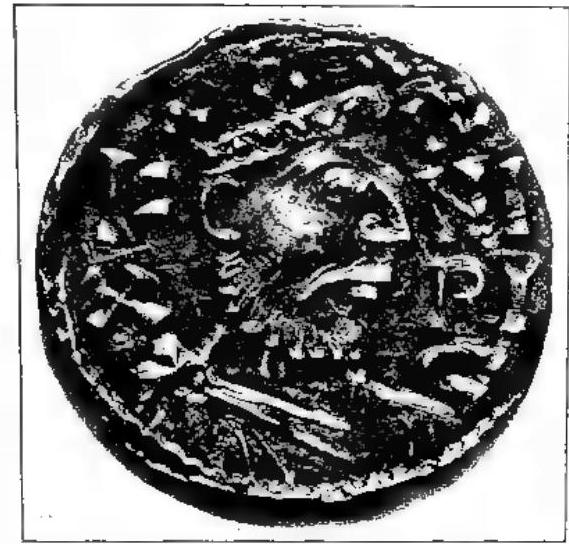
HENRY II, EMPEROR – Silver coin (1002-24) – Berlin, Goldsmithum der deutschen Reichsbank.

was continued until 1154; only from 1126 does it have original value. H. was buried in Lincoln Cathedral.

Initially, H. enjoyed great esteem as a historian, but after the critical studies of Liebermann (1878) and T. Arnold (1879), his reputation declined. H. is not sufficiently accurate. Nevertheless, he was a learned, skilled, and elegant writer. He also composed epigrams and some minor works, including the epistle De contemptu mundi (PL 195, 979 ff.), as well as others that have not come down to us.

The best edition of the Historia (already in PL 195, 799 ff.) is that of T. Arnold (in Rolls Series, London 1879).

BIBL.: E. Burton, Henry of Huntingdon, in Cath. Enc., VII, p. 235 ff.