
LASKI, JAN. - Archbishop, primate of Poland, and statesman, b. at Lask in 1456, d. at Kalisz on 19 May 1531. He was ambassador to Rome in 1494, to Flanders in 1496, and again to Rome in 1500.
The accession of King Alessandro I Jagellone (1501-1506) brought about the decisive rise of L.'s political career: secretary of the crown in 1501, he was chancellor from 1503 to 1510.
In 1505 he provided the first official compilation of Polish laws, but failed to strengthen the crown against the magnates; he did, however, succeed in placing the predominance of the middle nobility on firm foundations (constitution Nihil novi of 1505). Archbishop of Gnesen in 1510 and primate of Poland, he took an active part in the Fifth Lateran Council; he obtained from Leone X the bull of 9 Aug. 1515, which regulated the discipline of the Church in Poland, and the title of Legatus natus; and he continued always to speak in favour of a general council pro reformatione Ecclesiae.
A staunch opponent of Protestantism and an eminent patron of the arts, L., even after his chancellorship had ended, retained considerable political influence; he opposed the policy of understanding with the Habsburgs that prevailed after 1515 and upheld the need for an alliance with France. After 1518, opposed by the new queen Bona Sforza, he rapidly lost all influence and, having not hesitated, out of anti-German hatred, to assist Zapolya, allied with the Turks, in his struggle against the Habsburgs, he was censured by the Holy See shortly before his death.
(from F. A. Mac Nutt, B. De Las Casas, New York 1865, p. 296)
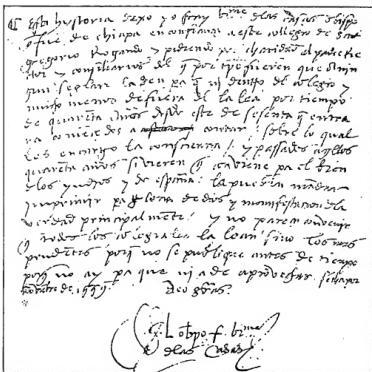
LAS CASAS, BARTOLOMÉ de - Autograph of L. C. concerning the publication of his Historia (16th century) - Madrid, Biblioteca Nacional.
confirmed by the Pope. Meanwhile, suspicions about his orthodoxy grew, given the many contrary manifestations he displayed and his now continuous contacts with Protestant leaders. Indeed, as early as 1538, he was in fact a Protestant. Passing through Frankfurt, Louvain, and Emden, he was even entrusted with leading the Reformed Churches of the region. In 1544, back in his homeland, he swore allegiance to Catholicism once more, but soon distanced himself again and returned to Emden to organize the Reformed community there on humanistic-Calvinist principles, decidedly anti-Lutheran.
Meanwhile, in England, while Edward VI was a minor and power was in the hands of the Lord Protector, Somerset, and the primate of the English Church, Archbishop Cranmer, the latter, who was diligently working on the organization of the Anglican Church, called Laski to collaborate. Laski arrived in England in 1550, and while serving as Cranmer's advisor, he devoted himself particularly to that colony of Protestant exiles following the Interim of Augsburg in 1548, known as the Ecclesia peregrinorum. A Calvinist on the question of the Eucharist and radical in worship, he favored the introduction of laypeople into the direction of ecclesiastical affairs. After Edward VI's death (1553) and the accession of Mary the Catholic, Laski left England. Hated by the Lutherans, who rejected him, along with his Reformed community, in the dead of winter, from Denmark, Mecklenburg, Lübeck, and Hamburg, he finally took refuge in 1556 in Poland, where he was welcomed by King Sigismund Augustus, whom he had long pressured to support his attempts to unite the Polish Protestant Churches, bitterly divided among themselves over the sacramental question. His final efforts were dedicated to trying to unite Calvinists, Lutherans, and Moravian Brethren into a single confession. He achieved some success in "Little Poland," where he fiercely opposed Catholicism, but his unification efforts, as Farel declared to Calvin, seemed destined to always produce the opposite effect. The agreement was reached later (1572), twelve years after Laski's death, in Sandomierz, when the virulence of the sacramental question began to decline.