
LOLO, PREFETTURA APOSTOLICA DI

Image from page 901
Image from page 901

LOLO, APOSTOLIC PREFECTURE OF. — In the Belgian Congo, entrusted to the Order of Premonstratensians (abbey of Tongerloo in Belgium), erected on 22 Feb. 1937 in a small territory detached from the Apostolic Vicariate of Buta.

It has an area of 10,000 sq. km., with 45,000 inhabitants, of whom 16,727 are Catholics. It has 77 churches, including 3 parishes, served by 16 regular priests; 2 female religious communities, 77 schools; 9 charitable works (including 2 hospitals) and associations of charity and Catholic Action (Ann. Pontif., 1951, p. 715).
Bibl.: AAS, 29 (1937), pp. 295-96; MC, pp. 231-32; Archivio della S. C. de P. F., *Prospectus Status Missionis*, pos. prot. n. 3221/49.

Lombardi, Alfonso. — Sculptor, b. probably in Ferrara in 1497, son of Niccolò Cittadella of Lucca and of Eleonora L., d. in Bologna on 2 Dec. 1537.

The native qualities of this master, who took his mother’s surname and worked assiduously especially in Bologna and in Romagna, appear, albeit in a derivative form, in the terracotta busts of Christ and the twelve Apostles, formerly in the Bolognese church of S. Giuseppe and, after its suppression in 1760, transferred to the cathedral of Ferrara, where they were painted. In these one admires a vigorous modelling, combined with penetrating somatic and psychological characterization, entirely Ferrarese in style (Francesco Filippini, however, attributes them to Baccio da Montelupo: cf. F. Filippini, *Baccio da Montelupo in Bologna*, in *Dedalo*, 8 [1927-28], pp. 527-42 ff.). By comparison, the figures in the grand and crowded group in S. Maria della Vita, Bologna, representing the *Transitus of the Virgin*, appear academic and theatrical; this work is, in a certain sense, a plastic equivalent of the finest paintings by Girolamo da Carpi, for the courtly Romanism of the poses and the classical architectural background (1522). To this period also belongs a gigantic and fierce Hercules in the Palazzo comunale, while from 1526 to 1530 L. executed in marble several biblical reliefs and a solemn, harmonious *Resurrection of Christ* for the left portal of the church of S. Petronio. Having gained the favour of Charles V in 1530, on the occasion of the Emperor’s sojourn in Bologna, he portrayed his likeness, as well as making, in Rome, portraits of Clement VII and Giuliano de’ Medici. Works from his last period include the statue of the Virgin and figures of saints at the Madonna del Baraccano, the *Pietà* in S. Pietro and the elegant marble predella for the famous ark in S. Domenico, with an *Adoration of the Magi* and episodes from the life of the Saint (1533).

Bibl.: G. Baruffaldi, *Vita di A. L.*, Venezia 1847; I. B. Supino, *L'Ercole di A. L.*, in *Rivista d’arte*, 11 (1929), pp. 110-113; F. Schottmüller, s. V. in *Thieme-Becker*, XXIII, pp. 345-50.

Lombardi, Carlo. — Canonist, b. at Dronero (Cuneo) on 29 Dec. 1858, d. at Rome on 18 Dec. 1908.

He completed his ecclesiastical studies at the Roman Seminary; ordained priest in 1881, he obtained the degree in *utroque iure* in 1889. The following year he was appointed substitute professor for canon law in the Faculty of Law of the same Seminary, in 1893 full professor of canonical institutions and in 1901 transferred to the teaching of canon law. Subsequently he was appointed defender of the bond at the Sacred Congregation of the Council (1902). Consultor to the Commission for the Codification of Canon Law (1904), professor of political economy at the Academy of Ecclesiastical Nobles (1906), editor of the *Sacra Rota* (1908).

Article illustration
Among his principal works are: *Iuris canonici privati institutiones* (3 vols., Rome 1897-99; 2nd ed., 1901); *De iudiciis in genere* (ibid. 1899); *La scienza della religione* (ibid. 1901).

Lombardi, Family. — A prolific dynasty of architects and sculptors, originally from the Canton of Ticino, whose surname Solari was almost always replaced by the generic Lombardo or L. Their principal centre of activity was Venice, but their taste, eminently decorative both in architecture and sculpture, spread during the last decades of the 15th and the early years of the 16th century throughout the Veneto, Lombardy, Ferrara and the Romagna, displaying a combination of craftsmanship qualities reminiscent Cosmati (v.) in the Lazio region.

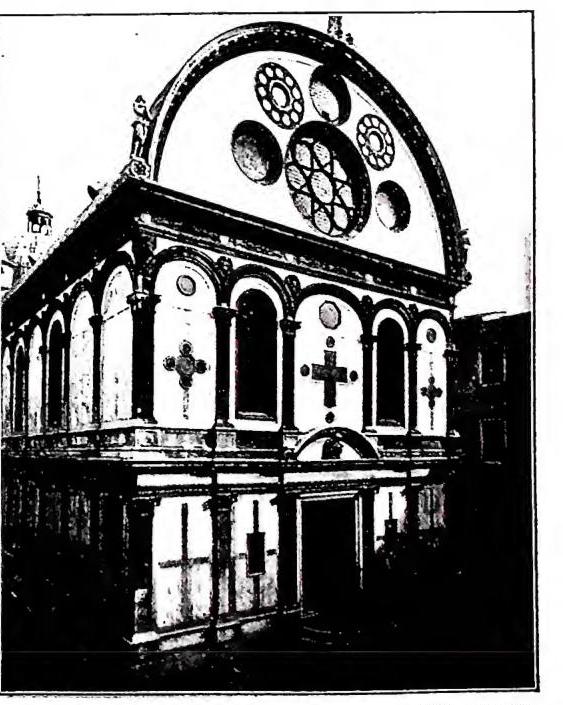
The most notable of the L., for originality of invention and technical skill, was Pietro di Martino, b. at Carona on Lake Lugano about 1435, d. at Venice in June 1515. Having absorbed certain elegances of contemporary Florentine sculpture, he began his activity as a sculptor with the Roselli tomb at the Santo in Padua (1464-67), to which were added, in Venice, the more complex and admired tombs of some doges in the churches of SS. Giovanni e Paolo, the Frari, etc., which remain typical of a lively and graceful tendency, called “Lombardesque,” not profound, but playful and inventive. Better still did his serene genius express itself in the architectural field, with works of great significance in that process of classical updating which Venetian Gothic architecture underwent, without renouncing its original polychrome oriental character. His masterpiece in this field is the church of S. Maria dei Miracoli (1481-89), where the use of multicoloured marble revetments, oculi, disks, pilasters and friezes is combined with a clear and simple functionality of linear structures. Most fruitful and faithful collaborators of Pietro L. were his sons Tullio (b. about 1455, d. at Venice on 17 Nov. 1532) and Antonio (b. c. 1458, d. perhaps at Ferrara in 1516). The former produced numerous works in the Veneto and at Mantua, among which, more than the relief of S. Anthony and the heart of the work in the Arca del Santo at Padua, and the Bacchus and Ariadne in the Museo Estense at Vienna, stands out, for the composure of the line and the elegiac abandon, the funerary statue of the young warrior Guidarelli in the Civic Museum of Ravenna. Antonio left, among other works, the relief with a Miracle of S. Anthony in the Arca del Santo at Padua, which, for purity of form, seems to anticipate neo-classical motifs (1505), and carried on a flourishing activity at Ferrara from 1506 to 1516 around the famous “alabaster chambers” of Duke Alfonso I in the Castello Estense, with opulent sculptural friezes, largely preserved in the Stieglitz Museum in Leningrad (a seated Mars in the Galleria Estense in Modena). A son of Antonio was Girolamo, also called da Ferrara (b. at Ferrara c. 1504, d. c. 1590), who was influenced by Andrea and Jacopo Sansovino; he first worked successfully for the Library and the Loggetta Sansovinian in Venice (1532-1540), then, having moved to Loreto in 1543, for that of the Holy House, where his four statues of prophets are especially admired. About 1550 he went to Recanati and there cast in bronze some of his best works: the ciborium, in the form of a small Roman temple, for the high altar of the Milan Cathedral, the tabernacle of the cathedral of Fermo and the reliefs of the doors for the Holy House of Loreto, to which his son Antonio collaborated (b. c. 1550, d. in 1610). Notable marble works executed, also at Loreto, with austere Sansovinian taste, were by the brothers of Girolamo, Aurelio (b. at Venice in 1501, d. at Recanati on 9 Sept. 1563) and Ludovico (b. c. 1507, d. in 1575).

Bibl.: L. Planiscig, *Venezianische Bildhauer der Renaissance*, Vienna 1921; id., *Deux reliefs en marbre de Pietro L.*, in *Gaz. des beaux-arts*, 1930, pp. 1-10; id., *Pietro L. e alcuni bassorilievi veneziani del 1400*, in *Dedalo*, 10 (1929-30), pp. 461-87; id., *Per il quarto centenario della morte di Tullio L.*, ibid., 12 (1932), pp. 901-24; A. Callegari, *Pietro L. e il lombardismo nel basso padovano*, ibid., 9 (1928-20), pp. 357-85; A. Venturi, *Pietro L. e alcuni bassorilievi del Quattrocento*, in *L’Arte*, 1 (1930), pp. 101-205; A. Moschetti, s. V. in *Thieme-Becker*, XXIII, pp. 341-51.

Lombardy. -

I. Geography

As a natural region, Lombardy is the territory bounded by the crest of the central Alpine zone and by the course of the Po between the Ticino and the Mincio; but the political (with Switzerland) and administrative borders, while excluding the northern Alpine part (Ticino Canton, Swiss), include strips beyond the Ticino (Lomellina), the Po ( Oltrepò Pavese, Gonzaga and Sermide) and the Mincio (Goito and Ostiglia). Only in the Valtellina does Lombardy reach the Alpine watershed, which it crosses with the small (307 sq km) protrusion of the Val Livigno. It is one of the largest, and the most populous, of the Italian regions, and in terms of population density it is surpassed only by Campania and Liguria, which are considerably less extensive.

Article illustration

The Lowland Lombardy, corresponding to the central part of the Po-Venetian plain, remains almost everywhere below 200 m and is itself divided into high and low plain. The latter benefits from resurgences, gushing forth at the contact with the high plain: agriculture and livestock (irrigated meadows) have enabled it to achieve the highest productivity found in Italy. The high plain, formed by coarse and permeable alluvial deposits (brugniere or groane), prefers industrial crops (mulberry, flax) and vines, which are also found, together with olive trees, in the hilly area around the lakes and in the low pre-Alpine and Alpine valleys. The mountainous belt, which closes Lombardy to the north, rises to over 4,000 m (Bernina), but gives way to numerous passes (seven the most important, from the Gotthard to the Stelvio), which connect the Po Valley with Central Europe. The pre-Alps (Lugano, Bergamo, Brescia), stretching from Lake Maggiore to Lake Garda, are separated from the properly Alpine zone by a series of deep valleys (Morobbia, S. Jorio, Valtellina, Corteno).

Lombardy is the Italian region with the highest development of industry: 47.5% of its active population is engaged in this sector (compared to 28.6% in agriculture, which nonetheless remains one of its economic foundations). All branches of industry flourish here, but foremost among them is the textile industry (with cotton mills at the forefront), followed, in order of importance, by steel, metalworking, mechanical, chemical, food (dairy products), etc. The area of most intense industrial concentration corresponds to the provinces of Milan, Varese and Como, with Milan absolutely predominant. Lombardy also leads the Italian regions in commerce: about one-fifth of those employed in this activity in Italy are concentrated in Lombardy.

The population is very unevenly distributed, as is clear from the extremes of its density. Almost all the main urban centres of Lombardy lie in the plain or on its margins. Apart from Sondrio, all provincial capitals (in addition to Monza and Busto Arsizio) exceed 50,000 inhabitants. Two of them (excluding Milan, which has now surpassed one million) now count among the cities with more than 100,000 inhabitants (Brescia and Bergamo).

BIBL.: A. Brenna-C. Cantù, Grande illustrazione del Lombardo Veneto ecc., Milan 1858-61; G. Graziani-S. Grande, L. col Canton Ticino, Turin 1924; G. Dainelli-N. Tarchiani, L., Florence 1927; P. Parpagliolo, L'Italia negli scrittori italiani e stranieri, II: la L., Rome 1929; L. V. Bertarelli, Guida d'Italia del T.C.I.; L. 2nd ed., Milan 1930; D. Olivieri, Dizionario di toponomastica lombarda, ibid. 1931.

Article illustration

II. Civil and Religious History

The name Lombardy (medieval "Longobardia"), introduced by the Byzantines to indicate, in contrast to Romania, the territories occupied from the 6th century by the Lombards, after 888 was applied to the Carolingian March of Italy; under the Visconti the Ticino valleys and Valtellina were also called Lombardy; the territories of Bergamo, Brescia and Mantua were later added to Lombardy; but even under the dukes vast territories beyond the Po and towards the Apennines were part of Lombardy, which now includes in the Oltrepò only the province of Pavia. In antiquity it corresponded to the eastern part of Transpadana (XI Augustan region) and, from the Oglio to the Mincio, to the western part of Venetia (X Augustan region), while the province of Pavia was Liguria, a district which under Diocletian included almost the entire present Lombardy.

Lombardy is now divided into the nine provinces of Milan, Varese, Como, Sondrio, Bergamo, Brescia, Mantua, Cremona and Pavia; among the dioceses, nine already existed in 1300, namely Milan, Lodi, Como, Bergamo, Brescia, Mantua, Cremona, Pavia and Bobbio; Bobbio was later abolished (v. BOBBIO).

The traditions, which are late and largely legendary, say that at Milan the apostle Barnabas himself introduced Christianity; at Pavia St. Hermagoras, bishop of Aquileia, is said to have sent SS. Syrus and Evencius to evangelize. In reality, it emerges, especially from the lists of bishops, that in Milan the diocese was established around 200, in Brescia around 300, in Pavia in the mid-4th century or shortly before; in Bergamo, Lodi and Como in the mid-4th century, and later in Cremona. The first bishops would have been: in Milan Anathasius, in Brescia Clateus, in Bergamo Nemo, in Pavia Syrus, in Como Felix, in Lodi Bassianus. Christianity therefore entered Lombardy as an organized institution no earlier than the beginning of the 3rd century, and became established throughout the territory only in the second half of the 4th century; the oldest known Christian inscription in Lombardy dates to 244 (CIL, V, 6181). Uncertain, partly legendary and fundamentally late is also the tradition of the martyrs in the Lombard region, which would place them in the Neronian age, whereas they should be attributed to the 3rd century. The names of the principal martyrs will be recalled under the individual names of the places; the same will be done for the most illustrious bishops of the individual dioceses, but two names cannot be forgotten here, because they had, especially the first, a wide resonance in Lombardy, indeed in Italy: St. Ambrose (374-97), who extended the ecclesiastical province as far as the Swiss district of Chur, and St. Charles Borromeo (1560-84), the principal architect of the Lombard Counter-Reformation.

The prehistoric and historical events of Lombardy are extremely complex and varied: the presence of man in the Paleolithic is unlikely; human settlements in the Neolithic, however, are characteristic, such as those in the lower Cremonese area (e.g., Vhò, Cella Dati), and later in the Mantuan and Brescian regions; the Copper Age is important with the lake dwellings of Lake Varese and then the terremare between the Adda and Mincio rivers, followed by the Bronze Age (e.g., Cascina Ranza, Albairate). Famous for

Article illustration
Lombardy - Remains of Catullus' villa - Sirmione.

Lombardy - Remains of Catullus' villa. (photo by Alinari)

Lombardy - Remains of Catullus' villa - Sirmione.

the most important political events of the region: this is the time of Ansperto and the Rhaetians from Germany, who here rely on the clergy to overcome the opposition of the feudal lords, and thus begins the new struggle of the people against the feudal bishops; in 933 Milan rebels against Bishop Landolfo; shortly after, Cremona against Bishop Olderico. The rise of the Commune begins, sometimes favored, sometimes opposed by the episcopal authority.

During the 11th–12th centuries, the transition from feudal rule to the communal system in Lombardy is completed, and the bishops participate in the general compromise with the result that they now abandon temporal power, a source of disorder, abuses, and sometimes immorality; such abuses give rise to the Patarine movement, which takes root especially in Milan and contributes to the decline of episcopal authority.

This is followed by the struggles among the Lombard communes: Milan against Lodi and Como; Pavia against Tortona; Cremona against Crema; Bergamo against Brescia. Milan manages to coordinate around itself, by force, the activities of an ever-widening circle of neighboring cities, until Frederick Barbarossa, intervening in Lombardy for his own interests, deems it expedient to provoke the resentment of the smaller cities against the dominant city; the result is the destruction of Milan in 1162, with the collaboration of Pavia, Como, and Lodi.

But the Lombard League strengthens again the ties among the communes against the Empire, and at Legnano (1176) Barbarossa is defeated. The Peace of Constance restores an agreement among the parties, including the bishops, but within the communes internal factional strife intensifies (among other things, the Waldensians against Catholics, the latter supported by the Humiliati), until at Cortenova (1237) the communes are defeated by Frederick II: this is the time of the struggles between Guelphs and Ghibellines, where in Bergamo the Colleoni and Suardo families fight, in Pavia the Beccaria and Langosco, in Como the Rusca and Vittani, in Lodi the Vignati and Vistarini, in Milan the Visconti and Torriani. Meanwhile, the commune of Milan expands through imperial concessions, territories, and privileges, while respecting elsewhere in Lombardy the great ecclesiastical fiefs, until in 1294 Matteo Visconti obtains from the Emperor the appointment as imperial vicar for Lombardy, subject to him being Milan, Como, Bergamo, Lodi, Cremona, Piacenza, Pavia, and also Novara, Tortona, Vercelli, and Alessandria. Thus is born the Duchy of Milan, i.e., the Lombard signoria, which unifies the region and prepares a great state in the center of the Po Valley, extending toward Genoa and Bologna. Later, the duchy is shattered by civic particularism, which Francesco Sforza seems to oppose for a brief time until the Peace of Lodi (1454). Under Ludovico il Moro, Lombardy enjoys a few more moments of splendor before, with his fall, it becomes prey to foreigners who regard it as the fulcrum of Mediterranean hegemony. Indeed, as a result of the struggle between Francis I and Charles V, Lombardy remains tied to Spain for nearly 200 years, on which it depends politically, economically, and morally; not even ecclesiastical properties resist the fiscalism from beyond the Alps.

Article illustration

At the beginning of the 18th century, Vienna replaces Spain in Lombardy, so that from then on this region (though part of the broader Italian Enlightenment reform movement) is tied to Austrian interests until 1796, when the French army enters Lombardy, inaugurating a period of French predominance; thus are created the Cisalpine Republic, including Valtellina, then the Italian Republic (1802), and then (1805) the Kingdom of Italy, until the return of the Austrians after the Congress of Vienna (1815). It is during this period that, in Lombardy’s dealings with Austria, the first revolutionary fermentations mature with the Giovane Italia (1821); in 1848, with the Five Days of Milan and the Ten Days of Brescia, the revolution explodes, driving the Austrians back to the Mincio; the vote of the Lombards was then for annexation to the Kingdom of Sardinia, but the Armistice of Salasco brought the Austrians back into the region. Conspiracies resume, culminating in the 1853 insurrection, until the war of 1859 and the creation of the Kingdom of Italy, of which Lombardy then became a part; after which the Lombard region was one of the most active and meritorious of the Italian state.

Article illustration

The Catholic religious spirit is still widely alive throughout Lombardy, especially in Bergamo and the entire Bergamasque region. This widespread diffusion of religious spirit has a long history, tracing back to episodes of religious struggles, epidemics, wars, and dangers, and manifests itself in the rise and flourishing of nearly 150 shrines, mostly dedicated to the Virgin, which are characteristic especially in the hilly and mountainous areas of the region.

Among those with the oldest traditions—also referring to various localities—are: Santa Maria del Sacro Monte di Varese, dating back to the Ambrosian age and especially renowned during the anti-Arian struggle; Santa Maria dell'Aiuto in Mantua, venerated since the 8th century; San Pietro near Civate, at the foot of the Corni di Canzo, a sanctuary founded by a vow of the last Lombard king, Desiderius (d. 774); Santa Maria delle Grazie in Brescia, with a venerated Nativity image, and the Madonna of Campione on Lake Lugano, both from the 13th century; san-

III. CONCILIAR REGION

The Lombard conciliar ecclesiastical region extends within the boundaries of the ecclesiastical province of Milan and does not everywhere coincide with the boundaries of the civil administrative region. It groups around the metropolitan see of Milan the suffragan bishoprics of Bergamo, Brescia, Como, Crema, Cremona, Lodi, Mantua, and Pavia.

A characteristic of the Archdiocese of Milan is the current persistence of the so-called Ambrosian Rite, which, reorganized by St. Charles Borromeo, reveals its claimed Latin mark, while differing from the Roman Rite in significant peculiarities. Exceptions are the districts of Monza, Trezzo d'Adda, and Ghignolo Po, and the towns of Civitavecchia, Varenna, and Sesto Calende. Conversely, the Ambrosian Rite is also followed in some towns of the Diocese of Bergamo, in the Valle Cannobina of the Diocese of Novara, and in some Swiss localities near Lake Lugano.

The episcopal conferences of the Lombard region are convened and presided over each year by the Archbishop of Milan or, in his absence, by the most worthy and senior bishop of the region (S. Congregation of Bishops and Regulars, 24 Aug. 1889; S. Congregation of the Consistory, 15 Feb. 1919 and 22 Mar. 1919; S. Congregation of the Council, 21 June 1932), who, assisted by the secretary of the conferences, coordinates their work and submits their deliberations to the S. Congregation of the Council for necessary approval and any observations.

Since the entire region forms a single ecclesiastical province, the decree of 15 Feb. 1919 exempts it from the obligation to hold a regional plenary council; therefore, it follows the common norms of can. 283 and following regarding the convocation and presidency of the provincial council.

The regional tribunal with matrimonial jurisdiction has its seat in Milan and serves as a court of first instance for the above-mentioned Lombard dioceses, and as a court of second instance or of appeal for the regional tribunals of Turin and Venice (*motu proprio*: Qua Cura, 8 Dec. 1938; Norms of the Sacred Congregation of the Sacraments, 10 July 1940). The court of appeal for the Lombard region is the Ligurian regional tribunal.

BIBL.: G. B. Castiglioni, *Del ius metropolitico della Chiesa di Milano*, Milan n.d.; Gr. Carli, *Del diritto ecclesiastico metropolitano d'Italia e particolarmente di Milano e d'Aquileia*, 1878; L. Muratori, *De antiquo iure metropolitae Mediolanensis in episcopum Ticinensem*, s.n.t.; F. Roberti, *De processibus*, I, Rome 1940, pp. 227-29; C. Sartori, *Enchiridion canonicum*, 1874, pp. 46-48; *Annuario pontificio*, 1950, pp. 122, 130, 162, 168, 241, 253, 260, 296.

IV. ART

The beginnings of art in Lombardy coincide with the advent of Roman civilization in this region.

Article illustration
LOMBARDY — Fragment of an ambo (11th century) — Como, Civic Museum.

Among the sanctuaries of the 15th century are S. Maria dei Miracoli near S. Celso in Milan, S. Maria dei Miracoli in Brescia, l'Incoronata in Lodi, the Blessed Virgin of Caravaggio, the Madonna of Galle-S. Maria della Croce in Crema, the Blessed Virgin of Saronno, the sanctuary of S. Girolamo Mani in Vercurago (Lecco), founded by the Somascans, and still from the early 16th century are the Madonna of Tirano, the Blessed Virgin of the Help of Busto Arsizio, that of the Madonna delle Lagrime in Treviglio, erected in memory of the salvation obtained in 1522 from the threats of Marshal Lautrec, S. Maria delle Grazie in Milan, and the sanctuary of the Sorrowful Virgin in Rho; those of the 17th century include the Madonna della S. Casa in Treviso (Valtellina), the Madonna del Bosco near Merate, the Blessed Virgin of Lezzeno above Bellano, and S. Maria delle Grazie near Mantua. A number of these sanctuaries are situated in the mountains: the Madonna del Ghisallo of this association, S. Maria della Cornabusa near Cepino in the Val Imagna, partly carved out of a cave; the Madonna della Seriola on Montisola in the middle of Lake Iseo, and the sanctuary of Alpe di S. Colombano, near Bormio, at almost 2,500 meters above sea level.

BIBL.: Modern comprehensive works on Lombardy do not exist, except for encyclopedia articles or studies on individual cities; C. G. M. Reina, *Descrizione corografica e historica della L.*, Milan 1712; L. Parpagliolo, *La L. negli scritti italiani e stranieri*, Rome 1929; C. Cattaneo, *L. antica e moderna*, Florence 1948 (reprint). Among special studies: E. Rota, *L'Austria in L. e la preparazione del movimento cislalpino*, Milan 1911; A. Visconti, *La pubblica amministrazione nello Stato milanese durante il predominio straniero (1541-1795)*, Rome 1913; C. Morandi, *Idee e formazioni politiche in L., dal 1748 al 1814*, Turin 1927; Lanzoni, pp. 971-1031; *Codice diplomatico di L.*, ed. L. Schiaparelli, I, Rome 1929; F. Valsecchi, *L'assolutismo illuminato in Austria e in L.*, 2 vols., Bologna 1931-34; F. Chabod, *Per la storia religiosa dello Stato di Milano durante il dominio di Carlo V*, in *Annuario Ist. storico II. per l'età moderna e contemporanea*, ibid. 1938, pp. 1-261; *L. romana*, publications of the Istituto di studi romani, Lombard section, I-II, Milan (1938-39); A. Calderini, *L. preistoria e protostoria*, Rome 1945; R. Thomson, *The Italic regions from Augustus to the Lombard invasion*, Copenhagen 1947. For the bibliography of 16th-century Lombard religious history, see CARLO BORROMEO, saint.