Machine translation of the 1948–1954 Italian original. The original text is authoritative.
LUCENA, JUAN de. - Spanish writer, who lived in the 15th century. He resided for some time in Rome, where he was a familiar of Enea Silvio Piccolomini (the future Pio II); he enjoyed the protection of Alfonso V d'Aragona and Isabella la Cattolica, to whom he addressed an Epistola exhortatoria a las letras; d. 1506.
In his Libro de vida beato, composed in the period 1452-1453, the bishop of Burgos, the marquis of Santillana, Juan de Mena, and L. himself, whose characters are effectively delineated, converse about the active and contemplative life, examining the various conditions of men and concluding that perfect happiness is unattainable on earth. Noteworthy are its apologetic arguments on behalf of converted Jews. The work, largely a reworking
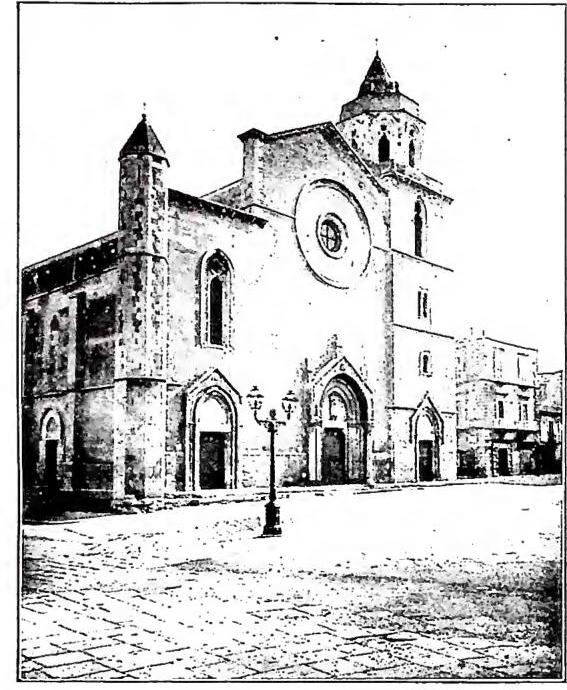
LUCERA, DIOCESI di. - Façade of the Cathedral begun in 1300 and completed in 1317.of the Dialogus de felicitate vitae by the Italian humanist Bartolomeo Facio, enjoyed wide circulation and, because of its linguistic merits, ranks among the autoridades of the Spanish Academy. A manuscript of it, signed by the author in 1464 and annotated by an anonymous hand, is preserved in the National Library of Madrid.
BIBL.: The Libro was first published at Zamora in 1483 and subsequently at Burgos in 1499 and 1502; modern ed., edited by A. Paz y Melia, in Opusculos literarios de los siglos XIV a XVI (Sociedad de bibliofilos españoles), Madrid 1892, p. 209 ff. Enzo Navarra
Cite this article
“LUCENA, JUAN DE.” Enciclopedia Cattolica, vol. VII (1951), p. 971. Azione Romana digital edition, https://azioneromana.com/article/lucena-juan-de.