
MELOTHERAPY. — Therapy by means of music. The principle that gave rise to this therapeutic aid was the general one, improperly regarded as magical, of « similia similibus », namely, that just as music is an indication of perfect harmony, so the morbid state is one of disruption; therefore, applying musical therapy to someone who is ill amounts to restoring in him that harmonious proportion which he had lost, and thus bringing him back to a state of health.
The idea of melotherapy is traced back to Pythagoras, but examples are found scattered everywhere (one may recall the beneficial calming influence exerted by the sound of David’s harp on Saul’s violent attacks). Because of its sometimes stimulating and sometimes calming effect, it is said that many people have benefited from music to induce analogous states in isolated individuals or entire communities. Asclepiades of Bithynia (1st–2nd centuries B.C.) recommended it for psychopathy. During the Renaissance it was so widespread that Rabelais, satirizing it, imagines a
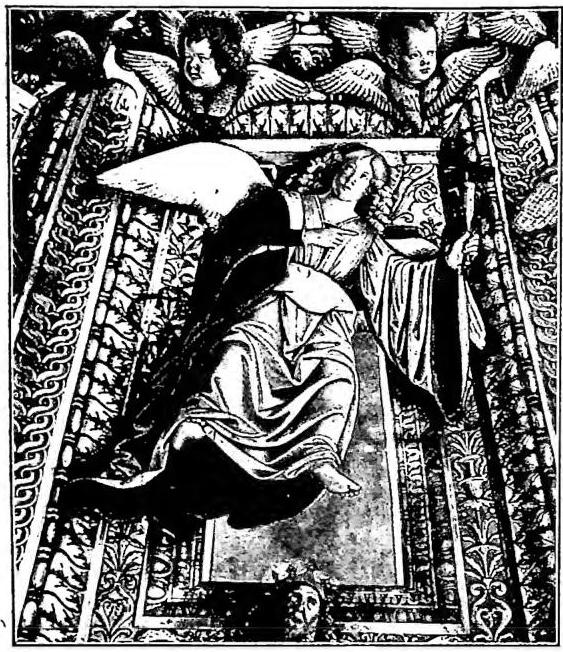
Fresco in the Treasury Chapel — Loreto.
Madonna Armonia who heals every kind of illness.
The seventeenth and eighteenth centuries, as well as the preceding century, made use of m. and recounted marvels accomplished through II. Mesmer had music played during his “séances”; Lichtenthal, in the nineteenth century, wrote the Medico musicale. Special mention must be made of that particular music with which, in the seventeenth century (and beyond), those who had been bitten by the tarantula were treated (hence the name “tarantella” given to the music itself). Apart from the psychological aspect of arousing, by sympathy, states of mind in the individual analogous to those expressed by the “piece,” music seems to act also upon animals (increased milk secretion in cows) and upon processes in which suggestion plays no role (the healing of wounds, etc.).