RASSLER, CHRISTOPH

RASSLER, CHRISTOPH. - Gesuita moralista, n. a Costanza il 12 ag. 1654, m. a Roma il 16 luglio 1723.

After many years of teaching philosophy, dogmatics, and especially moral theology, he was called to Rome as general reviser of books and prefect of studies at the German College. In the great controversy over the liceity of using probable opinions, he supported and defended a moderate probabilism in the work: *Controversia theologica tripartita de recto usio opinionum probabilium*, in refutation of the work by the general Tirso González; but the censors prohibited its printing, and he, despite his insistence, was unable to obtain permission to publish II. Only after the general’s death (though it seems that printing had already begun at Dillingen in 1693, but was interrupted and the work never appeared) was he able to develop his ideas in another work: *Norma recti* (Ingolstadt 1713), which constitutes his principal work. In this he leaned toward equiprobabilism; but, contrary to the assertion of Astrain, followed by Pastor, he cannot be considered its founder.

Article illustration

BIBL.: Sommervogel, VI, 1641-44; J. von Dollinger-Fr. H. Reusch, *Gesch. der Moralstreitigkeiten*, I. Nördlingen 1886, pp. 236 seq.; II, 1889, pp. 169 seq., 190 seq.; A. Schmitt, *Probabilismus und supplerte Jurisdiktion*, in *Zeitschr. für kath. Theologie*, 39 (1915), pp. 48-64; A. Astrain, *Historia de la C. de J. en la asistencia de España*, VI, Madrid 1920, pp. 335-39; Pastor, XIV, II, p. 464; B. Duhr, *Gesch. der Jesuiten in den Ländern deutsch. Zunge*, III. Munich-Ratisbon 1921, p. 11 seq.

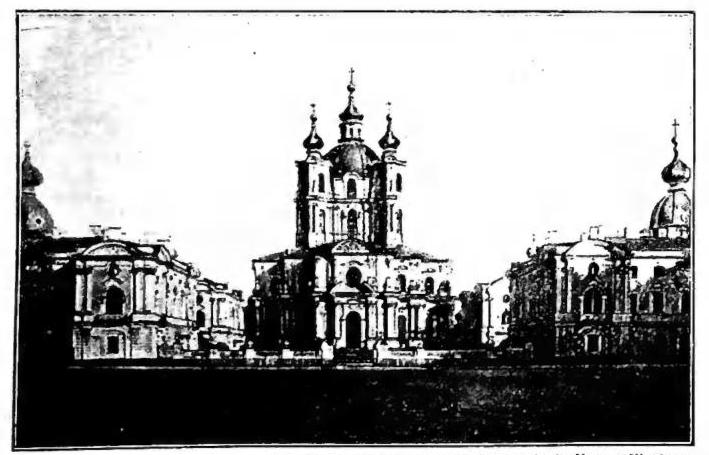
RASTRELLI, BARTOLOMEO FRANCESCO. - The central complex of the Smolny Monastery – St. Petersburg, now Leningrad.

His masterpieces include: the Winter Palace, the palace at Tsarskoye Selo, the Razumovsky, Stroganov, and Vorontsov Palaces, the Smolny Convent in St. Petersburg, and the Cathedral of St. Andrew in Kiev. In the Winter Palace, traces of the artist’s Roman sojourn are evident in the grandiose and solemn proportions of the building, especially in the two projecting lateral wings. He designed many private palaces, renowned for their facades adorned with rich columns and pilasters.

Russian religious architecture also felt the influence of Rastrelli’s art, renewing itself in its principal tendencies. R. drew inspiration from Western churches while preserving the traditional and national character of the new Russian cathedrals—five domes and other architectural and decorative features. His masterpiece in this genre was the Smolny Convent, built as a place of pious retreat for spiritual exercises. Also notable is the aforementioned Cathedral of St. Andrew in Kiev, built in 1744 and consecrated in 1767; crowned by a four-lanterned dome and luxuriously decorated inside, it is an example of Baroque transplanted onto Russian soil.

R. marked an epoch in the artistic development of all Russia; many Russian architects trained under him and continued his work worthily, spreading Western art and culture in Russia.

Bibl.: A. Benois, *Tzarskoe Selo sotto Elisabetta* (in Russian), St. Petersburg 1910; E. Lo Gatto, *Gli artisti ital. in Russia*, I. Rome 1934; M. Gibellino Krasceninico, *Storia dell’arte russa*, II, 1937. Maria Gibellino Krasceninico.

RATDOLT, ERHARD. - German printer and bookseller, b. at Augsburg in 1447, d. there in 1527 or 1528.

As a young man, in 1462 he went to Venice, where he remained until 1486, first in partnership with Bernardo “Maler” (Pictor) and Pietro Löselin (1476-78), then on his own (1480-86). From 1486, having returned to his homeland at the invitation of Bishop Johann von Werdenberg, he continued printing until 1522.

A leading figure among 15th-century printers, he used elegant typefaces and promoted the production of books adorned with fine and rich frames and graceful silographic initials, sometimes printed in multiple colors. His output included books on mathematics, astronomy, and history, but chiefly liturgical works (breviaries and missals) supplied to numerous dioceses, always printed with a true sense of art. Among his notable editions are: the Latin and Italian editions of the *Kalendarium* by G. Müller of Königsberg, known as Regiomontanus (Venice 1476), considered the first book with a title page; the *Ars moriendi* of Capranica (Venice 1478); the editio princeps of Euclid’s *Geometria* (ibid. 1482), the first book with geometric figures; and the *Chronica Hungarorum* by G. Thwroz (Augsburg 1488), with silographic engravings of portraits and battle scenes.

Bibl.: G. R. Redgrave, *E. R. and his work at Venice*, London 1899; O. Viola, *E. R. e i più antichi fregi tipografi*, nelle stampe del sec. XV, in *I. Arte della stampa*, 38 (1908), pp. 172-74; K. Schottenloher, *Die liturgisch. Druckwerke E. R. aus Augsburg 1485-1522*; Mainz 1922; R. Diehl, *E. R. Ein deutscher Meisterdrucker des XV. und XVI. Jahrhunderts*, in *Philobiblon*, 6 (1933), pp. 91-96, 123-128, 155-61; K. Ohly, *Eine gefälschte Ratdoltnikunabel*, in *Gutenberg Jahrb.*, 5 (1933), 53-61; C. D. McMurtrie, *E. R. the father of typograph. decoration*, Chicago 1936; R. Diehl, *E. R.*, in *Altmeister der Druckeschrift*, 1940, pp. 41-50. Giannetto Avanzi