
RATIONAL. — That which belongs to reason or is in conformity with II. In this sense one speaks of a rational demonstration, a rational deduction, as well as the very activity of reason consisting in combining concepts and propositions.
Rational is also the “good judgment” (Descartes, Discours de la méthode, I, 1), that is, the faculty which knows how to distinguish the true from the false, the good from the evil, etc. Likewise, natural truth is called rational to distinguish it from the superrational revealed truth (v. RATIONALISM); and rational is also the system of a priori principles, logically formulated, whose origin and value are independent of sensible experience. Hegel (v.), concept (v.) the essence of things, identifies the real with the rational: “All that is rational is real; and all that is real is rational” (Philosophy of Right, Preface). There are other particular meanings as well: for example, in the sense of “good method” (a “rational education,” a “rational distribution” of the parts of a subject, etc.). Mathematicians speak of a “rational number,” that is, one that can be expressed as the ratio of two integers; and physicists speak of “rational mechanics,” that is, mechanics constructed by purely deductive methods starting from the notions of mass, force, and inertia.
Cournot opposes logical order to rational order; the former, according to him, is linear and discursive, the latter synthetic and intuitive. Logical order determines assent without showing the true reasons of things; rational order, instead, connects truths to their natural principle and enlightens the mind. As is well known, modern rationalism and Kant oppose the rational to the empirical.
It consisted of a square piece of cloth folded like a pouch (a kind of bag) made of rich fabric woven with four colors and gold threads, similar to the ephod (q.v.), to which it was attached by golden chains at the upper fastenings and secured to the belt with two violet cords. On it were set, in four rows of three stones each, twelve precious stones of different kinds, each engraved with the names of the twelve tribes of Israel in gold. Thus the high priest, in the most solemn act of his duties, carried “the names of the sons of Israel upon his heart... as a continual memorial before Yahweh” (Ex. 28:29). Yet the chief prerogative of the rationale was to contain the ’urim and tummim (q.v.), “light and perfection,” from which the high priest drew the responses of Yahweh in important circumstances. For this purpose it is called in the original Hebrew hōšen hammīpāṭ (or simply hōšen, of uncertain etymology, perhaps equivalent to “pouch” or “ornament”) — that is, “the pouch of divine decisions” (λογεῖον τῶν κρίσεων, “oracle of judgments”; Vulgate rationale indicii; Symmachus δόγιον, “pouch”; Josephus and other Greek versions simply λόγιον, “oracle”).
The rationale seems to be of Egyptian origin: indeed, various figures in ancient Egypt wear a kind of trapezoidal or square ornament hanging from the neck over the chest (notable is the one found on the mummy of Queen A’āh-hotep, mother of Amosis I, founder of the 18th Dynasty, 1580–1558 B.C.: it is shaped like a finely wrought shrine adorned with symbols, figures, and mosaic-embedded precious stones).
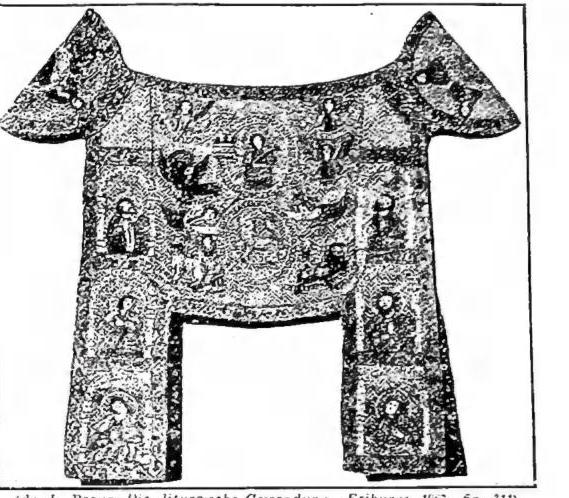
This privilege was granted to the bishops of Halberstadt by Pope Agapito II (946–55); Adalberone II, bishop of Metz (984–1005), obtained it from Hilduin of Halberstadt; Poppo, Patriarch of Aquileia, was permitted to wear it by Pope John XIX in 1027. In the Middle Ages, it was also worn by several other German bishops: those of Minden, Paderborn, Naumburg, Eichstätt, Würzburg, Regensburg, Speyer, Prague, Olomouc, Kraków, Liège, and Toul. Today, it is still used only by the bishops of Paderborn and Eichstätt in Germany, Toul and Nancy in France, and Kraków in Poland—dioceses that once belonged to the Holy Roman Empire. It was never used in Rome. J. Braun distinguishes three types: a) one shaped like the letter Y of the pallium, used in Eichstätt, Regensburg, and Würzburg until the 17th century; b) one shaped like a circular pallium, with two short appendages on the chest and back (used in Kraków, Toul, and also in Eichstätt and Regensburg); c) a rectangular cloth collar, as wide as the shoulders, hanging about 20 cm down the chest and back, with two longer bands on either side, used in the Middle Ages in Bamberg and Liège. Unlike the pallium, the razionale was always richly adorned with embroidery or symbolic inscriptions and was typically purple in color.
II. A variant of the razionale was a silver or gold plate (instead of the cloth version), resembling the ephod of the Jewish high priest (Ex. 28:2–4), with chains or clasps attached to the amice. This is mentioned in the 12th century by Ivo of Chartres and Honorius; Sicardo of Cremona (q.v.) also lists it among pontifical ornaments. It was used in Reims (still at the beginning of the 16th century), Münster, and Mainz, though it never became widespread. The origin of the razionale is explained either as an imitation of the Jewish ephod or as a substitute for the pallium for non-metropolitan bishops (Braun). Because it is associated with the see rather than the person, it is not buried with the bishop.