
REID, THOMAS. — English philosopher, born on 25 April 1710 at Strachan, near Aberdeen, at whose University he was a professor from 1752 to 1764, the year in which he succeeded A. Smith in the chair of moral philosophy at the University of Glasgow, where he died on 7 October 1796.
His first important work dates from 1763: An inquiry into the human mind on the principles of common sense (London), followed, among other minor works, by the Essays on intellectual powers of man (Edinburgh 1785), and the Essays on the active powers of man (ibid. 1889). The philosophy of “common sense” (v.) or of the “Scottish School,” of which R. was the leading figure, exerted a European influence, especially in France (Jouffroy, Cousin, Maine de Biran, etc.), in Italy (Galluppi, Rosmini, etc.), in Spain (Balmes), and, naturally, in England as well. For almost the entire first half of the nineteenth century, R.’s name remained coupled with that of Kant in the critique of Hume’s empiricism (v.) and in the solution of the problems of knowl-
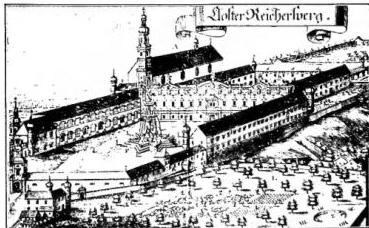
REICHERSBERG — Abbey of the Canons Regular (1984); Baroque reconstruction by various local artists, among whom were C. A. Carlone, P. B. Carlone, Cristoforo Weiss, etc. Exterior courtyard, fountain, main building (prelature). Engraving from the 17th century.
knowledge and the origin of ideas in relation to rationalism (see) and to the empiricism of the 17th and 18th centuries.
The method of observation and analysis, whose limit is experience, is characteristic of R. and his school: for him, to know the spirit means observing and analyzing the various faculties and constitutive principles of man as an intelligent, active, social, and moral being, respecting the impassable limits of phenomena and renouncing any attempt to explain their origin (metaphysical agnosticism). Sensation (see) and perception (see) are the primitive acts of human knowledge, through which we know the secondary and primary qualities (both objective) of things. The immediate object of our spirit is not «ideas», but things themselves. Sensation «attests to the existence of the thing and of a quality inherent in it, a faculty of thinking and feeling, and a permanent being or spirit in which this faculty resides» (Inquiry, ch. 2, sec. 7). To admit between the objects perceived and the perceiving subject the «intermediary» of «ideas» is to be unable to avoid the skeptical consequences of Berkeley’s «idealism» (see) and Hume’s phenomenalism (see), that is, it is to deny the reality of things, spiritual substance, the validity of the principle of causality, etc. Certainly, we do not know what material and spiritual substance are, just as we cannot demonstrate the existence of things and of their qualities, but we know that they are not subjective ideas or impressions. In short, perception has an irresistible and immediate evidence (see), which gives rise to the invincible belief (see) that the perceiving subject exists and that the perceived things exist. Every reasoning (see) is founded upon it, whereas it is independent of all reasoning. It is an innate suggestion which, although it explains nothing, makes us believe everything and gives man confidence. It is not common sense that must conform to philosophy, but philosophy to common sense. «The most immediate conclusions which reason draws from perception form common sense», or that body of data according to which men conduct themselves in the ordinary affairs of life; the more remote conclusions form science. Science and common sense are thus connected «that we cannot precisely say where the former begins and the latter ends». Our knowledge of nature «may be compared to a tree which has its root, its trunk, and its branches. Perception is the root, common sense the trunk, and science its branches» (Inquiry, ch. 6, sec. 20). In short, for R., the reality of things and spirits is the result of an instinct (see) or of a primitive belief.
Thus the philosopher believed that he had resolved, against empiricism, the problem of the objectivity of knowledge and of reality. This problem, which is the same as that faced by Kant in opposition to Hume, often brought the Scotsman close, especially in the 19th century, to the philosopher of Königsberg. The distance, however, is enormous: R. remains within the sphere of empiricism without succeeding in overcoming it; he ignores the Kantian concept of «critique», and his «belief» or «instinct» is something quite different from Kant’s a priori. As Rosmini rightly observes (Nuovo saggio, II, Rome 1830, p. 245), the objectivity of knowledge cannot be founded on instinct: «common sense, which is authoritative in bearing witness to such a fact (an a priori cognition exists), nevertheless knows how to offer no explanation of it».
R. deserves credit for having demonstrated that perception has not merely a representational character and for having asserted the principle of the activity of consciousness against that of passivity, characteristic of the empiricist psychology of his time and of Condillac.