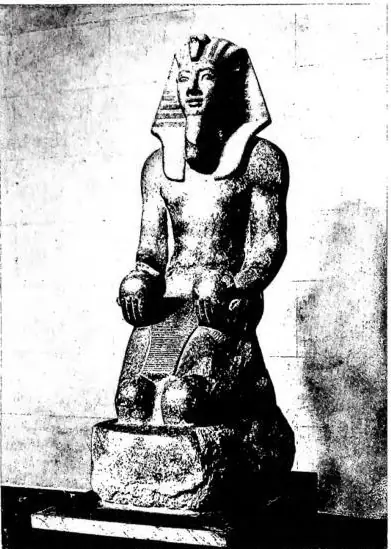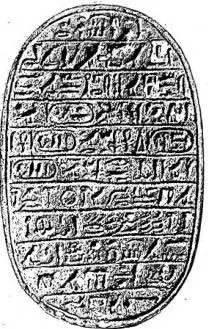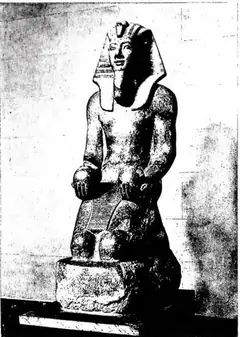
AMENOPHIS III and IV (Amen-hotep or Amen-hothe, rendered by the Greeks as Amenothès and Amenophis: "peace of Amun"). - Pharaohs (7th and 8th) of the 18th Egyptian dynasty (1410-1358 B.C.).
Amenophis III. - Adoptive son of Thutmose IV, he ascended the throne very young and had a glorious and peaceful reign of 36 years (c. 1410-1375).
Except for a military expedition against the land of Kush that brought him great profits and war booty, among other things much gold, his foreign policy was peaceful. He carried on a far-sighted diplomatic action, continuing the policy of his predecessor. To combat Hittite expansionism he allied himself with the Mitanni. He also sought other alliances, with Babylonia and Assyria and with Amurru. The requests for help from the vassal princes of Syria to the pharaoh, in moments of danger, received only evasive answers or some reproach to the state disturbing the peace. Syria was increasingly withdrawing from Egyptian influence. When Amenophis III died, the new Hittite power was becoming a danger for Egypt, made even more serious by the political disinterest of his successor.
Giustino Boson
A. IV. - Son and successor of A. III; according to some, his mother Teje or Ti, associated in the documents with A. III, was a Semite. He married Nefertiti, daughter of the Babylonian king Burnaburiash III (ca. 1385-1361), and Taduhepa, widow of A. III and daughter of King Tushratta of Mitanni. Sickly, he died before the age of 35. He devoted his entire reign (1375-1358) to the religious reform for which he was called the "heretic" pharaoh: the propagation of the unitary cult of the solar disk, Aton.
"Among the pharaohs he was undoubtedly the most remarkable man" (R. Kittel, Gesch. des Volkes Israel, I, 7th ed., Stuttgart 1932, p. 353). Orienting himself toward a form of universalist monotheism and a more spiritual religiosity, A. IV wished to break the tyrannical supremacy of Amun (v.) and his priests, even though his father had built the majestic towers of the temple of Amun at Thebes, and he prescribed the worship of Aton alone, or the sun god, under the image of the radiant solar disk, source of all life.
To this god of all, vivifier and benefactor of men, A. IV addresses a beautiful hymn of monotheistic tone ("O sole God, without equal...") preserved for us in many copies carved in the temples of the god, engraved wholly or in part on all the tombs of Tell el-Amarna, in which the words "light, truth, love, life" echo incessantly: it is the most interesting religious document of ancient Egypt. This hymn, which many compare to Ps. 103 (104), presents analogies with the Babylonian hymn to Shamash (P. Dhorme).
A. IV assumed the name Ech-en-aton ("he who is pleasing to Aton") and built for himself, abandoning Thebes after 4 years of reign, the new capital Achet-aton ("horizon of Aton"), halfway between Memphis and Thebes, about 10 km north of Hermopolis.
This center of the new cult, whose well-preserved remains were brought to light by the excavations of Tell el-Amarna, built hastily of mud bricks, did not survive A. IV. The reforming pharaoh gave new and original impetus to art: painting and sculpture model themselves on the real; fine examples are the portraits of A. IV with his mother, his wife Nefertiti and his six daughters. In art as in thought, A. IV appears to us "modern."
The reform of A. IV, most notable for its philosophical-religious significance, foundered at the death of the young daring monarch. By fighting the cult of Aton-Ra, whose images he had destroyed and whose name he had chiseled away, abolishing the priests of Amun and confiscating their vast possessions,
A. IV clashed with too many interests. Although his god was in reality the ancient solar deity of Heliopolis Hor-akhet (Horus of the Horizon), and coincided with Ra, by positing him as the only one, A. clashed with fundamental Egyptian beliefs. His second successor and son-in-law Tutankhaton hastened, shortly after his accession, to change his name to that of Tutankhamun, to return to Thebes and to restore the cult of Amun. The disorder and political decadence caused by the "Tell el-Amarna period" were later remedied by the energetic pharaoh Haremheb (ca. 1340-1320).
For knowledge of the time, the ideas and the methods of A. IV, the monuments and archive letters of Tell el-Amarna are precious (v. AMARNA). - See Pl. LXXXIV.