Machine translation of the 1948–1954 Italian original. The original text is authoritative.
CASTELSEPRIO. — Municipality in the province of Como. The church of S. Maria foris portas, particularly noteworthy for its ground plan and pictorial decoration, is preceded by a covered and rather low narthex and has a single nave and an apse. Two other apses, of which only the structures remain, opened along the sides; they were accessed through two narrow arches, so that they must have appeared to be separated from the nave. In terms of its plan, therefore, the building conforms neither to the typical longitudinal scheme nor to that of a τριαστικό: this is probably due to the fact that, in the architect’s conception, the construction, undoubtedly very close to a centralized plan, was intended to have a different elevation and roofing system from those it eventually acquired, perhaps for technical reasons.
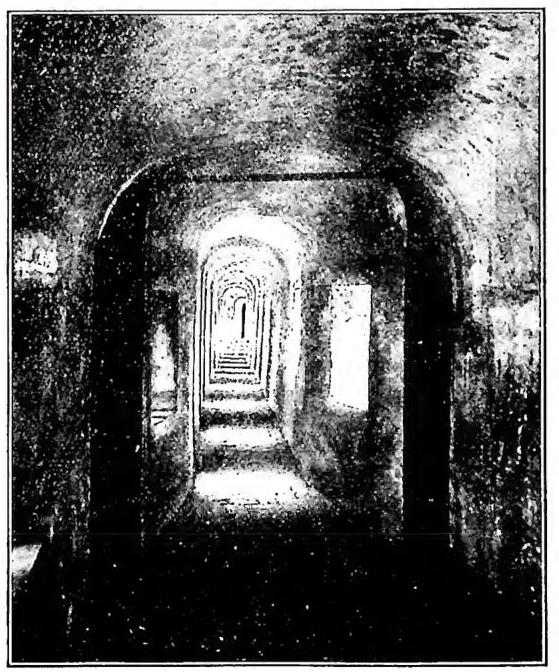
(phot. Anderson) CASTEL SANT'ANGELO - Interior of the corridor between the Vatican and C. S. A. (13th century).Bognetti holds that the church dates from the 7th century and was built by a community of Eastern monks who had settled in Italy. In the apse, beneath the frescoes of an unknown Lombard artist of the 15th century, paintings of great interest were brought to light after 1944. They are arranged in two long, superimposed horizontal zones and depict scenes from the cycle of the infancy of Jesus. Particularly noteworthy is the Annunciation, inspired by the apocryphal Gospels, since the Virgin is represented seated and spinning. The cycle is interrupted at the center by a tondo in which the bust of the Παντοκράτωρ appears. Other paintings decorated the triumphal arch: among those preserved is a medallion with the symbol of the ἐνουχαία, flanked by two archangels carrying a staurophere globe in flight. The frescoes certainly predate the second half of the 9th century: indeed, graffiti referring to the time of the Milanese archbishop Tadone (863–65) have been found on the painted plaster. They may perhaps be attributed to the 7th century. As regards composition and the use of colors, the artist, endowed with a powerful personality, follows the Hellenistic pictorial tradition and rapidly sketches, in an elegant and lively manner, the figures and backgrounds of his compositions. De Capitani d'Arzago has advanced the hypothesis that he was a Melchite from the East who may have been forced to leave Palestine, Syria, or Egypt following a persecution by the nationalist Monophysite populace. - Vedi Tav. LIX.
BIBL.: A. De Capitani d'Arzago, Le recenti scoperte di C., in Bollettino d'arte, 4th series, 33 (1948), pp. 17–23; G. P. Bognetti-G. Chierici-A. De Capitani d'Arzago, S. Maria di C., Milan 1948. Giuseppe Bovini
Cite this article
“CASTELSEPRIO.” Enciclopedia Cattolica, vol. III (1949), p. 603. Azione Romana digital edition, https://azioneromana.com/article/castelseprio.