
COMPREHENSIVENESS (Comprehensiveness). – A characteristic of the Anglican Church consisting in its “comprehending” among its members the faithful of diverse religious doctrines. The official Church of England outwardly flaunts a certain unity that may be misleading. Indeed, it displays that external unity which derives from its being the Church of the State, without whose approval it can change neither the doctrines, nor the prayers, nor the rites of the official book; moreover, it also appears to form a single united bloc through its use of the same book, the Book of Common Prayer, through the common bond of the same 39 Articles of Religion, and also through the existence of an episcopate recognized throughout the Anglican Communion, which every decade gives an appearance of unity at the Conferences of Lambeth, presided over by the primate of the Anglican Church. But if the matter is examined attentively, it is discovered that the reality is quite different, since the Anglican Church teems with such a variety of doctrines, often contradictory, as perhaps exists in no other Protestant Church or sect.
This phenomenon, called c., is not only acknowledged, confessed, and accepted by Anglicans, but is almost, one might say, incorporated into the Church itself as an essential element of its existence. The Anglican Church “comprehends” indiscriminately within its bosom the faithful whom it allows the freedom to profess contradictory doctrines or to doubt fundamental truths. Thus there remain within the Anglican Church, and are considered good Anglicans, those who believe or deny the virginal birth of Jesus Christ; those who accept or reject the miracles of the Gospel; those who profess or doubt the historicity of the fourth Gospel; those who admit that Jesus Christ was mistaken in his doctrines or prophecies, and those who believe in the truth of everything he said. C. is nothing other than the natural consequence of Anglican principles, namely, the denial of any infallible doctrinal authority and the free interpretation of the Bible. The same 39 Articles of Religion are drafted in such a way that they can be interpreted differently, and there is no authority capable of determining what their authentic meaning is. Thus powerless to decide a controversy arising over some point of revealed doctrine, Anglicanism attempts to conceal this impotence with the convenient theory of c., which in practice means leaving the faithful the power to determine their own Creed, or, as the Anglican bishop Knox put it, “to teach what I believe to be false, provided that I may also teach what others believe not to be true”; in other words, the Church of England is called comprehensive because it embraces errors and truths, and, being unable to decide which is error and which is truth, it “comprehends” them both.
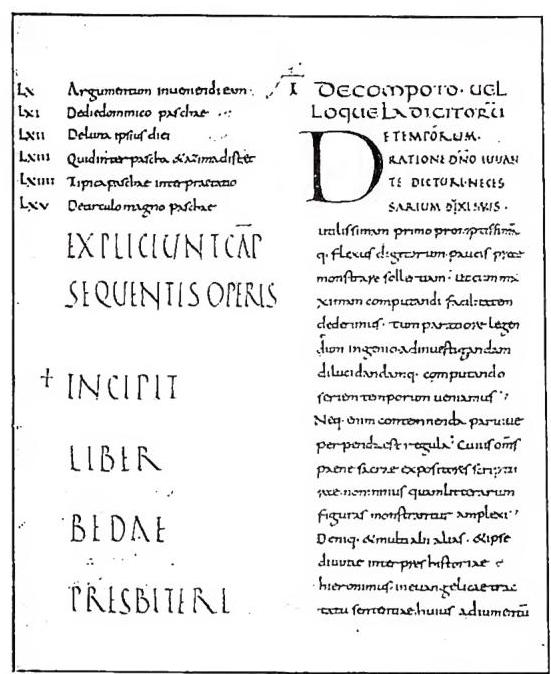
ECCLESIASTICAL COMPUTUS - Incipit of the De temporum ratione by S. Beda the Venerable. Codex originating from the Monastery of S. Nazzario at Lorsch, from the second half of the 11th century - Vatican Library, Cod. Pal. Lat. 1449, fol. 30r.