
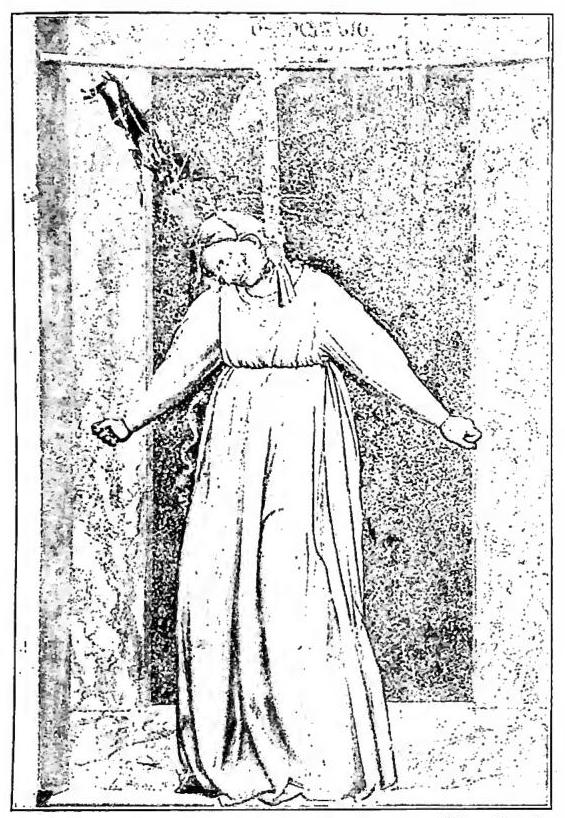
DISPERAZIONE. — Psychologically and morally, d. is the positive and direct opposite of supernatural hope.
Psychologically, d. shares with hope the same presuppositions, namely, in the intellect, knowledge of man’s supernatural destiny to the beatitude of the eternal possession of God; and, in the will, the desire to attain II. But d. excludes what constitutes the essence of hope, namely, trust in the promises made by Jesus Christ, which assure us of God’s will to give himself as a reward, together with the means necessary to merit II. In the contrast between this conscious desire for happiness and the lost confidence of attaining it lies the anguish of the despairing person.
At the basis of this spiritual attitude there ordinarily lies either a positive doubt concerning divine forgiveness with regard to one’s past sins, or, with regard to the future, a positive doubt concerning the efficacy of divine Grace in sparing one temptations beyond one’s strength, or at least in sustaining the weak will in the face of their allurements, toward
Very different from d. is the pusillanimity often found in the religious practice of sensitive persons, arising not from distrust in God’s mercy, omnipotence, and fidelity to his promises, but solely from distrust in their own cooperation with Grace; cooperation which, in hope, acts as a condition to which God has bound the efficacy of his promised goodness and omnipotence in granting salvation and the means of meriting II. Such distrust in their own cooperation arises in these souls from erroneous preconceptions concerning its necessity and efficacy, or more often from disappointments and failures, more or less culpable, in their own ethical-religious experience, or also from innate timidity and lack of confidence in all their aspirations, even natural ones, and not only in these aspirations of supernatural hope.
Also very different from theological d. is that form of d. of a pathological nature, which appears in an individual whenever, as a result of some physical or psychological disorder, he falls into profound, anguished melancholy, despises himself without foundation, and considers himself damned, thinking without reason that he is committing or has committed faults so atrocious that he cannot find forgiveness before God. The diagnosis and treatment of this state of mind belong to psychiatry, not to religion.
It is evident in itself that d., in the sense explained, is in direct and positive opposition to hope:
in direct opposition, because it strikes at its very essence, opposing distrust in God’s promises to trust in them; in positive opposition, because this distrust is not merely a failure of the will to adhere to the divine promises, but an act of the will that rejects access to them.
Morally, too, d. is positively opposed to hope: for, just as hope, through trust in God’s promises, honors his goodness, omnipotence, and fidelity, so d., through distrust in his promises, offends him in these same attributes. Therefore d. is in itself always a very grave fault; and although there are more serious faults, this is the most dangerous; but ordinarily, as stated above, one falls into d. through distrust in one’s own cooperation, or through weariness in renewing efforts against inveterate evil habits, which continually return under the blows of a struggle prolonged over time.
Finally, d. is in direct opposition to hope insofar as, by excluding and destroying it, it excludes the virtue of hope, infused at the act of Baptism as the permanent endowment of the soul deified in Christ (v. SPERANZA).