Philadelphia (City of the Decapolis) redirects here.
Also known as:
Amman, Rabbah, 'Ammān, Rabbah Ammon;
Italian: Rabbat Ammon
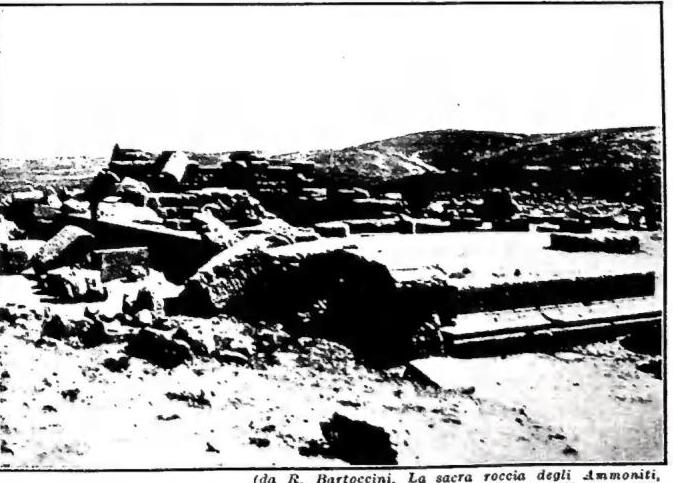
RABBA (RABBATH) of AMMON - View of the excavations.
RABBA (Rabbath) of Ammon. - Ancient city
(Deut. 3:11) east of the Jordan, today 'Ammān,
capital of Jordan and formerly of the Ammonites (v.).
After the siege of the lower city by Joab,
in which Uriah died, and that of the upper city by
David, R. lost its independence and became a
mere capital of the Kingdom of David (II Sam.
10-12; I Chron. 20:1-3). It did not take long to regain
its freedom.
Excavations have revealed the tomb of Adoni Nur,
servant of Ammi Nadar who reigned in the time of Ashurbanipal
(ca. 650 B.C.). From the Iron Age, walls
have been found on the acropolis (excavations of the Italian Mission) and two tombs.
(phot. Enc. Catt.)
RABANO, MAURO - R. M. is presented to St. Martin by the abbot Albino. Miniature of the 9th century in the De Lauda Sanctae Crucis. Vatican Library, cod. Reg. Ist. 124, fol. 2v.
In 258-247 B.C., R. expanded and took the name Philadelphia in homage to Ptolemy II. Around 135 it was governed by the tyrant Zeno and a tomb with characteristic pottery indicates the Nabataean presence. In 63 B.C. it became part of the Decapolis and in 106 A.D. it belonged to the province of Arabia of Trajan, developing greatly. From the Roman period there are fine buildings in the lower town and the temple on the acropolis.
In Christian times it became an episcopal see dependent on Bosra, and Cyrio, a bishop, took part in Nicaea and Antioch. Four ancient churches are known, one near the river, where the great mosque stands today, two on the slopes and one on the acropolis. In 635 it passed to the Arabs, who erected a fine palace of Sasanian art on the acropolis. It soon began to decline and with the Turkish period nothing remained but a wretched village. Revived by an immigration of Circassians, from 1878 it developed and after the First World War it became the seat of the emir of Transjordan. The development has not ceased and in 1948 its population was doubled (about 100,000) with the settling there of Palestinian refugees.
Bibliography11 worksR. Bartoccini, La roccia sacra degli Ammoniti, in Atti del IV Congresso nazionale di studi romani, Roma 1938; id., Un decennio di ricerche e
BIBL.: R. Bartoccini, La roccia sacra degli Ammoniti, in Atti del IV Congresso nazionale di studi romani, Roma 1938; id., Un decennio di ricerche e di scavi italiani in Transgiordania, in Bollettino del R. Istituto di arch. e storia dell'arte, 9 (1941), pp. 1-10; L. Harding, Two iron age tombs from 'Amman, in Quart. Depart. antiquities in Palestine, 11 (1945), pp. 67-74; E. Henschel-Simon, Note on the pottery of the 'Amman tombs, ibid., pp. 75-80; G. R. Driver, Seals from 'Amman and Petra, ibid., pp. 81-82; L. Harding, A nabatacan tomb at 'Amman, ibid., 12 (1946), pp. 58-62; id., Recent discoveries in Transgiordan, in Palestine expl. quart., 80 (1948), p. 118 ff.; 82 (1950), p. 67; id., A roman family would on Jebel Jofen, 'Amman, ibid., 14 (1950), pp. 81-94; B. Bagatti, Il cristianesimo ad 'Amman, in La Terra Santa, 23 (1948), pp. 35-39; S. Saller - B. Bagatti, The town of Nebo, Gerusalemme 1949, pp. 30, 225-26.
Bagatti, Bellarmino. “Rabba (Rabbath) di Ammon.” In Enciclopedia Cattolica, vol. X, coll. 440–442. Città del Vaticano: Ente per l’Enciclopedia Cattolica e per il Libro Cattolico, 1953. https://azioneromana.com/article/rabba-rabbath-di-ammon.
MLA
Bagatti, Bellarmino. “Rabba (Rabbath) di Ammon.” Enciclopedia Cattolica, vol. X, Ente per l’Enciclopedia Cattolica e per il Libro Cattolico, 1953, coll. 440–442. Azione Romana, https://azioneromana.com/article/rabba-rabbath-di-ammon.
BibTeX
@incollection{ec10_rabba_rabbath_di_ammon,
  author    = {Bagatti, Bellarmino},
  title     = {Rabba (Rabbath) di Ammon},
  booktitle = {Enciclopedia Cattolica},
  volume    = {X},
  pages     = {440--442},
  note      = {Cited by column},
  publisher = {Ente per l’Enciclopedia Cattolica e per il Libro Cattolico},
  address   = {Città del Vaticano},
  year      = {1953},
  url       = {https://azioneromana.com/article/rabba-rabbath-di-ammon}
}
One of some 20,000 entries brought back from the twelve printed volumes (1948–54). Spotted something? Help us improve it.
Click or scroll to zoom · drag to pan · Esc to close