Also known as:
Protus and Hyacinthus;
Latin: Protus et Hyacinthus
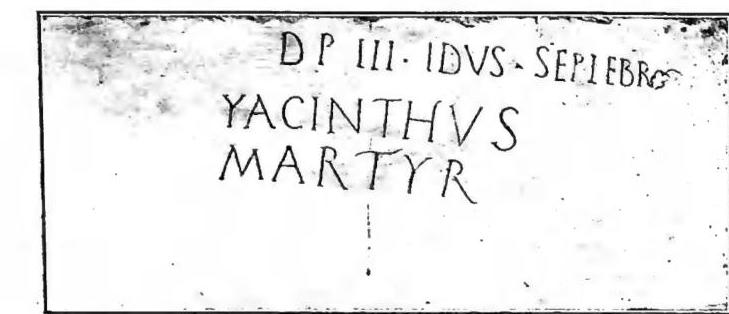
PROTO and HYACINTH, saints, martyrs - Inscription of the martyr H. found on 21 March 1845 in the cemetery of Bassilla, now in the chapel of the Urban College De Propaganda Fide - Rome.
PROTUS AND HYACINTH, Saints, Martyrs. - They are already mentioned in the Depositio Martyrum on September 11, buried in the cemetery of Bassilla on the old Via Salaria.
On the same date they are commemorated in the Gelasian Sacramentary of the 8th century from St. Gall and in the Gregorian, while their tomb is mentioned by the Itineraries of the 7th century with the indication "in spelunca." It has been identified in a double crypt where on March 21, 1845 the intact loculus was found, with the epitaph of H. still in situ and his charred remains. The tombs of the two martyrs had already been blocked in the 4th century by a landslide, and Pope Damasus had arranged for their restoration with an access stairway and a lucernarium: the work of the priest Theodore. The tombs of the two martyrs were embellished (5th century) through the care of a priest Leopardus, not further identified (cf. E. Josi, "Sepulcrum Hincinthi martiris Leopardus presbyter ornavit," in Römische Quartalschrift, 32 [1924], pp. 10-36).
They are mentioned by the late and legendary Passio s. Eugeniae (BHL, 2666), according to which they were brothers and employed as eunuchs in the service of Eugenia. After accompanying their mistress to Alexandria, they were handed over to the virgin Bassilla, whom they converted to Christianity. During the persecution of Valerian, they were arrested following a popular uprising and, led into a temple to sacrifice, their prayers reduced the statue of the god to dust. The prefect Nicetius then had them killed.
Bibliography8 worksG. Marchi, Monumenti delle arti cristiane primitive, Rome 1845, pp. 238-72; Acta SS. Septembris, II, Paris 1845, pp. 746-62; Martyr. Hierony
BIBL.: G. Marchi, Monumenti delle arti cristiane primitive, Rome 1845, pp. 238-72; Acta SS. Septembris, II, Paris 1845, pp. 746-62; Martyr. Hieronymianum, p. 501 ff.; H. Delehaye, Les origines du culte des martyrs, Brussels 1933, p. 272; id., Etude sur le légendier romain, ibid. 1936, pp. 171-86; Martyr. Romanum, p. 391; R. Valentini-G. Zucchetti, Codice topografico della città di Roma, II, ibid. 1942, p. 26; A. Ferrua, Epigrammata Damasiana, Vatican City 1942, pp. 190-94.
Amore, Agostino. “Proto e Giacinto, santi, martiri.” In Enciclopedia Cattolica, vol. X, col. 200. Città del Vaticano: Ente per l’Enciclopedia Cattolica e per il Libro Cattolico, 1953. https://azioneromana.com/article/proto-e-giacinto-santi-martiri.
MLA
Amore, Agostino. “Proto e Giacinto, santi, martiri.” Enciclopedia Cattolica, vol. X, Ente per l’Enciclopedia Cattolica e per il Libro Cattolico, 1953, col. 200. Azione Romana, https://azioneromana.com/article/proto-e-giacinto-santi-martiri.
BibTeX
@incollection{ec10_proto_e_giacinto_santi_martiri,
  author    = {Amore, Agostino},
  title     = {Proto e Giacinto, santi, martiri},
  booktitle = {Enciclopedia Cattolica},
  volume    = {X},
  pages     = {200},
  note      = {Cited by column},
  publisher = {Ente per l’Enciclopedia Cattolica e per il Libro Cattolico},
  address   = {Città del Vaticano},
  year      = {1953},
  url       = {https://azioneromana.com/article/proto-e-giacinto-santi-martiri}
}
One of some 20,000 entries brought back from the twelve printed volumes (1948–54). Spotted something? Help us improve it.
Click or scroll to zoom · drag to pan · Esc to close