Machine translation of the 1948–1954 Italian original. The original text is authoritative.
GUGLIELMO RUBIÓ (DE RUBIONE). - Fourteenth-century Franciscan theologian. Biographical data are sparse and uncertain. One tradition describes him as Aragonese, a native of Villa Franca; another as Catalan, a native of Villa Franca del Panadés (Barcelona).
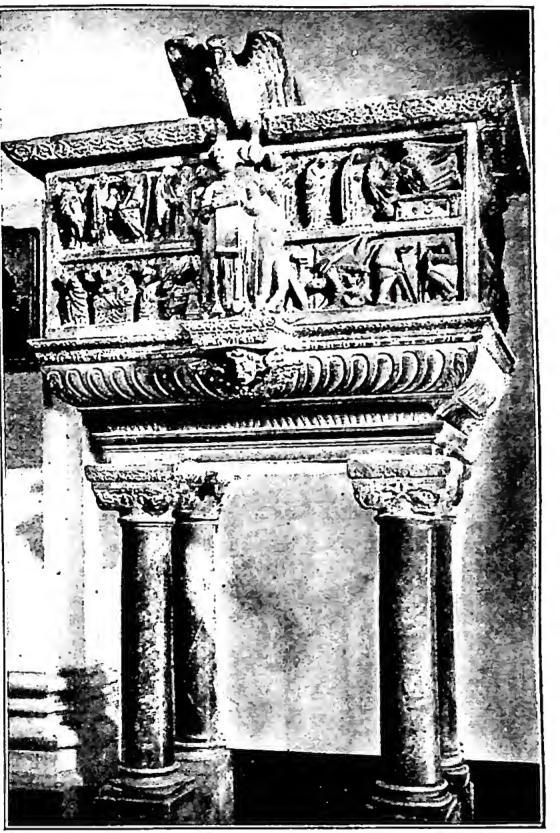
GUGLIELMO da PISA - Pulpito con storie della vita della Vergine (eseguito tra il 1159 e il 1162) - Cagliari, Cattedrale. (fot. Alinari)In the document approving his commentary on the Sentences, dated May 25, 1333, in Assisi, he is designated as minister provincie Aragonie. He likely completed his studies in Paris, as implied by the Explicit II l. Sent. fr. Francisci Rubi reportatus per fr. G. de Rubione, Parisias, in the manuscript formerly in the Library of the Twelve Apostles in Rome. Another reportation also indicates the time of his stay in Paris: Explicit reportatio IV l. Sent. sub mag. Franciscio de Marchia... facta per fr. G. de R. an. D. 1323 (cod. Chig. B. VII. 113; cod. 531 of the metropolitan church of Prague). It is assumed that he was among the immediate disciples of J. Duns Scotus, but certain proof cannot be adduced. His commentary on the Sentences, which alludes to other writings of his such as the Quodlibeta (now lost), was published in Paris in two volumes between 1517 and 1518.
BIBL.: C. Rubert, Fr. G. R., in Archivio Ibero-Americano, 30 (1928), pp. 5-32; 32 (1929), pp. 145-81; 33 (1930), pp. 5-42; 34 (1931), pp. 161-76, 321-40; L. M. Farré, La concepció immaculada de la Verge segons Fr. G. R., in Analecta sacra Tarraconensia, 7 (1931), pp. 95-138. Celestino Piana
Cite this article
“GUGLIELMO RUBIÓ (DE RUBIONE).” Enciclopedia Cattolica, vol. VI (1951), p. 753. Azione Romana digital edition, https://azioneromana.com/article/guglielmo-rubio-de-rubione.