
AEGEAN RELIGION. - The conventional name "Aegean" is given to the civilizations of the countries washed by the Aegean Sea (Greece, the islands, Anatolia) from the Neolithic to the end of the Bronze Age. But neither the civilization, although it presents points of contact, nor the religion can be considered as an organic whole; it is necessary to treat the various centers separately. The sources are scanty, represented solely by the results of excavations, easy to interpret in an arbitrary manner for lack of written controls. The numerous forgeries of statuettes and seals make dif-
offered in the cave of Amnisos (terracotta vases) around two stalactites surrounded by a wall, and they continue until the Roman age.
In the Early Minoan period the cave of Arkalochori begins (votive weapons): in Late Minoan III, after the cave of Amnisos had collapsed, the offerings were deposited outside. In the Middle Minoan period we have the caves of Skoteino (double axes and figurines), of Kamares (terracotta vases), which continues until the end of Late Minoan III, of Psychro (weapons, male and female figurines, animals), which goes on until the Geometric period, and various open-air cults, limited to the Middle Minoan period alone, at Zakro (male and female figurines, goats, cattle), at Petsofa and on Mount Juktas (the place of worship was enclosed by a wall; the offerings, figurines and parts of the human body, were thrown into the fire).
To Late Minoan I belongs the cave of Phaneromeni (male worshippers, knives, double axes), which reaches the Orientalizing age. From Late Minoan III are the cave of Patso and the open-air cult in the square of Haghia Triada, which lasted until the whole Geometric period with very varied offerings of figurines, weapons, horns of consecration, animals, etc. At Haghia Triada there were also an altar (?) and a sacrificial pit with ashes, charcoal and burnt bones of small animals. Less important in the Late Minoan period was the cult of Phaistos (figurines, animals, libation tables) a few metres above the ruins of the second palace. A votive deposit from the end of Late Minoan III comes from a covered spring near Knossos (vases and sphinxes). It is not known which deities were worshipped in the places listed. At Amnisos in the historical age Eileithyia was venerated; for Patso there has been talk, wrongly, of Hermes Cranios. Perhaps the cults of Petsofa and of Mount Juktas were directed to healing deities because among the offerings were reproductions of human limbs; those of Arkalochori, Psychro and Phaneromeni, where among the votive offerings weapons were numerous, to a warrior deity; those of Phaistos, Patso, Haghia Triada and Zakro to a rustic deity protecting animals and field work. For Kamares and Amnisos it makes difficult a judgment. The island of Crete alone has more abundant cultic data, but we cannot extend them to the whole Greek world. Of the cults of the island of Cyprus, which are outside the E. r. properly so called, although they present points of contact with the E. r., no mention is made here.
CRETA
Places of worship were caves, open-air sites whether or not enclosed by a wall, and small shrines: votive deposits more or less rich are connected with the open-air cults and the caves, whereas none have been found in connection with the cult rooms. The first [traces] go back to the Neolithic period an identification [is suggested by] finding only vases as offerings. At the spring of Knossos a water deity will have been venerated, which could also be the one depicted by a female figure with raised arms inside a small round urn, found in the votive deposit.
In the Middle Minoan period there are the first certain proofs of cult in palace rooms: in the first palace of Phaistos, there was a room destined for cult with three adjoining accessory rooms and a sacrificial pit.
Certain depictions of deities are found only at the end of the Middle Minoan period. The female figurines in the tombs of the Early Minoan period and the vases with a female protome, in which people have wanted to see images of the Minoan Mother Goddess, are only funerary offerings; even for two female statuettes with snakes from Knossos it is uncertain whether they are deities. From the end of the Middle Minoan period we find depicted on seals, gems and sealings a goddess mistress of animals between two lions, dogs or griffins, another with a pointed cap and spear also accompanied by a lion or a dog. Other seals show an identical scheme for a male deity: a god between two animals (griffins, dogs or lions), another with a pointed cap, spear, quadrangular shield, who is also accompanied by a lion or dog.
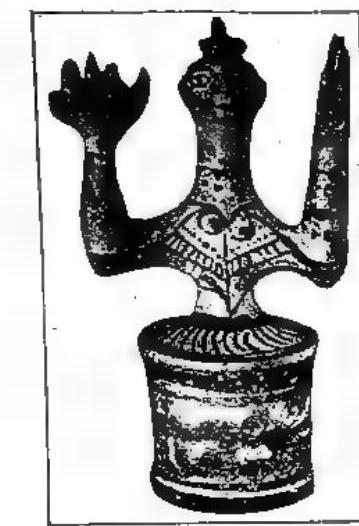
The god does not seem to have a position of inferiority with regard to the female deity, so one cannot speak of a paredros. Seals with supposed marine or warrior deities offer no certain elements. Cult statues are found only in the Late Minoan III period: they are female deities with raised arms, they have on their head a diadem with various emblems (birds, horns of consecration, poppies, etc.). Some have snakes in their hands. It is not known whether they depict one and the same deity with different attributes or various goddesses. The goddesses with snakes cannot be domestic deities, as was supposed, because they were found in sanctuaries separated from any dwelling. The female deities never appear nude: a figure scratched on a jug from Mallia, and a statuette from Haghia Triada will represent, if they really are goddesses, foreign concepts and cults.
There has been talk of the cult of the double axe, of the pillar, of the column, of the horns of consecration, of trees: only the cult of the latter seems proven by gems. Demons and monsters, hybrid fusions of man and animal, have secondary functions.
GREECE
No trace of cults until the beginning of the Minoan artistic influence, but then it is not easy to distinguish whether the cult scenes represent imported concepts or not. In a shaft grave of Mycenae there were two nude female figures with doves, perhaps goddesses; the type is foreign to Crete, but may have been imported from the East. A slab from Mycenae shows a female figure, almost entirely covered by a large bilobate shield, which could be a Greek warrior deity. In the Late Mycenaean period numerous female figurines have come out of tombs, houses and places of worship: those in the tombs will be funerary offerings, the others may be either goddesses or worshippers.
The places of worship are not earlier than the late Mycenaean period: at Klenies a cave with votive offerings has been found; at Haghia Triada in the Argolid there was a cult at the aporto with a votive mige; at Delphi beneath the temple of Apollo there were cenari with remains of sacrifices, beneath that of Athena Pronaia, a leera with an altar and female figurines. There are also rooms intended for worship in the palace of Mycenae and at Becheti. At Asine a room of a house had a stone bench that supported vases and statuettes; it recalls those of the Cretan shrine-rooms, but the deity worshipped is male (contrary to the Cretan ones) and attempts have been made to identify him - but without proof - as Zeus or Poseidon. In the courtyard of Tiryns there was an altar. Beneath numerous Greek sanctuaries Mycenaean structures have been found (Eleusis, Athens, Argos, Delos, etc.); but no certain trace of cult.
AEGEAN ISLANDS
Although various divinities and places of worship are traced back to the pre-Hellenic age, no traces of cults earlier than the Greek era have been found. In the marble figurines from the tombs of the Cyclades, some have sought to recognize a fertility goddess, but the hypothesis is much debated.
Bibliography10 works
Luisa Banti