PAPINI TARTAGNI, NICCOLÒ

Image from page 501
Image from page 501

PAPINI TARTAGNI, Niccolò. – Franciscan historian, born at S. Giovanni Valdarno in December 1751, died at Terni on 16 December 1834. He entered the Order at a very young age and was first a professor of philosophy, theology and rhetoric in his native Tuscany and
PAPINI TARTAGNI NICCOLÒ – PAPYRUS

784

languages (v. PAPIROLOGY); the particular dryness of the soil in some regions of the ancient world (and especially in Egypt, and also at Dura Europos on the right bank of the Euphrates) favoured the preservation of p. documents, which now, in so many surviving examples, can admirably serve to document the material and spiritual life of antiquity in the most diverse spheres.

With regard to Christianity, the surviving p. (Greek, Latin and Coptic) refer to texts by authors (biblical, liturgical, patristic), to documents concerning the functioning of Christian churches and monasteries in Egypt (correspondence, accounts, denunciations, petitions, etc.), and to various manifestations of Christian life (private letters, amulets, etc.).

The biblical texts are very numerous, whether they refer to the Old Testament (in the Septuagint version) or to the New. The Greek Old Testament is represented by almost 150 p. and ostraca, almost all from the 3rd and 4th centuries AD; an important p. of Deuteronomy from the Ptolemaic age of the 3rd century BC is noteworthy (P. Ryl., III, 458); the Old Testament book most widely represented is the Psalms, with more than 60 p., especially from the 4th and 5th centuries; they contain fragments of more than half of the Psalms, and more frequently of those at the beginning of the traditional series. Next in frequency is the book of Genesis with about twenty p., including a fragment of a Latin translation and a commentary by Origen on Genesis itself; among the prophets, Isaiah seems to be the best known. The interest of all these biblical p. lies in the fact that they are useful in countless questions concerning the manuscript tradition of the books and their various philological and exegetical problems. A surviving text from the 3rd century AD (P. Oxy., XVII, 207) contains a Christian treatise in polemic with the Old Testament, in the manner of Justin’s Dialogue with Trypho the Jew.

The p. of the four canonical Gospels are also numerous; Matthew has more than a dozen fragments from the 3rd to the 7th-8th centuries; and these are textually closer to the Sinaitic and Vatican codices than to the Syriac; Mark has only four, from the 4th to the 6th centuries; Luke has about a dozen from the 4th to the 6th centuries; but the representation of the Fourth Gospel is especially frequent with more than 15 fragments, and, what is very noteworthy, with a fragment already from the beginning of the 2nd century AD (v. RYLAND), which helps to bring the composition ever closer to the end of the 1st century, something which many, before the discovery of the p., seemed unwilling to accept (cf. C. H. Roberts, An unpublished fragment of the IV. Gospel, Manchester 1935 [P. Ryl., III, 457]); others of these manuscripts are from the 3rd century; the most recent is from the 7th century; Papyrus Egerton 3 may also contain a fragment of a commentary on the Gospels. More than ten p. of the Acts of the Apostles survive, from the 3rd to the 6th centuries; it is interesting to note that among them is the “Western” text of the Acts. Of the letters of St Paul, the most represented are those to the Romans and then that to the Hebrews, sometimes in important copies from the 3rd century; then especially those of St James; those of St Peter and St John are also sometimes represented; the Apocalypse has as many as six p. from the 3rd to the 7th centuries, with the commentary of Oecumenius in a Michigan papyrus (H. Ch. Hoskier, The complete Commentary of Oecumenius on the Apocalypse, Ann Arbor 1928).

A series of apocryphal Gospels is also represented in the p.; one of the most notable is the so-called Egerton papyrus (v.), another is the Proto-Gospel of James, surviving to a considerable extent in a 4th-century p.; there is also a Gospel of Mary in the Ryland papyri of the 3rd century, and perhaps a Gospel of the Egyptians; some Logia of Jesus, which are read in the Oxyrhynchus papyri (v. OXYRHYNCHUS), are also found in the p.

There are also Acts of John, Acts of Peter and especially the Acts of Paul, preserved among other things in an important manuscript of the year 300 AD (Πράξεις Παύλου, ed. Schubart and Schmidt, Glückstadt-Hamburg 1936) and in other p.

The p. also preserve hymns, prayers and various liturgies: hymns to the Saviour, to the Virgin, to the Trinity, to the martyrs; one consisting of a cento of Psalms, discovered among the Berlin papyri of the 7th-8th centuries (Berl. Klass. Texte, 8, xvi);

Article illustration
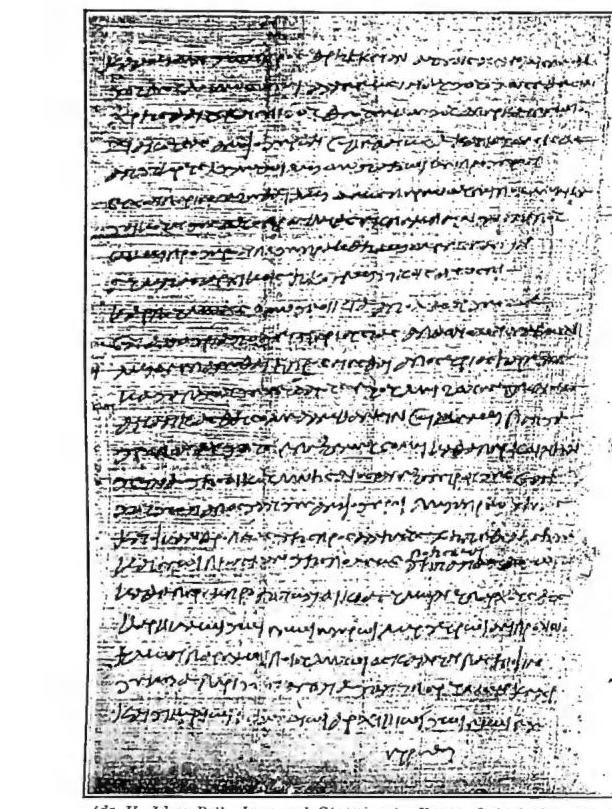
(d) H. Idris Bell, Jews and Christians in Egypt, Oxford 1924, pl. II. Papyrus – Part of the letter of Claudius to the Alexandrians (41 AD). London, British Museum, Greek papyri, Papyrus 1912.

another, very notable, contains the oldest known fragment of Christian music to date (P. Oxy., XV, 1786; cf. G. B. Pighi, Ricerche sulla notazione ritmica greca. L'anno cristiano del P. Oxy. 1786, in Aegyptus, 21 [1941], pp. 189 ff.). There are more than twenty liturgical texts, and among them one is written in Latin (P. Ryl., III, 472) and belongs to the 3rd-4th centuries; another, which sets out the liturgy of Christmas, is found among the Berlin papyri and belongs to the 7th century (Berl. Klass. Texte, 6, VII, 2); an acclamation much used in the Byzantine liturgy was recognised in a Florentine papyrus (cf. A. S. Mercati, Frammenti della acclamazione in un papiro fiorentino, in Aegyptus, 20 [1940], pp. 212 ff.). For liturgical texts, cf. C. Del Grande, Liturgiae, preces, hymni Christianorum e papyris collecti, Naples 1938. Amulets on p., with verses from the Gospel and other canonical texts, sometimes mixed with pagan invocations, have also survived in the material so far brought to light.

A certain number of p., not frequent otherwise, contain passages from Christian orations and homilies from the 3rd to the 6th centuries: about twenty have been traced (cf. G. Ausenda, Contributo allo studio dell'omiletica cristiana nei papiri greci dell'Egitto, in Aegyptus, 20 [1940], pp. 43 ff.): among them are Origen and Chrysostom.

Article illustration

Sacred writers are also represented in the surviving p. material: Athanasius, Cyril, the Apology of Aristides, Eusebius of Caesarea, Gregory Nazianzen, Irenaeus, the Didache and especially the Shepherd of Hermas, which is preserved in about a dozen p. from the 2nd to the 6th centuries and thus demonstrates that it was widely read in Egypt (cf. L. Alfonsi, Ermia, Brescia 1947). Some p. contain Acts of Martyrs: Abraham, Nabrahe, Julian of Anazarba, Paphunius the anchorite, St Christina and perhaps others.

Another category of p. that are of interest for the life of the Church are the texts of the Nicene Creed (P. Ryl., I, 6 is the oldest) and of the Constantinopolitan Creed; the fragment of a festal letter of 577 directed by a trierarch of Alexandria to the Church of Egypt (P. Grenf, II, 112) and a very extensive Easter letter of another Alexandrian patriarch, in the Berlin papyri (Berl. Klass. Texte, 6, VI, 3): there is also a surviving ecclesiastical calendar of 535-536 (Oxy., XI, 1357; cf. H. Delehaye, in Anal. Boland., [1924], pp. 83-99).

The series of almost a hundred libelli of the so-called persecution of Decius in 250 brings us more directly into contact with the time and manner of the struggles against the nascent Church (v. A. Bludau, Die ägyptischen Libelli und die Christenverfolgung des Kaiser Decius, in Röm. Quartalschrift. Suppl., 27 [1931]).

Numerous administrative documents concern the Egyptian Church and the monasteries of every century, and these have been largely studied (v. P. Barison, Ricerche sui monasteri dell'Egitto bizantino e arabo, in Aegyptus, 18 [1938], pp. 20-148; L. Antonini, Le chiese cristiane in Egitto dal IV al IX secolo secondo i documenti dei papiri greci, ibid., [1940], pp. 129-208). The Christian letters found in papyri have also been collected and studied, and the subject would merit renewed attention (v. G. Ghedini, Lettere cristiane da p. greci del sec. III e IV, Milano 1923).

Bibl.: K. Wessely, Les plus anciens monuments du Christianisme écrits sur papyrus: PO 4, 95-210; 18, 345-308. A list, with bibliography of Christian scriptural and liturgical papyri up to the 6th century, is being prepared under the direction of Prof. Peremans by Rev. Marien at the University of Louvain. U. Wilcken, Heidnisches und christliches aus Ägypten, in Arch. f. Papyrusforschungen, 1 (1901), pp. 306-436; P. D. Scott Moncrieff, Paganism and Christianity in Egypt, Cambridge 1913; A. Heckel, Die Kirche von Ägypten, Strasbourg 1918; A. Deissmann, Licht vom Osten, 4th ed., Tübingen 1923; G. Baudry, Le vie chrétienne au IIIe et IVe siècle d'après les papyrus, in Rev. apolog., 41 (1926), pp. 643-511, 707-211; G. Ghedini, I risultati della papirologia per la storia della Chiesa, in München. Beiträge, 19 (1934), p. 264 ff.; De Lacy O'Leary, The Saints of Egypt, London 1937. Aristide Calderini.