Machine translation of the 1948–1954 Italian original. The original text is authoritative.
RETABLO. – The interpretation given here of the term, which belongs to the Spanish language, is confined to the meaning it assumes in the fields of architecture and archaeology and refers to the decoration of altars.
Etymologically, r. derives from the Latin retro tabula and thus refers to what is behind the mensa. In the Spanish language, the term also denotes the oldest portable painted images that were placed on altars. Today, in the usual sense, r. means a large architectural complex made of marble, stucco, metal, or wood, decorated with figures and sculptures, immovable by its intended purpose, which covers the wall or conceals the space behind the altar. R. are found in Italy and in the other European regions and almost always assume the charac-
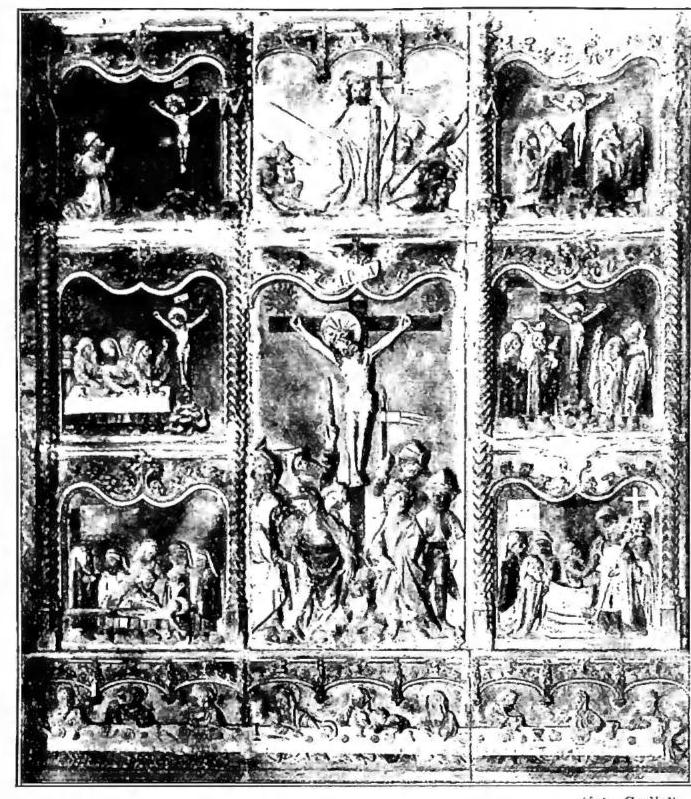
(photo Gudiol) RETABLO - R. of the church of Gesù (beginning of the 15th century) - Iviza.teristic of particularly extensive polyptychs, but the Iberian Peninsula is the land where the r. is most widespread, being one of the characteristic features of its places of worship. Some echo the architectural motifs of the settings in which they are located, while others appear independent of them. Among those in carved stone, one may recall that of S. Nicola da Bari in Burgos, that of the chapel of Los Sartres in the cathedral of Tarragona, and the sixteenth-century one in the chapel to the right of the presbytery in the cathedral of Coimbra. Those in silver are very numerous, and the oldest date from the 15th century; the same is true of those carved in wood and of the painted ones. But almost always the essential character of the r. derives from the multiplicity of techniques that combine to create a complex of great richness and striking effect, intended to frame a sacred image or composition or, as occurs in the Aragonese churches, to house a kind of display case in which the Blessed Sacrament is exhibited among glass panels, lamps, and symbolic images. - Vedi tav. XLIII.
BIBL.: anon., s. V. ENOCH. Eur. Am., 50 (1923), pp. 1367-72.
Emilio Lavagnino
Cite this article
“RETABLO.” Enciclopedia Cattolica, vol. X (1953), p. 481. Azione Romana digital edition, https://azioneromana.com/article/retablo.