Machine translation of the 1948–1954 Italian original. The original text is authoritative.
ROOSEVELT, FRANKLIN DELANO. — President of the United States of America, born on 30 January 1882 at Hyde Park (New York), died on 12 April 1945 at Warm Springs (Georgia). He began his political career in 1910, as the Democratic candidate for the New York State Senate, although at the time this was considered political suicide, because for no fewer than 32 years the Republicans had held the district that R. wished to win. Thanks to his promise to support legislation that would protect farmers from wholesale merchants, he was elected on 8 November 1910, with 15,708 votes against the 14,568 received by the Republican Schlosser.
In 1912 he supported the nomination of W. Wilson as the Democratic presidential candidate, and when the latter became president, he entrusted him with the undersecretaryship of the Navy, which R.
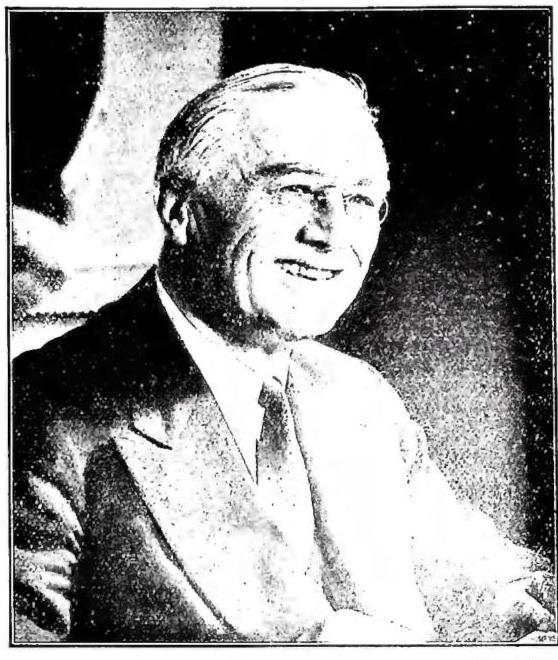
(phot. Usin) ROOSEVELT, FRANKLIN DELANO - Portrait.He retained it until 1920. In that year the Democratic Party acclaimed R. as candidate for the vice-presidency, but the resounding victory of the Republicans removed him from all political activity. In August 1921 R. was stricken with poliomyelitis and never completely recovered. Governor of the State of New York in 1928, he was elected president in 1932 and assumed the highest office the following March, with a resounding majority in 42 of the 48 states.
After the crisis of the American economic system during the Hoover administration, R. set out to implement a new policy, the New Deal, with highly social aims. He opposed the principle of cooperation to individualism and in fact sought, during the twelve years in which he held power (for he was also victorious in the elections of 1936, 1940, and 1944), to achieve an economic balance that would guarantee all citizens of the United States a sufficient standard of living and the means to enjoy the fundamental rights secured by the Constitution. The New Deal, while constituting a decisive stand against profiteers from human labor, against monopolists, and against all those who in any way exploited the efforts of others, helped to eliminate unemployment to a considerable extent, to raise the standard of living of the working classes, to ensure highly advanced social legislation, and to promote the regulated development of natural resources. The financial market was regulated and the way was opened for grandiose public works (most notably the reclamation and irrigation of the Tennessee River basin, with the establishment of the « Tennessee Valley Authority »); agriculture was protected against various forms of speculation; the tax system was improved, with particular attention to direct taxation; and protectionist policy was abandoned in order to allow a more intense flow of commercial exchange with the rest of the world.
R.’s foreign policy, one of « good neighborliness » and the intensification of friendly relations with all states prepared to respect the other members of the international community and to honor their obligations, assumed, following Hitlerite aggressions, a line of conduct decidedly opposed to totalitarian regimes and
(from P. de Nolhac, R. et l'humanisme, Paris 1921, p. 256)favorable to the democratic powers, which, until the United States entered the war (December 1941), benefited from American aid (Lend-Lease Act, March 1941) and thereafter from the direct contribution of the economic and military potential of the U.S.A. Opposed in principle to war (as early as 1920, during the campaign in which he was a candidate for the vice-presidency, he argued for the necessity of the Senate’s ratification of the Treaty of Versailles and the Covenant of the League of Nations), which constituted an obstacle to the constant perfecting of his New Deal, R. addressed himself on 23 December 1939 to the heads of the various religious confessions, proposing that political and religious forces work for the triumph of peace and for a sustained effort to provide spiritual and material comfort to the victims of war. This initiated a correspondence between R. and Pius XII, which continued until the President’s death, and the dispatch of his personal representative to the Holy See « to coordinate and develop common initiatives for the return of peace and the alleviation of suffering ». The myth of universal peace, alive in R.’s mind, prevented him from discerning, beyond ideological constructions, the reality of the facts, as demonstrated by the text of the Atlantic Charter and the decisions of the Yalta Conference.
BIBL.: sources: F. D. R., The public papers and addresses 1928-29, 13 vols., New York 1938-50; The R. letters being the personal correspondence of F. D. R. 1887-1945, 3 vols., London 1949-51; La corrispondenza fra il presidente R. e papa Pio XII durante la guerra, introduction and notes by My. C. Taylor, Milan 1948. From a biographical point of view, in the absence of a comprehensive and objective work, cf. R. E. Sherwood, R. and Hopkins, New York 1948, Italian translation Milan 1949, and J. Gunther, R. in retrospect., London 1950 (anecdotal in character). On the candidacies and the outcome of the elections cf.: S. Lorant, The presidency. A pictorial history of presidential elections from Washington to Truman, New York 1951, especially pp. 577-673. On the New Deal v.: E. Fossetti, New Deal. Il nuovo ordine economico di F. D. R., Padua 1937; M. Pierro, L'esperimento R. e il movimento sociale negli Stati Uniti d'America, Milan 1937. On foreign policy: T. A. Bailey, A diplomatic history of the American people, 4th ed., New York 1940, p. 732 ff. (with bibliography); S. F. Bemis, A diplomatic history of the United States, 3rd ed., ibid. 1950, pp. 830-99. On the Yalta Conference: E. R. Stettinius jun., R. and the Russians, London 1950. Silvio Furlani
Cite this article
“ROOSEVELT, FRANKLIN DELANO.” Enciclopedia Cattolica, vol. X (1953), p. 796. Azione Romana digital edition, https://azioneromana.com/article/roosevelt-franklin-delano.