
SYRIA. -
I. GEOGRAPHY
A historical region and (since 1946) an independent state of the Near East, bordering Turkey, 'Irāq, Transjordan, Israel, and Lebanon.Its territory (187,000 km²), extending from the Levantine Sea to Upper Mesopotamia (Tigris) and from the Taurus to Jabal al-Druze, encompasses a vast desert or semi-desert sector to the east and a far more varied and resource-rich area to the west. Here, between the inland reliefs (Golan, Hermon, Anti-Lebanon) and the coast—also dominated by high plateaus—lies the depressed corridor through which the Orontes (Nahr el-'Āṣi) and the Litani (Nahr el-Litānī) flow in opposite directions. Except for the highest elevations and the sublittoral zone, the country suffers from water scarcity (the Mediterranean-type climate exacerbates this condition inland): its economic potential is thus contingent upon solving the irrigation problem, given that even pastoralism lacks adequate grazing land, and significant mineral resources are absent.
Cultivation occupies barely one-eighth of the territorial surface and essentially meets domestic needs (cereals, legumes, vines, olive, sesame, cotton); tobacco and fruit trees (apricot) hold some importance. Livestock rearing is dominated by sheep and goats (cattle are scarce). Far more notable is sericulture, whose product sustains a substantial and traditional craft industry; skilled artisans also work cotton, artificial silk, and leather. Though expanding, industries remain limited to processing local raw materials; the two largest cities are simultaneously the country’s most active manufacturing centers.
The population, almost entirely concentrated in the southwest, is highly heterogeneous both ethnically (significant minorities of Arabs, Turks, Armenians, Persians, Europeans, etc.) and religiously. Numerous large centers exist, many with ancient traditions and serving as major cultural hubs; only Homs exceeds 100,000 inhabitants. Syria lacks an adequate port (Latakia and Tartus are merely fishing centers); most of its maritime trade passes through Beirut (Lebanon).
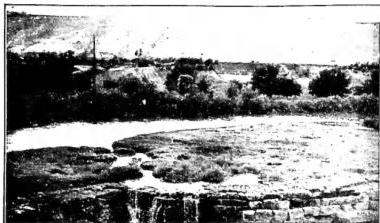
(Courtesy of Soc. F. Vattioni)
SIRIA - Antica diga dell'Oronte, presso Hamat.
II. SYRIA IN THE BIBLE
Both in Greek and Latin, the name was sometimes used to translate Aram (v.), in general and with the specifications "of Damascus," "of Soba," etc.: Σορία Δαμασκού: II Sam. 8:5; Σ. Σουβά: II Sam. 10:8; Σ. Μοογά: I Par. 19:6, etc.; Syria: Hos. 12:12 (Heb. 13); Mesopotamia Syriae: Deut. 23:5 (Aram Nahārajim); etc.
In the Jewish era (I-II Macc.), Syria is the principal part and the kingdom (v.), with Antioch as its capital. However, in a geographical sense, the name had a more restricted usage. The Seleucid kingdom extended from the Taurus mountain range and the region where the Ḥabūr River flows into the Euphrates in the north to Egypt. Geographically, however, Phoenicia (II Macc. 10:11) and Palestine or Judea, along with other minor regions, were distinguished. The political sense of the name appears in the designation of the Seleucids as "kings of Syria," in contrast to the Ptolemies of Egypt and certain "kings of Damascus" (the Aretas), etc.
In the time of the New Testament, Syria is the Roman administrative district of the Syria provincia, which seems to have essentially comprised the former territories of the Seleucids, thus including Palestine as well (there are no well-founded reasons for doubt). It was governed by a praeses (ἡγεμίαν: Lk. 2:2, Volg. praeses) who resided in Antioch but acted through representatives in various centers, including local rulers, whom the Romans often left in place or installed with various titles. Thus, already after the conquest (63 B.C.), Pompey left Hyrcanus in Jerusalem as high priest and ethnarch (almost a "leader of the people"). In the event of revolts and disturbances in Jerusalem, the governor of Antioch regularly intervened, as Quintilius Varus did after the death of Herod. In this broad sense, of the Syro-Phoenician region, the term Syria is used in the New Testament (Mt. 4:24; Act. 15:23, 41; 18:18; 20:3; 21:3; Gal. 1:21). Subsequent expansions of the province reflect the transition to direct Roman administration of territories that had enjoyed local governance: thus, in 34 A.D., the tetrarchy of Philip, comprising territories beyond the Jordan, which shortly thereafter were assigned to Antipas but remained under the supervision of the governor of Syria (v. LEGATO; for Judea, V. PROCURA).
III. MUSLIM SYRIA
The history of Muslim Syria begins with the Arab invasion (634) and continues to the present day. Until 877, it is characterized by Syria's status as a province within the Islamic caliphate. From 877 to 1516, various dynasties, mostly originating from and ruling in Egypt, succeeded one another in Syria with more or less extensive dominion. This period also saw the long interlude of the Crusades (1097-1291). From 1516 to 1920, Syria was under the Ottoman Empire. From 1920 onward, through the French protectorate, the successive phases of Syrian independence unfolded, culminating in 1946.The history of Syria is highly fragmented. There is no strong national unity; rather, it is the history of individual regions and cities. One must therefore consider, on the one hand, the entries related to regions (v. LIBANO, etc) and principal cities (v. ALEPPO; DAMASCO, etc), and on the other, the entries ISLĀM, for the period under the caliphate; EGITTO, for the dynasties originating from there; TURCHIA, for the period of Ottoman occupation.
It should be noted that the chronological indications regarding individual dynasties pertain only to their period of rule in Syria.
1. The Conquest (634-40). - The main phases of the Arab conquest in Syria (and simultaneously in Palestine [v.]) are: the victories at Aḡnāḏajn (634) and Fihl (Pella, 635); the capture of Damascus (635); the decisive battle of the Yarmūk River (636); the conquest of Jerusalem (638) and Caesarea (640).
Arab administration, in Syria as elsewhere (v. ISLĀM, L'espansione storica), initially retained the character of a military occupation. Syria was divided into fund, military districts: Damascus, Hims, Palestine, Jordan; the caliph Jasīd I later added Qinnasrin. The subject population was subjected to tribute, both land (barāḏ) and personal (ḡizjah). Converts to Islam (manvālī) were exempted from the ḡizjah and attached as clients to Arab tribes.
2. Syria under the Caliphate (640-877; 905-35). - With the advent of the Umayyad dynasty (661-750), Syria became the center of the caliphate. The capital was moved to Damascus and remained there, though the last Umayyad caliphs rarely resided there, until Marwān II (744-50), who transferred it to Ḥarrān in Mesopotamia: a not insignificant cause of the dynasty's fall. The foundation of Umayyad power was the army, composed of Arab tribes already present in Syria before the conquest, united with the conquerors. However, internal struggles among these tribes (divided into Qāṣites and Yamānites) undermined the state's stability. The gradual disappearance of military camps led to a parallel ethnic and linguistic Arabization; the latter was furthered by the introduction of Arabic in administration from the time of ʿAbd al-Malik (685-705) and the partial removal of indigenous elements from administrative positions. Islamization was limited, with relatively few manvālī: this attests to the tolerance generally enjoyed by non-Muslim subjects.
The Abbasids, who came to power in 750, moved the capital to Baghdad. Syria remained a mere province. Control of the state was taken from the Syrians. They repeatedly attempted revolts, but persistent tribal discord rendered them futile. Fiscal pressure was intensified, as was religious pressure, culminating in the discriminatory measures of al-Mutawakkil (847-61).
3. Autonomous Dynasties until the Seljuq Invasion (877-905; 935-1076). - The Tulunids ruled Syria from 877 to 905; the Ikhshidids from 939 to 969. Both dynasties were Turkish. The Abbasid caliph of Baghdad opposed the Ikhshidids with the Hamdanids, who from Mesopotamia advanced into northern Syria and dominated it, with Aleppo as their center, from 944 to 1003; the greatest Hamdanid ruler was Ṣajf ad-dawlah, at whose court the poet al-Mutanabbī lived. In the north, the Hamdanids faced the Byzantines, who, having occupied Antioch (668), advanced to ʿArqah. In the south, the Fatimids, having taken Egypt in 969, simultaneously expanded into Syria, supplanting the Ikhshidids and later the Hamdanids. Through the exploitation of their governors, the Fatimids weakened the country's resources; Shiite propaganda developed, manifesting in extremist movements such as the Druze, Nuṣayris, and Mutawalis (v. sette*). In the 11th century, the Fatimids declined: in Aleppo, the Mirdasid dynasty (1023-79) established itself; it was then occupied by the ʿUqaylids of Mesopotamia from 1079 to 1085. Fatimid rule in Syria can be considered ended with the Seljuq capture of Damascus (1076).
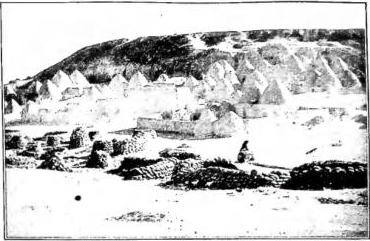
(courtesy of F. Vattioni)
SYRIA - Indigenous village near Aleppo.
4. The Seljuks and the Atābegs
The Seljuks (v. TURCHIA), having conquered Syria, remained there with a branch of the family until 1117. The formation of dynasties of atābegs, their officers, common to all parts of the Empire, also occurred in Syria: in Damascus, the Būrids ruled (1103-54); in Aleppo, and later also in Damascus, the Zangids (1128-81), who with Nūr ad-dīn restored an era of prosperity.Meanwhile, Crusades (v.) had begun. The Christians conquered Antioch in 1098, Jerusalem in 1099, and Tyre in 1124. Their occupation extended along the Syrian coast and part of the interior, though they did not reach the great cities: Aleppo, Ḥamāh, Ḥimṣ, Baʿalbek, Damascus. With Nūr ad-dīn, the Muslim resurgence began.
5. The Ayyubids (1174-1260)
The Ayyubid Ṣalāḥ ad-dīn (Saladin), who had replaced the Fatimids in Egypt in 1171, undertook the conquest of Syria upon the death of Nūr ad-dīn, completing it between 1174 and 1183. He then turned against the Crusaders and defeated them at Ḥaṭṭīn in 1187, reconquering Jerusalem and pushing them back to the fortified coastal cities. Here, the Crusaders made some gains with the Third Crusade, which secured Acre and the coastal strip from Tyre to Jaffa. After Saladin’s death (1193), al-Malik al-Kāmil ceded Jerusalem to Frederick II by treaty (1229). However, the city was definitively retaken in 1244. The Ayyubid dynasty was supplanted in Egypt by the Mamluks in 1250. Of its secondary branches, the most important in Syria—Damascus and Aleppo—ended in 1260; Ḥimṣ in 1262; the branch of Ḥamāh lasted until 1341, but under Mamluk authority.6. The Mamluks (1260-1516)
The Mamluks crushed the Mongol invasion in Syria with the victories of ʿAyn Jālūt (1260) and Marj aṣ-Ṣuffār (1303). They continued the struggle against the Crusaders, ultimately expelling them (1291, capture of ʿAthlīth). In 1401, Tīmūr Lang (Tamerlane) invaded Syria, sacking Aleppo and Damascus before withdrawing. Administratively, the Mamluks divided the region into six districts (niyābah): Damascus, Aleppo, Ḥamāh, Tripoli, Ṣafad, and Kerak. The governors (nāʿib), among whom the one in Damascus predominated, were frequently replaced to prevent them from becoming autonomous. Their economic exploitation depressed Syria, whose commercial activity had already suffered a severe blow with the end of the Crusades. Among the internal upheavals of this period, the one in Lebanon, linked to extremist Shia movements (1293-1305), stands out. Mamluk rule in Syria ended in 1516, when Selim I annexed the region to the Ottoman Empire after the victory at Marj Dābiq.7. Syria under the Ottoman Empire (1516-1920)
Syria was administratively divided into the pāshāliq of Aleppo, Tripoli, Damascus, and later Ṣajdā. Like the Mamluk nāʿib, the pāshā, frequently rotated, engaged in the economic exploitation of the country, causing further decline. Their authority did not extend beyond the major cities and their surroundings: the countryside and mountains remained under local emirs. In particular, Lebanon (v.) was semi-autonomous, inhabited by heterodox Muslim communities (Druze, Nuṣayrī, Mutawālī) alongside Christian groups (Melkites, Jacobites, Maronites). The emir Fakhr ad-dīn (Faccardino, 1585-1635), of the Banū Maʿn dynasty, rebelled against the Ottomans, achieving temporary independence and establishing relations with some European states. Another center of rebellion was later Acre: the local lord az-Zāhir maintained autonomy from the Porte from 1750 to 1775; his successor, Jazzār (1775-1804), also held great power there, successfully resisting Napoleon’s attack (1799).The support of the Lebanese emir Bashīr, of the Shihāb dynasty succeeding the Maʿn, facilitated the Egyptian conquest of Syria in 1831. Only in 1840, under pressure from European powers, did Muḥammad ʿAlī’s troops withdraw, and Ottoman authority was restored.
In 1860, Lebanon was the center of new unrest: the massacres of Maronites by the Druze provoked French intervention. The region was granted administrative autonomy and received a Catholic governor, whose appointment had to be approved by the European powers.
The years preceding World War I saw, in response to the intensifying oppression of the Turks and their indifference to the country’s economic progress, a nationalist awakening in Syria and a rapprochement between Christians and Muslims against the common enemy. France contributed with its capital to the construction of railways and the opening of schools. There was a notable flourishing of culture, placing Syria, alongside Egypt, at the forefront of Muslim countries. The work of the Jesuits was effective here, founding the Université Saint-Joseph in Beirut in 1875, a center of the cultural movement.
At the outbreak of World War I (1914), the Turks suppressed Lebanese autonomy. Through Syria, they twice attempted (1915 and 1916) to invade Egypt. The Allied counteroffensive routed them. The British occupied Damascus in 1918; the French established themselves on the coast. The armistice was signed that same year. Two years later, Emir Faṣṣal proclaimed himself king in Damascus, but the French, to whom control of the region had been assigned by the Sykes-Picot Agreement (1916), forced him to flee. On August 10, 1920, the Treaty of Sèvres sanctioned Syria’s separation from the Ottoman Empire and foreshadowed the mandate regime.
8. Contemporary Syria (from 1920 onward)
The mandate was entrusted to France (1922). Syria was divided into four autonomous states (1925): Syria proper; the State of the ʿAlawites (new name for the Nuṣayrī) or of Lāḍiqiyya; the Jabal Druze; and Greater Lebanon.Despite French policies aimed at the country’s economic and cultural progress, the nationalist movement continued to agitate for independence. A revolt was suppressed in 1925-26. In 1936, a Franco-Syrian Treaty recognized Syria’s and Lebanon’s independence within three years; that same year, the States of the ʿAlawites and the Jabal Druze were annexed to Syria. France’s failure to ratify the Treaty provoked strong unrest.
With the outbreak of World War II (1939) and the fall of France, the French troops in Syria sided with the Vichy government. Defeated by the British and the Free French (1941), the latter replaced them. General Catroux proclaimed the independence of Syria and Lebanon that same year, subject to the limitations imposed by the state of war. The persistence of these limitations, exacerbated by French repressive policies, led to a violent revolt in 1945. British intervention forced the French to withdraw definitively in 1946.
The early years of independent Syria were marked by great political instability. Internal party conflicts and the struggle for influence among foreign powers were reflected in a series of government changes and coups. The last of these brought the military movement led by Adib el-Shishakli to power (November 29, 1951); the leaders of the "People’s Party," who had previously directed Syrian politics, were imprisoned; subsequently, the Chamber was dissolved, and all political parties were abolished.
BIBL.:
For the Seljuk and Atābeg periods: C. Cahen, La Syrie du Nord à l'époque des Croisades et la principauté franque d'Antioche, Paris 1940; R. Grousset, Histoire des Croisades et du royaume franc de Jérusalem, 3 voll., Paris 1934-36.
For the Ayyubid period: R. Grousset, Histoire des Croisades, cit.; H. A. R. Gibb, The Aiyūbids, in The Cambridge History of Islam, II, Cambridge 1970.
For the Mamluk period: G. Wiet, L'Égypte arabe de la conquête arabe à la conquête ottomane, Paris 1937; D. Ayalon, Gunpowder and Firearms in the Mamluk Kingdom, London 1956.
For the Ottoman period: A. H. Hourani, Arabic Thought in the Liberal Age, London 1962; P. K. Hitti, History of Syria, London 1951.
For the contemporary period: S. H. Longrigg, Syria and Lebanon under French Mandate, London 1958; P. Seale, The Struggle for Syria, London 1965.
F. GABRIELI
IV. PRESENT SITUATION OF CATHOLICS
The territory of present-day Syria forms part of the ancient Patriarchate of Antioch (v.). From the 5th century onwards, Monophysitism also flourished there, Jacobites (v.) was established.According to a government statistic dated 17 July 1952, the Syrian population is divided as follows: Catholics 114,086 (of whom: Melkites 51,493, Syrians 18,127, Armenians 18,010, Chaldeans 5,116, Maronites 15,112, Latins 6,228); dissidents 319,289 (of whom: Greeks 156,886, Jacobites 44,971, Gregorians 107,251, Nestorians 10,181); Protestants 12,671. Christians total 446,046, compared to 2,644,991 Muslims.
The Catholic hierarchy is present in Syria with the following ecclesiastical circumscriptions: for the Melkites: the patriarchal diocese of Damascus, metropolitan sees of Aleppo, of Bostra and Hauran, the archiepiscopal see of Homs for the Syrians; metropolitan sees of Damascus and Homs, the patriarchal vicariate of Upper Jazira; for the Armenians: the archiepiscopal see of Aleppo, the patriarchal vicariate of Upper Jazira; for the Chaldeans: the apostolic administration of Syria (and Lebanon); for the Maronites: the episcopal sees of Aleppo and Damascus; for the Latins: the apostolic vicariate of Aleppo. It should be noted, however, that since the political borders between Syria and Lebanon were only recently established, some circumscriptions whose centers are in Syria also extend into Lebanon and vice versa.
Among Syrian cities, Aleppo has the largest Christian population: all Catholic and dissident rites are represented there, and many educational and welfare institutions flourish. Aleppo’s Christians make up 40-50% of the population, though this percentage is declining due to the emigration of many Armenians and the economic influx toward the coast. Damascus, by contrast, is the moral capital of Syrian Christians, as it is home to the dissident patriarchs and the Melkite (Catholic) patriarch: demographically, however, the Christians of the capital represent barely 50% of the population. Latakia also has a predominantly Christian presence, as in its region—formerly called the "Alawite State"—Christians, mostly dissident Greeks, account for about 25% of the population. Homs, the ancient Emesa, is the seat of the Jacobite patriarchate. However, a very flourishing Melkite community also exists there. The Hauran region presents itself as a mission field: Upper Jazira has welcomed numerous groups of Assyrian refugees.
From 1762 to 1947, the Holy See was represented in Syria by an apostolic delegate, who was also the apostolic vicar of Aleppo for the Latins. After Lebanon’s separation from Syria, while a nuncio was sent to Beirut, the Holy See was represented in Syria from 1951 by a chargé d’affaires (for the apostolic delegation) residing in Damascus. Recently, regular diplomatic relations were established: the Holy See is represented by an apostolic internuncio, and Syria has accredited a minister plenipotentiary to the Vatican (cf. L'Osservatore Romano, 22 February 1953).
In addition to the religious Orders and congregations of the various Eastern rites, many Latin-rite Orders and congregations, both male and female, carry out their apostolate in Syria through schools and welfare institutions, which also benefit dissidents, Jews, and Muslims.
Article 28 addresses schools and education: it contains positive elements insofar as it affirms and sanctions the principle of the coexistence of private schools alongside state schools, establishes compulsory education in accordance with the beliefs of the pupils, and gives a spiritual orientation to the formation of new generations. However, it simultaneously grants excessive interference and strict, detailed control to the State over private schools and, indirectly, over the education of pupils themselves. Such control, in fact, is not limited to the subjects of the government curriculum, which is mandatory even for secondary schools, but also extends to supplementary subjects, which, according to the constitutional text, will be determined by a specific law. Nor is there less concern regarding the provision on the sports and scouting movement, which, wherever organized, remains under the aegis of the State, which reserves the right to "protect" and "develop" it through laws and regulations.
The concerns of Catholics increased when Decree-Law No. 175 of 17 March 1952 was issued, reorganizing non-state education in Syria on new bases. The most damaging innovation for Christian communities was the outright, albeit implicit, abolition of the concept of the confessional school: indeed, through a clever distinction between the founder and the director of confessional schools, the document removed the school from the protection and effective direction of the bishop, considering the school director as the sole responsible party, who, to assume office, requires government approval. Other articles made the government the exclusive arbiter of the existence of individual confessional schools, as well as of their activities and administration. Particularly harmful to the Catholic Church was the blow dealt to missionary schools (defined as foreign), as their future establishment was absolutely prohibited.
V. SYRIAC LANGUAGE
Semitic languages (v.), proper to the Eastern Syriac Church, developed from the Eastern Aramaic spoken in Edessa, capital of Osroene, and from the region dominated at the time of Jesus' birth by the dynasty of the Abgarids. It is divided into two dialects: the more conservative Eastern dialect, used by the Nestorians, and the Western dialect, used by the Jacobites. These dialects became more clearly distinct following the political and later religious separation, which in the 4th century subjected the Westerners to Byzantium and the Easterners to the Sassanids.The phonetic system of the language is characterized by a marked vocalic reduction at the end of words, an effect of the accent that weighs on the other syllables. The originally short vowels, in an open and unstressed syllable, are reduced alternately to an indistinct very short vowel (Hebr. šēšā), with which a preceding j merges into i. This law, however, is suspended in secondary, later formations. In the syllable preceding the accent, in contrast to Hebrew, the vowel is shortened. The rich consonantal system of the Semites is simplified, as in common Aramaic. The originally spirant dentals have become explosive (momentary): d > d, t > t, d > ' (no longer q), v > t; instead of i there is s; only one ' and one h remain (Orient. h). The non-emphatic explosives, which are aspirated, become spirants under the same conditions as in Hebrew, with the exception that w and j of diphthongs are consonants that close the syllable. Consonantal assimilation prevails over dissimilation (e.g., Syr. nedda, Aram. jinda). The weight of the accent is mostly on the same syllable as in Hebrew; however, pausal forms are not observed. In a closed and unstressed syllable, i normally becomes ē, ō becomes ō. In Western Syriac, ā and ē have become ō and i, though ē derived from a' is preserved (e.g., tēhod "you will take"). Eastern Syriac has preserved a more ancient vocalism, and in the consonantism, for example, instead of h, a voiceless laryngeal spirant, there is h, a voiceless velar spirant.
In verbal morphology, regarding the formation of stems, the intransitive qatula has become very rare: qatila
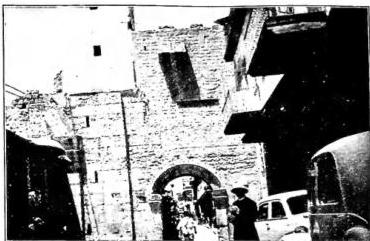
(courtesy of Soc. F. Vattioni)
SYRIA - St. Paul's Gate in Damascus.
It is often confused with qatala. The passives in n, the reflexives in n, and the conative are entirely absent; the causative is formed with ', although traces of the causative in ša and ha also remain. There is also a reflexive proper to the fundamental theme, the intensive theme, and the causative theme. Occasionally, a formation with a diphthong (aw, aj) appears in the first syllable: e.g., sajbar "to nourish," gavzel "to light." Doubling of the third radical occurs, for example, in 'abded "to enslave," 'ajnen "to watch"; repetition of the second and third radicals, for example, in hēzavzel "to show oneself repeatedly," i.e., "to strut," eltēragrag "to fantasize" from šērāgā, "lamp." Often, the repetition of the entire triconsonantal root is encountered, e.g., ramrem "to elevate," qangen "to sing." Not infrequently, quadriliteral roots arise from the dissimilation of the doubled radical in a qattala, e.g., 'argelda 'aggel "to roll," pargi "to rejoice" from the root pegjā "to please." Regarding inflection, it is observed that in the imperfect, neither the jussive nor the energic exists. Certain modalities, however, are expressed with forms of the verb "to be" (hēwā) combined with participles or finite forms. Some traces remain, instead, of the fact that, as in Arabic, in Syriac a perfect qatula corresponded to an imperfect jaqtulu, which appears sporadically in forms like neqrob "will be near," nehhōb "will be thin." As an entirely new tense in Aramaic, the active participle in the absolute state appears with the value of a present, while the passive participle in the absolute state with a dative of the agent functions as a past, e.g., šēmi'li "I have heard." What strikes most in the inflection of the imperfect is that, in accordance with Eastern Aramaic, the preformative of the 3rd sing. masc. and the 3rd pl. masc. and fem. is n instead of j. A remnant of an ancient triradical formation in verbs of media jīw is the Syriac and Arabic participle qā'im, whose ' can only derive from a semivowel.
In the morphology of the noun, a trace of the ancient Semitic cases may perhaps remain in the old locative kaddā "sufficiently." Forms such as bēhav jīm "on that day," bēhav dār "in that generation," seem to testify that occasionally the noun by itself is fully determined, as occurs in Arabic, etc. The definite article has lost its determinative value but can be replaced by a suffix, e.g., latre'sar talmīdaw (Sin) τούς δώδεκα μυθητάς (Mk. 6:7); such a suffix is normally used before a determined genitive (with dē), a determined accusative, or a preposition, e.g., 'alēh 'al mēdittā, "against the city." A remnant of mimation, i.e., the ancient indefinite article, is found, for example, in imām "by day." The construct state with its governed noun now expresses a single and new concept, e.g., huppāk mellē "answer"; not infrequently (especially if a participle or verbal adjective), it is followed by a preposition, e.g., nāsbaj bappē "hypocrites," mēsām bērēlā "punishment." The feminine ending -at, the ancient marker for various classes of
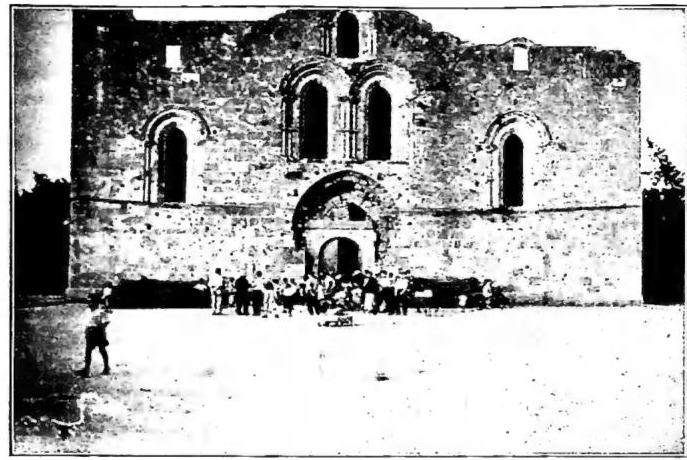
The ruins of the medieval Cathedral of Tàrtus.
The feminine ending -at, originally used for various classes of nouns (collective, pejorative, etc.), was also employed to form so-called unit nouns. Examples of this remain, such as zēbattā "one time" from zabnā "time," nēfēltā "a breath" from nēfēlā "breathing," bē'tā "egg," etc., whose masculine plurals now replace the collective in singular form. This ending -at also serves to form abstract nouns from verbal adjectives, e.g., zēbintā "purchase" from zēbīnā "bought," hēfiktā "ruin" from hēfikā "destroyed," "spoiled." For the formation of abstract nouns, the feminine ending -aj is also used. Thus, verbal nouns (maṣdar) arise, such as tu'raj "error," tu'raj "concealment." The Arabic uḥraj "another" corresponds to oḥrē of ancient Aramaic, whose ē is preserved in Syriac ḥrētā.
As for numerals, only certain forms (two, twenty, two hundred) have survived. As in this case, so too in the plural, the formation with endings (-aj, -in, -ē; -āt, -ān, -ātā) prevails without restriction. Nevertheless, traces of the broken plural type, so frequent in South Semitic, remain, e.g., qurjā "countries" (qutal), Arabic quran (though before suffixes and in the construct state, the ending -aj is already found); ḥemrā "herd of donkeys" is of the qital type. To the broken plural types qatal, qital, qutal, the plural ending is also added, e.g., bātē "houses," 'ammē "peoples," gallē "waves." The forms ḥenkē "palates" and gumbē "robberies," as indicated by the mute spirant, are qital and qutal. No vestiges of the plurals of paucity (pl. paucitatis) seem to remain, though some have sought to see in these difficult-to-explain forms, such as rā'awcātā "shepherds," pl. of rā'jā (qātil of 3ʰ j/w), an ancient plural of plurals, formed by adding -at to the plural of the form ru'āt (type qutalat, Arabic broken plural of qātil of 3ʰ j/w), though changing the first vowel according to the singular. It is certain that in rawrēbīn "great ones," the repetition of the base, which generally expresses a distributive, is used to denote the plural. The close connection between abstract forms and the plural (as in Hebrew zēqūnim "old age," bēhūrīm "youth") appears, for example, in hērūrē "liberation," mēkūrē "marriage." For the transition of an abstract (maṣdar, nomen verbi) to a concrete meaning, so widespread throughout Semitic, the example talmīdā "disciple" (literally "the accustoming," "the habituating," from lēmūd "accustomed") suffices, corresponding to Hebrew limmūdh; both types, i.e., taqtīl and qittūl in Aramaic and Hebrew respectively, to express a verbal noun of the intensive stem.
In syntax, it is noteworthy that the absolute state of participles and verbal adjectives expresses the predicate of the sentence. The syntax of the period deviates greatly from the purely Semitic type. The nominal sentence is rare; independent clauses that are in fact subordinate, such as ḥāl clauses, conditions without conjunctions, etc., do not exist; subordinating conjunctions, however, abound.
The word order is very free, and no other Semitic language has assimilated as many foreign words as Syriac: Akkadian (numerical), Hebrew, Persian, Greek, even Latin through Greek. The very Greek particles δῆ and γῶς have been imitated, though using Semitic roots.
The Syriac language is the least Semitic of all Semitic languages and the most subjected to Hellenistic influence.
For general references, V. ARAMAICO, LINGUA; for grammar and syntax, Th. Nöldeke, Kurzgefasste syrische Grammatik, Leipzig 1898; C. Brockelmann, Syrische Grammatik, Leipzig 1938; for lexicon, R. Payne Smith, Thesaurus Syriacus, Oxford 1879-1901; J. Payne Smith, A Compendious Syriac Dictionary, Oxford 1903; for texts, V. SYRIACA, LETTERATURA.
Raimondo Köbert
VI. THE SYRIAC RITE
Also called Syro-Antiochene, Syro-Western, or Syro-Palestinian, this rite is currently in use in the Syriac patriarchates (Catholic and dissident) and, since 1653, in the Malankarese dioceses (v.) of India; rite (v.) is also connected to II. Until the formation of a separate Monophysite Church in Syria in the 6th century, the Syriac rite did rite (v.) of the Orthodox.
After the separation, it developed its own distinct character, determined more by the elimination of the Greek language than of Greek elements. In fact, it presents itself as a felicitous combination of Syriac and Greek elements: alongside ancient Greek anaphoras, it uses anaphoras composed in Syriac; together with biblical readings taken from the Pēšīṭtā version, it includes others from the Harklean version; in addition to Syriac hymns, it employs those from the Octoechos of Severus of Antioch, mixing Syriac ʿenyānē with translated Greek canons; and alongside mēmrē by Syriac authors, it includes homilies by Greek Fathers. This development continued beyond the 9th century, and new anaphoras were composed until the 15th century. The Arabic language, which began to be used shortly before the 10th century, later assumed an increasingly important role (cf. for Catholics Synodus Sciarfensis... anni 1888, Rome 1896, p. 34 ff.); in the 19th century, Turkish was also admitted in some regions; the script, however, always remained Syriac. V. BAPTISM; HYMNOGRAPHY; MASS; ORDER AND ORDINATION; PENANCE; DIVINE OFFICE.
VII. LITERATURE
The Syriac language, already in use among the Christians of ancient Syria, Osroene, and Mesopotamia, constitutes, together with the language of the Babylonian Talmud, Eastern Aramaic. Syriac literature, whose earliest writings begin in the 3rd century, flourished especially from the 4th to the 7th century, the period in which it began to be replaced by Arabic literature. Three branches of Syriac literature exist: Orthodox authors, from the beginnings until the 5th century; from that time until the second millennium, Jacobite (v.) and Nestorian (v. NESTORIO E NESTORIANESIMO) authors developed in parallel. In the first period, the estrangēlā script was used, while the Jacobites added small Greek vowels (the sertā script), and the Nestorians (the "Nestorian" script) employed a system of vocalization by means of points.The principal characteristics of Syriac literature are as follows: 1) it comprises almost exclusively ecclesiastical writings; 2) with the exception of the earliest Persian authors, the others depend on the Greeks, as seen from the abundance of translations; 3) it demonstrates a profound religious sense and a predilection for poetry. This poetry consists in verses having a certain number of syllables.
On the Syriac versions of Holy Scripture V. below. The Syrians have preserved many Greek writings whose originals have been lost. The Syriac versions of Greek philosophers later served as the basis for the corresponding Arabic versions, from which Latin translations were made during the Middle Ages.
The most notable authors of the Orthodox period are Aphrahat, St. Ephrem, the most celebrated among Syriac authors, Cyrillonas, and Bălaj, for whom V. the individual entries: V. ATTI DEI MARTIRI.
VIII. SYRIAC VERSIONS OF THE BIBLE
These are important from several perspectives: they reflect the daily life of those Christians, the political and religious upheavals (heresies) of those regions. They were preserved and transmitted with tenacious fidelity. Regarding the New Testament, the Syriac version is the oldest of all, and was made in a language close to that used by Jesus. Their history shows the increasing Hellenization of a Christianity originally Semitic. Although much useful research has been conducted thus far, the desirable working tools have not yet been created, especially critical editions that also incorporate the biblical quotations, carefully examined, from all Syriac literature. This results in the fact that in many questions, nothing more than probabilities or hypotheses can be reached. Furthermore, due to the lack of historical sources (v. ARBELA, CRONACA di), the origins and events of Syriac Christianity remain obscure.Many prefer a Jewish rather than Judeo-Christian origin for the most essential parts of the Peshitta of the Old Testament, canon (v.), with the exception of Par., Esd.-Neh., Esth., and in which a broad influence of the Targumim (v.) appears, especially that of Onkelos.
As for the Gospels, even for the New Testament one might suppose some Aramaic Gospel (the original Matthew, or the Gospel of the Nazarenes or according to the Hebrews?), which would explain the influence of some Aramaic apocryphal Gospel on Tatian’s Diatessaron (v.), which in any case was the first New Testament of the Syriac Church, composed before 172, according to recent authors, in a Syriac language of great expressive and stylistic qualities, and which had considerable influence in the history of Eastern and even Western versions (C. Peters, S. Lyonnet, G. Messina, A. Vöbus). However, older authors tend to believe that the original text was composed in Greek. They therefore cite a fragment found at Dura Europos. But that, along with Papyrus Berolinensis 1638 (published by O. Stegmüller), was analyzed by A. Baumstark, whose results are accepted by highly competent recent scholars (C. Peters, A. Vöbus). Tatian, a man of great talent, probably could write equally well in Greek as in his mother tongue. In any case, the Diatessaron became the beloved Bible of the Syriac Church for several centuries. The Syriac name of the Diatessaron is Evangelión damēthaliṭē, "Gospel of the mixed (texts)."
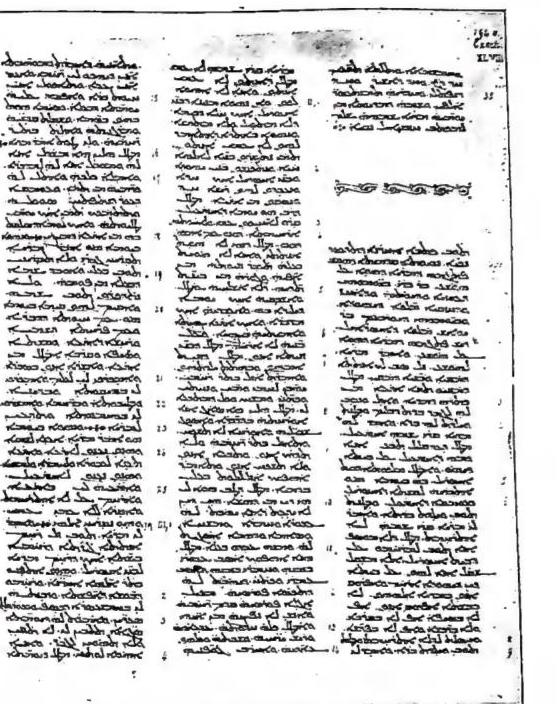
(from A. M. Ceriani, Translatio Syra etc., Milan 1833, fol. 1891) SYRIA - Explicit of Ezekiel, incipit of Hosea, Codex of the 7th century from the Biblioteca Ambrosiana - Milan.
versions, made by various people at different times and places. Several opposing forms existed, one of which is preserved in the very ancient palimpsest discovered in 1802 by Agnes Smith Lewis at the Monastery of St. Catherine on Mount Sinai, and which for this reason is called the Sinaitic Syriac; it is a codex from the 4th or 5th century. Already 50 years earlier, H. Tattam had brought to Europe another precious codex from the Monastery of St. Mary Mother of God in the Nitrian Desert of Egypt, later edited by W. Cureton (London 1858), and called the Curetonian Syriac. These two Gospel codices are independent of each other; they are more or less close to the Diatessaron; there were also other forms of the Syriac text of the Gospels, e.g., Titus of Bostra (v.).
The diversity of New Testament texts and the incompleteness and inaccuracies of the Old Testament in the 4th and 5th centuries required a revision; this was greatly influenced by the Greek Vulgate text of Antioch, where many priests and future bishops of the Syriac Church studied. The "harmonistic" readings caused by Tatian were eliminated, other interpolations were removed, omissions were restored, and the whole was stylistically conformed to the Greek text of Antioch. However, it is unknown who the revisers were, who, given the differences among the individual books, were many, perhaps not of the same generation or period.
In the end, that Bible was also introduced by ecclesiastical laws; Theodoret of Cyrrhus (v.) and Rabbula of Edessa waged a fierce struggle to eradicate from their flock the use of the Diatessaron, already venerable and more practical, for example, for traveling monks. Thus, not without struggles and delays, that revision became the Bible of the Syriac Church, practically up to the present day. The name of it, which is first transmitted to us by Mōšē bar Kēfā (d. 1913), is Pēliṭā, a term that, taken in context, means rather the "simple" than the "vulgate," and opposes the versions that were later made in a more scientific manner according to Greek texts, whose influence was increasing. Originally, in addition to the deuterocanonical books of the Old Testament, the books II Pet., II-III Jn., Jude,
(photo: Enc. Catt.)
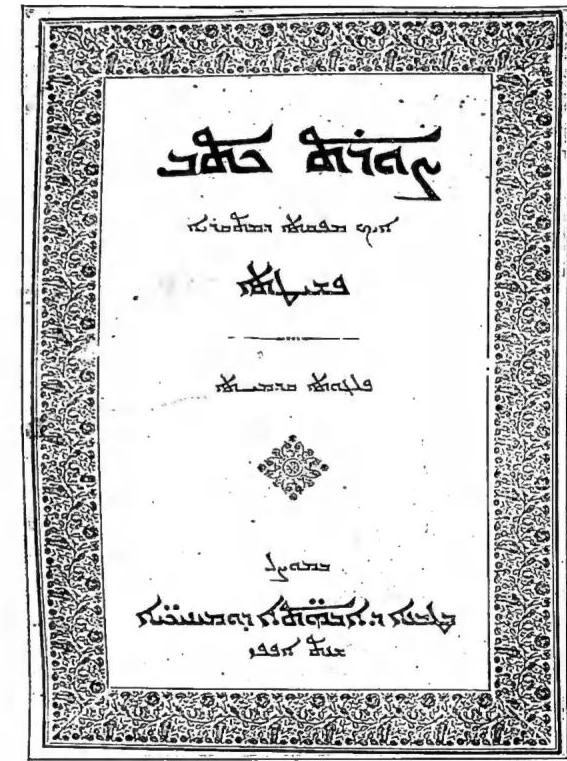
SIRIA - Frontespizio della Bibbia in lingua siriana dell'edizione di Mossul, 1886 (cattolica). Esemplare dell'Istituto Biblico Roma.
inseriti però in manoscritti del sec. XI, e l'Apocalisse, inserita in manoscritti del sec. XIII.
Si hanno principalmente quattro recensioni della Péfilità: la nestoriana, la giacobita, la melchita e la maronita. La prima edizione di SIMONIA (v.) nel 1645 nella Poliglotta di Parigi, riprodotta poi, da Brian Walton, in quella Londinese nel 1657, che è basata però su uno dei peggiori manoscritti e fu vocalizzata e trattata liberamente dagli editori e non senza abbagli tipografici. Walton però nel vol. VI dà i risultati di una collazione di manoscritti fatta da Herbert Thorndike, anch'essa con cose meno accurate, ma non ancora si può trascurarlo dato che non esiste altro apparato critico per la Péfilità intera. L'Ottocento ci diede tre edizioni, nessuna però di valore critico. Quella di Samuel Lee (1823) è sostanzialmente una ristampa della poliglotta. L'Urmiense, edita nel 1852 in Urmia (Irán) dalla American protestant missionary society, si basa su alcuni manoscritti nestoriani e dà la puntuazione per il testo completo, però dipende molto da S. Lee. Quella curata dai Padri domenicani di Mossul nel 1887-91, perciò detta Mossuliense, è la più completa, bella e comoda; sulla sua origine informa J. M. Vosté in Misc. card. Mercati, I (Città del Vaticano 1946), pp. 59-94, ma non dice da quali manoscritti fu preso il testo biblico. Con P. Bedjan e A. Vaccari la si può ritenere «la migliore di tutte» (rist., Beirut 1951; è l'unica in commercio). Rimane urgente il problema di una edizione critica dell'intera Péfilità, oltre le esistenti edizioni critiche parziali (Pentateuco, Salmi, Isaia, Paralipomeni ed altri).
molte discussioni, come quella recente se abbia per base un codice luciano di Antiochia (J. Schildenberger) o uno euthaniano, da Cesarea in Palestina, con un certo apparato critico (G. Zuntz); lo Zuntz potrebbe avere ragione in quanto sta in mezzo fra la libertà della Péfilità e la schiavitù alla lettera greca, della versione Harclense. Questa comprende soltanto il Nuovo Testamento e comporta oltre il testo un apparato critico; si disputa però se il testo di base sia il filosseniano, al quale Tommaso vescovo di Mabbag (Harqel) negli aa. 615-16, collazionando codici nel chiostro Ennatum presso Alessandria in Egitto, abbia aggiunto l'apparato che incorpora il risultato delle sue collazioni secondo la tecnica alessandrina, o se abbia piuttosto recensito e modificato il testo; di tale testo sono rimasti parecchi manoscritti. Per il Vecchio Testamento nel 617-18 Paolo, vescovo di Tella (presso Edessa, sotto il mandato di Atanasio, patriarca scismatico di Antiochia), fece cosa simile. Esaple (v.) di Origene e la tradusse fedelmente in siriano ritenendo i segni di critica testuale, come gli asterischi, gli obeli ecc. e le note marginali; il più celebre manoscritto dell'Ambrosiana di Milano fu pubblicato da A. M. Ceriani (Monumenta sacra et profana, Milano 1874) in una bella edizione litografica; quel manoscritto non comprende tutto il Vecchio Testamento; però, dando i segni di critica testuale di Origene, ci è di massimo aiuto per ricostruire l'Esapla e dà Daniele nella versione dei Settanta, sostituita nelle Bibbie greche da quella di Teodosione. Ma già nel 704-705 Giacomo di Edessa fece un'altra recensione del Vecchio Testamento secondo i Settanta; divise anche il testo dando brevi sommari ai singoli capitoli, aggiungendo note marginali ecc., e la «misora siriana», che prende nome dal chiostro di Karkafta, sul fiume Häbär (ma non esiste una «versione karkafana»).
Non è strettamente siriana la versione siropalestinese della Bibbia greca completa nel dialetto gallico-aramaico più recente, scritta in carattere siriano; è in uso nella liturgia dei melchiti; non devono essere sottovalutate relazioni dirette con le versioni siriane, né l'influsso dei Targum sulle due versioni; risalirebbe ai secc. IV-VI.
pp. 203-10; id., The New Test. Peshitta and its predecessors. The Stud. New Test. Societas Bulletin, 1 (1950), pp. 51-62; B. J. Roberts, The Old Test, text and versions, Cardiff 1951, pp. 214-28. Filosemiana e Harclense: oltre H. Höpfl-B. Gut, op. cit., cf. G. Zuntz, The ancestry of the Harleian New Test. (The British Academy Papers, 7), Oxford 1945; cf. Rev. bibl., 54 (1947), pp. 127-31; P. E. Kahle, The Chester Beatty M. of the Harleian Gospel, in Misc. G. Mercati, VI, Città del Vaticano 1948, pp. 208-33; G. Zuntz, Etudes harléennes, in Rev. bibl., 57 (1950), pp. 550-582. Siro-esaplare: H. Höpfl-B. Gut, op. cit., p. 325 seg. Siro-palestinese; ibid., p. 331 seg.; A. Baumstark, Das Problem des christlich-palästinensischen Evangelium-Textes, in Oriens Christianus, 32 (1935), pp. 201-24; C. Peters, op. cit., pp. 121-25. Pietro Nober
IX. CHRISTIAN ART
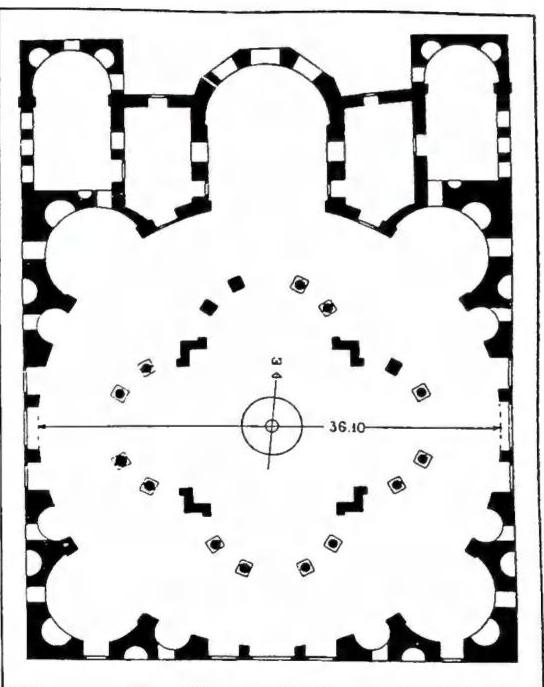
From the perspective of art history, Syria during the Christian era can be considered as divided into three major regions, each with distinct characteristics. The first is the vast coastal zone along the Mediterranean, stretching from Gaza to Antioch, varying in depth from place to place, occupying in its northern part the entire Orontes Valley with the cities of Apamea, Epiphania, and Emesa, up to Heliopolis; then the oasis of Damascus and, at the southern extremity, all of Palestine and the part of the province of Arabia south of Gerasa. As a whole, this is a deeply Hellenized land, comprising the largest cities, seats of ancient and highly developed culture, extremely wealthy in industries and trade, open to the sea and thus to the entire Mediterranean world, and especially to the imperial seat, Byzantium. The second region with its own characteristics is the Hauran, a vast volcanic plateau rich in basaltic rocks, inhabited since the Hellenistic era by a population of Arab character, containing many ancient centers but perhaps only one culturally significant city, Bostra (Bosrā). The third region is that of the limestone hills of inland Syria, east of the Orontes Valley, extending from Jabal al-ʿAlā at the latitude of Hamā in the south to include the entire Jabal Simʿān in the north, and reaching eastward as far as Jabal al-Ḥāṣṣ. This is a more distinctly Aramaic territory. It is in the first region that the greatest artistic production took place, where not only the most significant works of Syrian Christian art were created, but where all forms of decoration and luxury were produced: wall paintings and mosaics, rich floor mosaics, illuminated manuscripts, goldsmithing, carved ivories, and so on. Unfortunately, its grand architectural constructions have almost entirely disappeared and are known only through ancient descriptions. The other two regions, by contrast, have preserved a quantity—almost an excess—of architectural monuments, many of which are sufficiently well preserved in their still-standing parts to be fully appreciated from an artistic standpoint, while excavations may only clarify liturgical details or aspects of civil history. Moreover, most of these monuments have been published in convenient repertories (M. de Vogüé, H. C. Butler), making their study easy; and even more data will be available once the meticulous and detailed research of the Russian architect Čalenko is published. This ease of access to the monuments of inland Syria has led to a focus in books on Syrian Christian art, particularly architecture, almost exclusively on these, while they represent only the production of the less cultured and less creative part of the country. This has generated no small distor- SYRIA - Plan of the sanctuary of SS. Sergio, Bacco, and Leonzio in Bostra (512), drawn by J. Crowfoot.The imbalance in artistic judgment—which, due to lack of space, can only be corrected here in a necessarily summary manner—arises from the fact that in books on Syrian Christian art, and particularly on its architecture, only certain works are discussed: namely, those produced by the less cultured and less creative part of the country. This region, however, is not representative of the whole.
The first part of the Syrian territory outlined above is an eminently Hellenistic zone, Greek in culture and language, which not only inherited all preceding traditions but also maintained continuous contact with the great centers of the eastern Mediterranean—Alexandria, Ephesus, Byzantium. At the same time, for commercial reasons, it attracted Oriental, particularly Iranian, elements that brought Eastern models or ideas. It is no coincidence that, as early as the 3rd century, floor mosaics in Antioch displayed Iranian decorative motifs. Moreover, this was an extremely wealthy region, and the financial power of its clientele generated ever-larger commissions, enabling artists to conceive and execute the most ambitious projects. Finally, it was here that the great imperial foundations arose, not only on the Holy Sites. All this facilitated the exchange of ideas, access to any material, and abundant resources that attracted the best talent even from distant lands. Consequently, architecture—the fundamental art around which others were organized—realized the most diverse programs. This was already evident in the Constantinian constructions, which introduced the Hellenistic columned basilica with an atrium, adapted to Christian liturgy, and distinguished it from the centrally planned building used as a martyrion or for other distinct purposes. At the Holy Sepulchre in Jerusalem, the two types appear united in a single architectural complex through an atrium: there, the Anastasis is a rotunda with an ambulatory. In the Basilica of the Nativity in Bethlehem, the basilical structure is directly joined to the centrally planned building, which in this case is an octagon. The octagon with an ambulatory appears again in Jerusalem, in the Church of the Ascension and the Tomb of the Virgin, later reproduced with greater complexity of peripheral spaces in the Sanctuary of Mount Gerizim. The rotunda also reappears later in Beisân (Scythopolis). A more complex type is that of the oc-
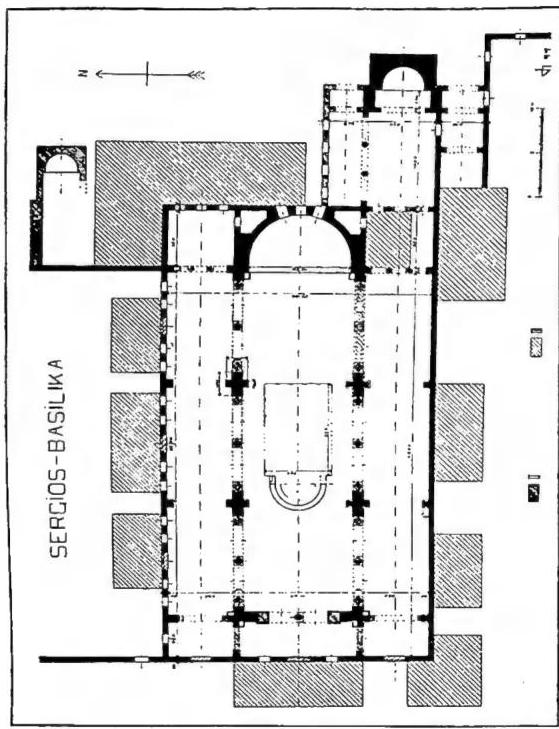
SYRIA - Plan of the basilica of S. Sergio at Ruṣāfah-Sergiopolis
(6th century), drawn by Spanner and Guyer.
It features an octagon with each side opened by niches, alternately semicircular and rectangular, which are also outlined externally: this is certainly Hellenistic, given its reproduction in the Piazza d'Oro of Hadrian’s villa at Tivoli, where the Emperor had copied the buildings that most impressed him in the East. Its adoption by Christianity is attested by the letters of Gregory of Nyssa to Amphilochios of Iconium, which describe a martyrion built in this form: the type must have been quite widespread, given its importation into the Po Valley, where it was adopted in several baptisteries. It must also have been known in Syria, though its simple form is not documented there—unlike at Nyssa, where the rectangular niches are so elongated as to form a cross—but a monumental and truly grand extension of it is known in the sanctuary built around the column of the stylite Simeon at Qal'at Sim'ān, where the four arms of the cross expand into basilical structures with three naves. This derivation, hitherto unobserved, is the only one that explains the genesis of that magnificent sanctuary. A simpler form was later realized in the sanctuary of another St. Simeon on Mount Ammirabile near Antioch. The idea of connecting the four arms of the cross to a central martyrion, giving each a basilical structure, may derive from the pre-Justinian sanctuary of St. John at Ephesus: but here the central building is square. In the martyrion of St. Babylas, erected near Antioch between 381 and 387, there is a simple cross form with arms extending from a central square with thicker walls, perhaps because it was raised in the form of a tower: a similar structure is found in the sanctuary at Jacob’s Well in Shechem (Neapolis), described and drawn by the pilgrim Arculf. The type of inscribed-cross sanctuary, i.e., traced within a square, is also of Hellenistic origin, its earliest source being those building types of which an example survives in the Tychaiion of al-Mismiyah (Phaenea) on the northern edge of the Leṣāh (Trachonitis): an incomplete realization is seen in the martyrion of St. Elijah at Ezra' (Zorava) on the western edge of the Ḥaurān and in central Syria at al-Anderīn, but its most monumental development was achieved in the Church of the Prophets, Apostles, and Martyrs at Gerasa, built in 404–405. It seems to have been in the form of a cross, though it is unclear of what type—perhaps more than a transept basilica—the church erected at Gaza by Bishop Porphyry on the ruins of the destroyed Marneion, built by an architect from Antioch according to a plan sent from Byzantium by the Empress: the fact that she also sent many columns of Carystian marble might suggest something similar to the church at Gerasa. A type of Hellenistic building, widely used by the Romans in thermal architecture, is that of an octagon with four semicircular niches on four opposite sides, all inscribed within an external square: it is found adopted by Christians in the baptistery of Qal'at Sim'ān and, with an internal ambulatory formed by an octagon of eight columns, in St. George at Ezra', built in 515 on "a dwelling of demons... where sacrifices were made to idols," as the foundation inscription states. It likely arose on the substructures of the destroyed pagan temple. But it was in Antioch that the most famous centrally planned building of Christian Syria arose: the "Golden Church," built by Constantine. Begun in 327, it was completed and consecrated only in 341. Despite its renown, the little we know of its structure (from two passages in Eusebius) does not permit even an approximate reconstruction: it is known to have been octagonal, with a dome and exedrae. This last detail raises doubts as to whether its plan had any relation to that of a recently discovered building at the port of Antioch: Seleucia Pieria. At the center of this structure is a square formed by four L-shaped corner piers, connected by four columned exedrae; the whole is surrounded by an ambulatory whose external perimeter follows that of the internal square of exedrae in parallel. To the east, an apse opens, preceded by a rectangular bay. A nearly identical building was discovered at Apamea but remains unpublished. The type enjoyed very wide diffusion. At Boṣrā, the square with exedrae stands at the center of a circular building inscribed within a square, with four large niches occupying the corners of the square—a type well known in Hellenistic architecture of the Roman period, also seen in the Church of St. John the Baptist at Gerasa: it then passed into Mesopotamia at the Sanctuary of the Virgin at Amida and the martyrion of Ruṣāfah-Sergiopolis (where, instead of a central square, there is a rectangle), and from there into Armenia, at Zwarthnots (641–661) and St. Gregory at Ani (1001). In the West, it is found in the building at the center of Hadrian’s Stoa in Athens, in the Balkans in the Red Church of Perushtitsa, and as far as northern Italy, where it is repeated in the Church of San Lorenzo in Milan. This vast distribution of derivatives presupposes a famous building as its starting model: which might support the hypothesis regarding the structure of Constantine’s church in Antioch, which Eusebius calls "a unique thing in the nature of a church," μονογενές τι χρῆμα ἐκκλησίας. A final type of centrally planned religious building realized in this part of Syria is the trichora cella of the martyrion of St. John the Baptist in Jerusalem, the church on Mount Nebo, and the monastery of St. Theodore near Jerusalem.
The realization in elevation of all these planimetric programs presupposes, as a fundamental condition, the solution to the problem of the dome. In this regard, one encounters a characteristic phenomenon: throughout Syria, just as builders remained faithful to wooden roofs (and in the Ḥaurān to basalt slabs) for covering naves and never tackled the problem of vaults, so too for buildings requiring a dome—whether of brick or stone—they never attempted to construct one. Nor did they ever address the problem of transitions between a dome and a square-based plan, despite knowing the perfect solution achieved by Hellenistic architects (Roman-period baths at Gerasa, the tomb at Samaria, etc.) for the pendentive transition, and despite the fact that their land was traversed by those currents that brought the Iranian solution of domes on squinches to the West. Syrian builders during the Christian period, though they constructed small domes in funerary and thermal buildings (but almost always with rudimentary transition solutions), never executed anything but pyramidal roofs or wooden domes when faced with larger dimensions. The method was so ingrained in their constructive thinking that even after the Muslim conquest, those Syrian builders employed to construct the Dome of the Rock (falsely called the Mosque of Omar) in Jerusalem covered its central rotunda with a wooden dome. When, during the Christian period, a rare real dome is found in Syria, it was built by Byzantine occupants using Byzantine construction techniques: as at Qasr ibn Wardān. While Syria offers valuable contributions to the problem of creating a church whose fundamental element, around which everything harmonizes, is the dome, its constructive realization was provided only by Byzantium.
Even in the problem of all possible forms assumed by the church with a basilical plan, the first zone of Syria has preserved traces of having attempted various solutions. At Ruhaibah in the Negeb and in the aforementioned church of Mount Nebo, one finds the three-nave basilica combined with a sanctuary featuring a trichora cell: poor provincial derivations of some great edifice of which every trace has been lost. Similarly, the Sanctuary of the Multiplication of the Loaves at al-Tābā must be considered, which presents the type of the basilica with a transept, a form that some believe was also realized in the church erected by Bishop Porphyry in Gaza, based on a plan sent from Byzantium and constructed by an architect from Antioch. The church of St. Sergius in Gaza, known through the detailed description provided by Choricius, is also distinctly Byzantine in type: if one looks at Hamilton’s careful reconstruction, it is evident that it was absolutely identical to the church of Qasr ibn Wardān, a monument built by Byzantines using entirely Byzantine construction techniques and employing exclusively bricks, which contradicts Syriac tradition but is characteristic of the capital. Now, St. Sergius in Gaza and Qasr ibn Wardān in northern Syria were constructed almost at the same time. The only difference is that the dome of Qasr ibn Wardān rests on pendentives, while that of Gaza is on squinches supported by columns of the type found at Koğa Kalessi and at Ruṣāfah-Sergiopolis. It was preceded by an atrium accessed through propylaea, a structure of distinctly Hellenistic tradition. A second church in Gaza, that of St. Stephen, also from the early 6th century, is instead a three-nave basilica, divided by two rows of columns supporting architraves, equipped with matronea and a coffered ceiling (κασέτα) that concealed the roof: it was also preceded by an atrium where the entrance was flanked by two towers and reached via a grand staircase. A truly monumental complex.
The cited texts of Choricius also provide many details on the decoration of the two churches of Gaza, which happily complement the far more summary indications that other writers give on various monuments of this part of Syria. Thus, we know of the extensive use of wall coverings in colored marbles, paintings, and figured mosaics that decorated the main part of the building. In St. Sergius, entire Gospel cycles were represented, primarily the Nativity and Childhood, many miracles, and scenes of the Passion up to the Ascension. In the dome stood the prophets. But purely decorative figurations were also present, such as gardens with fruit-laden trees full of birds. In St. Stephen, Egyptianizing scenes were represented, so widespread in the late Hellenistic period, with the reproduction of the Nile and its banks and the animals bathing in II.
On the exterior of the Basilica of the Nativity was a mosaic depicting the birth of the Redeemer and the Adoration of the Magi. All these wall mosaics have completely disappeared: but the skill of Syrian mosaicists remains amply documented in the numerous floor mosaics that have survived. That highly skilled workshops had formed as early as the Roman period is proven by the many mosaics of Antioch recently discovered: from the Christian era, there are many mosaics dated by inscriptions that follow one another at not too great intervals, so that their historical study is greatly facilitated. And these continue almost until the period of the Muslim conquest. Now, it is evident that these workshops did not disappear completely at once, and some works executed for the new Arab rulers must therefore be attributed to them. The stylistic identity of the mosaics of the palace of Khirbat al-Mafjar and much of those of the Dome of the Rock, with others not much earlier, especially those executed in the southern part of the province of Arabia, demonstrates that even for mosaic art, the Arab period of the Umayyads is nothing but the final concluding phase of the art of Hellenistic Syria. The Iranian motif of the palmette, repeatedly reproduced in the mosaics of the Dome of the Rock, had already been assimilated by Christian artisans, as shown by the oldest parts of the mosaics of Bethlehem with the representations of the Councils. The mosaics of the mosque of Damascus (which preserve figurations tracing back to the painting of Herculaneum and Pompeii) instead derive from models preserved in Byzantium or are works of those Byzantine workshops that, according to some Arab texts, would have been sent by the Emperor.
For a precise understanding of the stylistic characteristics of Syriac figurative painting, it is unfortunately not possible to avail oneself of the aid of miniatures in scrolls or codices, because no illuminated manuscript prior to the 8th century can be said to be of Syrian provenance. Several are generally considered as such, such as the celebrated one illuminated by the monk Rabula in 586, preserved in the Laurentian Library in Florence, or the two in the National Library of Paris, syr. 33 and 341; but only for the absurd reason that they contain texts in the Syriac language. However, the Laurentian was executed at the monastery of Zagba in Mesopotamia, and the provenance of the two Parisian manuscripts is certainly to be sought in the same region. Mesopotamia and Osrhoene, where Syriac was spoken, have an artistic development quite distinct from that of Syria. There must indeed have existed a very important miniature tradition, especially for the illustration of the Gospels, minutely analyzed by Millet, who called it precisely the "Antiochene recension," but today it is known only through fairly recent copies (Bibliothèque nationale de Paris, greci 72 and 923). While this is of great importance for iconographic study, it offers no assistance for stylistic knowledge. The prototype of the Ashburnham Pentateuch must also have come from Syria (though not from Hellenized Syria), to be studied in relation to the paintings of Dura, especially those of the synagogue: but one must also consider a hypothesis from Lower Mesopotamia. Such a study has not yet even been attempted.
iconographically but not outstanding in style. The masterpiece of Syrian sculpture that has survived is in ivory, namely the frontal part of the so-called Maximian's cathedra preserved in Ravenna. The figures of St. John the Baptist and the four Evangelists, depicted within niches in a severe style, are truly of the highest order: the two decorative bands with animals amid vine scrolls represent, with richness and taste, the decorative art of Syria in the 6th century. The other sculptures of the same cathedra, of a different style, are by another hand, almost certainly Egyptian. Decorative sculpture is more extensively documented, both in Hellenistic Syria and in northern inland Syria, where it develops along the same evolutionary lines. Already in the pagan era, monuments from Baalbek to Palmyra offer examples of the tendency to increase the importance of the decorative element over the purely formal aspect of architecture: this tendency becomes exaggerated in the Christian era, to the complete detriment of its logical distribution. It is under the influence of the Oriental spirit that this horror vacui intensifies, and decoration tends to become a covering for all walls, almost like a tapestry stretched over them. The technique itself transforms: the decorative element, no longer harmonized with the structure, loses all plastic character, flattening into a simple interplay of planes where the ornamental motif stands out against a dark background (tiefendunkel). New motifs from the East infiltrate what remained of Hellenistic traditions, gradually gaining the upper hand. The two pillars of St. John of Acre, transported to the small square of St. Mark’s in Venice, show how this process soon conquered Antioch itself. The execution itself reveals the assured intervention of Oriental, Mesopotamian, and Iranian craftsmen. Thus, in the Arab era, this evolution reaches its complete triumph with the façade of the palace of Mshatta. A parallel evolution in the penetration of Iranian elements and motifs is observed in the art of weaving, a flourishing industry of Syria.Already in some pieces (now in the treasury of the Sancta Sanctorum in the Vatican) depicting scenes of the Annunciation and the Nativity, where the figurative part still adheres to ancient tradition, the decoration reproduces the Persian palmette, eventually leading to a series of magnificent fabrics in which even the subjects are drawn from Iranian saga: animal combats, galloping archers shooting arrows, symmetrically arranged on either side of a central tree, the hom sacrum, such as those famous examples in the Diocesan Museum of Cologne. So distinctly Oriental that many classify them as Sasanian. It is therefore the decoration, more than the structure of the buildings, that documents the continuous and assured penetration of the Oriental spirit in S., culminating in its complete triumph in the 8th century.
The monuments of the second of the three zones of S., the Haurân, are distinguished by a highly particular construction technique. This is a region of eruptive rocks, especially basalts, which can be cut into slabs up to 3.50 meters wide. At the same time, it completely lacks timber. From very ancient times, the practice of covering buildings with such slabs had become widespread: this had the consequence that rooms, regardless of length, could not exceed the aforementioned width, sufficient for dwellings but inadequate for large assembly halls. Thus, a method was devised whereby arches were built between two parallel walls to serve as supporting elements, and slabs were laid upon two successive arches: the width of the building then depended on the span of the arch that could be constructed. To achieve even greater widths, instead of a single arch between walls, three were built in the same line: this resulted in three-aisled halls, as in the pagan basilica of Saqqâ and later in the church of Tafbâ and that of Nimreh. The arches could even reach a span of 10 meters. With this technique, the oldest churches of the Haurân were built: the lateral arches, narrower than the central one and thus lower, allowed for the placement of a series of slabs and the construction of an upper arch, reaching the—
(photo: Alinari)
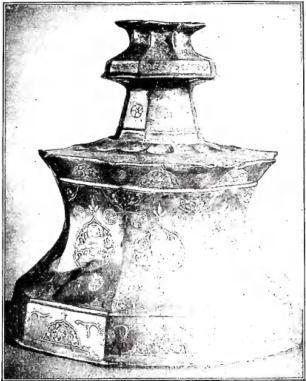
Syria - Base of a 14th-century Syrian candelabrum, chiselled and damascened - Florence, National Museum, Carrand Collection.
The height of the central arch was achieved by constructing the lateral arcades narrower than the central one and thus lower, allowing for the placement of a series of slabs and the construction of another upper arcade, resulting in a church with galleries. The arcades rested on square or rectangular piers: under the influence of northern Syria, columns were later introduced (church of Claudiano at Umm el-Gimâl). Occasionally, the central nave was covered with a wooden gabled roof, as in the church of Umm al-Quîten. Regarding the sanctuary, many churches in the Haurân feature a protruding semicircular apse; however, the sanctuary generally consists of a triple space, a rectangular or semicircular apse flanked by two square or rectangular chambers, following the type common to northern Syria. This latter structure is also applied to single-nave churches (church of Masecho at Umm el-Gimâl). The church façade often includes a portico with architraved columns (arches are rare, as at Umm al-Quîten): sometimes (Lubben, year 417; Suwedâ, al-Kâris, west church of Umm al-Gimâl) there is an entrance of the hilam type, that is, a central space open to the exterior with a large arch corresponding to the central nave, flanked by two enclosed square rooms open toward the side aisles and surmounted by towers. Churches of the broad-hall type, with only a lateral entrance on one of the long sides of the naves, can be seen at Şammeh, Wakm, and Deyr al-Guwâmî. The exceptional building at Qanawat, with the central nave surrounded on four sides by colonnades, preceded by a columned atrium and a frontal portico, is probably a pagan building repurposed as a church despite its southward orientation. Sculptural decoration in the Haurân is scarce and of no artistic value.
The art, and particularly the architecture, of northern inland Syria is well known due to the large number of published monuments and their generally good state of preservation above ground: the few excavations conducted so far may shed new light, but primarily on liturgical rather than artistic questions. The design of the place of worship is relatively uniform throughout the region and appears fully formed in all its essential parts already in monuments dating from the beginning of the Christian era, suggesting that it was imported rather than locally developed. Setting aside the small and insignificant single-nave churches or chapels, basilicas with three naves divided by two rows of columns supporting arches or, rarely, architraves are generally found. The arch on columns, artistically realized for the first time at the Diocletian Palace in Split, must derive from Antioch. The presbyterium of the church consists of a semicircular or rectangular apse corresponding to the central nave, flanked by two nearly square chambers: this structure derives from pagan prototypes, such as the Tychaion of is-Sanamēn, that of Musmieh, and in general Nabatean temples (Slēm, Qanavāt, etc.). The two chambers flanking the central apse differ in that one (generally the northern one) is accessible from the side aisle only through a door and functions as a diaconicon; the other (generally the southern one) is often widely open toward the side aisle by means of an arch and functions as a chapel for the cult of martyrs, as Lassus has demonstrated. This usage spread in the mid-5th century. The protruding semicircular apse, which reveals its curve externally, is generally reserved for small chapels; it is very rare in large churches. The church of Qal'at Sim'ān exceptionally features three protruding semicircular apses. Often, the layout of the arches, or the plan of the apses, is in the form of an outrepassed semicircle (horseshoe): at the monastery of St. Simeon, some arches have a slightly ovoid layout. All this is due to Mesopotamian influence. Vaults or domes are found only in the conch of the apses or in non-religious monuments (baths, tombs): inland Syria makes no contribution to what would become the central problem of medieval architecture, namely covering naves with vaults supported by arches. Generally, the western façade of the church is a simple wall where the entrance door may open: but in some more elaborate buildings (Termānin, Qalb Lauzeh, etc.), this front is formed by two lateral chambers corresponding to the side aisles and open only toward them (except in the cathedral of Kerrātīn from 504-505 and the church of the Apostles of I'gāz dated between 383 and 395, where they are also open to the exterior and constitute an exonarthex), surmounted by two towers, enclosing in the middle an entrance widely open to the exterior by means of an arch: this is the so-called bilana type, originating from Anatolia, where it was soon adopted in churches and which Syria already knew in temples of the Hellenistic period. The church of Ruwāhā and the southern basilical arm of the church of St. Simeon are preceded by a true portico. An internal narthex and an atrium preceding the church are not yet attested in northern inland Syria, except in the aforementioned church of I'gāz and the cathedral of al-Anderīn, where the structure of an exonarthex is hinted at: it is said, however, that Calenko has discovered monuments of this type, as well as others provided with galleries, but since they are still completely unpublished (1950), they cannot be taken into consideration: they would, in any case, demonstrate an influence of Antiochene forms. Occasionally, towers are also found on one or the other or even both of the chambers flanking the apse. The oldest monuments featuring towers on the two chambers flanking the apse date from the 5th century. Perhaps the two cathedrals of Kerrātīn (dated 504-505) and that of al-Anderīn (6th century) had four towers, two on the façade and two on the lateral chambers of the apse: a type that would later be adopted by Western medieval architecture. From the 5th century onward, a tendency to increase the intercolumniation between the columns of the naves is observed in inland Syria: and to provide better support for these increasingly wide arches, piers were substituted for columns, and the height of the piers was reduced to avoid making the side aisles excessively high. The culmination of this evolution seems to be represented by the churches of Qalb Lauzeh, one of the finest monuments of inland Syria.
The position of the access doors is highly significant. A great many churches have the main entrance door in the center of the western façade, thus on the axis of the central nave, with only very secondary small doors on the other sides: this is the normal type of
In other churches, however, there are instead two large doors on the southern side and none on the façade or what is considered as such. This is the very ancient conception of the broad-hall temple characteristic of the East from the earliest epochs of its civilization. A late liturgical text attributed to Bishop Giorgio of Arbela indicates that of these two doors, the one facing east—which is generally the larger and more richly decorated—served as the entrance for men: the other was for women. The church was divided into two parts: the anterior section, closer to the apse, was occupied by men, while the rear section was for women. In basilicas of Hellenistic structure, that is, with a single central door on the western façade, the separation of the sexes likely occurred in another manner, with the southern aisle assigned to men and the northern aisle to women. The central nave was almost entirely reserved for the clergy. In the middle of this nave, in many cases, there exists a raised platform, elevated one or two steps above the church floor, rectangular in shape and terminating in a semicircle toward the west. Along its periphery ran a bench for the priests, often interrupted in the center by a more prominent seat (the episcopal cathedra?). In the middle of the platform stood a lectern, which could be protected by a ciborium. This entire structure functioned as a choir, since the synthronon—that is, the series of benches for the choir arranged in a semicircle along the curve of the apse—was typically absent in Syriac churches. This arrangement is found in both Nestorian and Jacobite churches, not only in Syria but also in Sasanian Mesopotamia (al-Hīrah) and in Byzantine territory (Rujāfah-Sergiopolis), which presents the most grandiose example. It is curious to note that this is also the position of the choir in the much later medieval churches of the West, in Spain and England. The doors of Syriac churches are protected by porches with triangular pediments and double-sloped roofs supported by columns, another motif that passed into the Romanesque architecture of the West. Often, however, the entire southern front of the church is protected by a colonnaded portico when the entrances are on that side.Some buildings exhibit a more complex structure, evidently studied in the relationship of their masses. Such is the case at Deyr es-Soleib (between Hama and Masyaf), where a three-nave basilica with a single free-standing apse has its two sacristies not in continuation of the side aisles but projecting from their outer flanks. The façade consists of a central porticoed entrance flanked by two chambers (bases of towers), extended by two other projecting rooms (one of which is a baptistery). Between these and the two sacristies run two porticoes that clothe the sides of the church. This planimetric scheme would later be adopted by Armenian architects (Ereruk, Odzun, and perhaps Tekor). The whole is preceded by an atrium with Hellenistic-style porticoes.
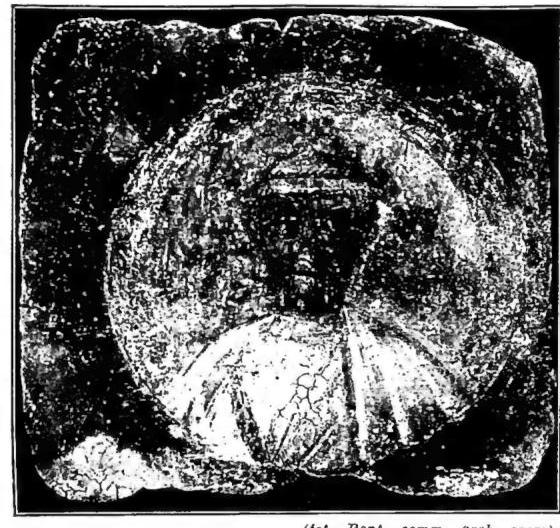
Sculptural decoration is rich and varied but concentrated almost exclusively on capitals and architraves. The capitals derive from ancient types of the classical Corinthian order, with two rows of acanthus leaves, though they tend toward dry and rigid forms. The variations are numerous. Some capitals also feature figures, as at the monastery of S. Simeone il Giovane. A characteristic of Syrian constructions is the almost systematic use of cornices or moldings that run continuously around openings—jambs and archivolts—and remain unbroken even when the openings are numerous, beginning and ending in volutes. Figurative sculpture is scarce and devoid of any artistic value: toward the eastern region, door architraves feature figures of the Virgin, flying angels, and stylite saints. As a rule, all this decoration appears only on the external facings of the buildings. Only at Qalb Lauzeh do moldings on archivolts and openings appear inside the church as well. This