Machine translation of the 1948–1954 Italian original. The original text is authoritative.
TAISIA (TAIDE, THAIS), saint. - Egyptian penitent of the 4th century.
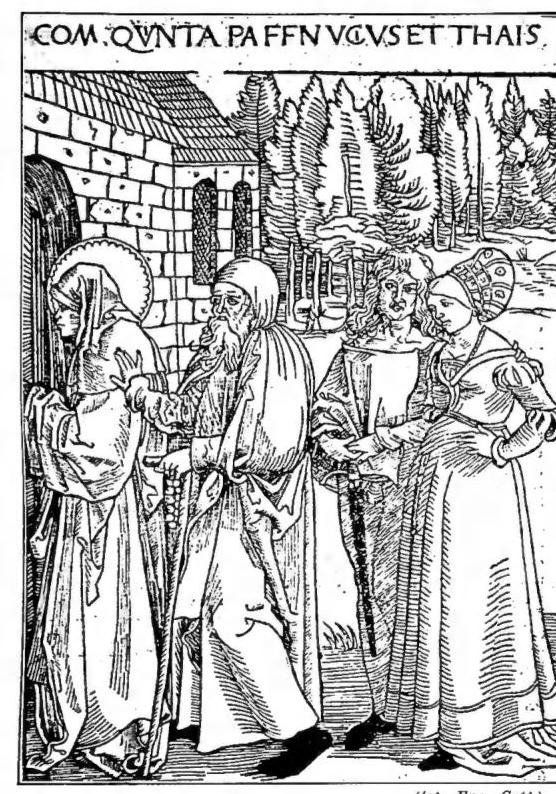
(fot. Enc. Cast.) TAISIA, saint - T. before and after her conversion. Engraving preceding the comedy Paphnutius by Hrotsvitha. From Opera Hronite, Nuremberg 1501 - Copy in the Vatican Library.The legend presents her as a young Christian woman from Alexandria, a courtesan, brought back to the right path by the Abbot Serapion (BHG, 1695; in the Vitae Patrum; PL 73, 661-62 the one who converts her is called Paphnutius; in the Syriac version she is called Bessarion, in a Greek redaction John the Dwarf and the penitent Παϊαία: Nau, V. op. cit. in bibl., p. 80) who shuts her up in a cell of a women's monastery. After three years of penitential life, the author of her conversion frees her from seclusion, but a few days later T. dies. There is insufficient evidence to identify, as has been attempted, the tomb of a certain Θαίας and a certain Serapion, found at Antinoe, now in the Musée Guimet in Paris (cf. H. Leclercq, Antinoe, in DACL, I, II, coll. 2337-40) with that of our Θαϊαία (a Coptic name derived from Isis) and Serapion, her spiritual father. Moreover, in the oldest redactions of the legend the name of T. does not appear, and the courtesan is anonymous. For this reason it is very probable that T. is a fictitious name, and her Vita a morally themed tale of the end of the 4th century, which enjoyed a very wide circulation in the Middle Ages: Hrotsvitha (v.) made it the subject of her comedy Paphnutius; Marbod in the 11th century put it into verse; from the 12th-13th century there are two long poems in French. The Greeks celebrate her feast on Oct. 8.
BIBL.: Synaxarium Constantinop., col. 120; hagiographical texts in BHL, 8012-19, suppl., p. 287; BHG, 1695-97; BHO, 1137; P. Batiffol, La légende de Ste Thaïs, in Bullet. de littér. ecclés., 5 (1903), pp. 207-17; F. Nau, Hist. de Thaïs. Publication des textes grecs inédits et de divers autres textes et versions, in Annales du Musée Guimet, 30, parte 3e (1903), pp. 51-114 (cf. the review of the two above-mentioned studies by H. Delehaye, in Anal. Boll., 24 (1905), pp. 400-401). A. Pietro Frutas
Cite this article
“TAISIA (TAIDE, THAIS), SANTA.” Enciclopedia Cattolica, vol. XI (1953), p. 1033. Azione Romana digital edition, https://azioneromana.com/article/taisia-taide-thais-santa.
 Enciclopedia Cattolica