Machine translation of the 1948–1954 Italian original. The original text is authoritative.
T'AI P'ING, REVOLT OF THE. - An anti-Manchu revolutionary movement that arose and developed under the two emperors Hsienfung (1850-61) and T'ungchi (1861-1875). The revolt was initiated and led by a certain Hung Hsu-tsien (1813-63), a Hakka from near Canton, a failed and disgruntled bachelor of arts, formerly in the service of Protestant missionaries.
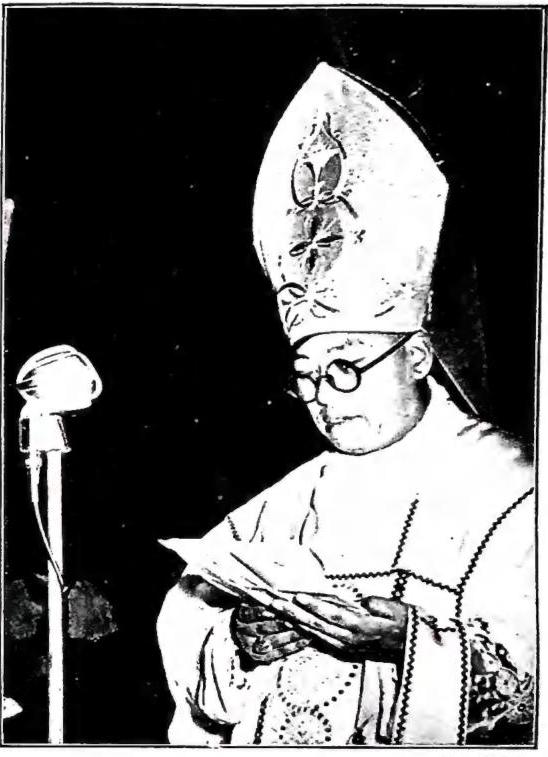
TAIPEH, ARCHDIOCESE OF. - H. E. Msgr. Giuseppe Kuo, first archbishop of T., speaks into the microphone immediately after his consecration, which took place on Oct. 26, 1952. (photo Fides)Upon reading some discourses on the Bible, he became convinced that he was the second Son of God, and therefore the younger brother of Jesus Christ; he baptized himself and, with a friend, went to Kwangsi to preach to the Mao Tse savages (1844). The new gospel promised every good thing on earth and in heaven, and its followers would all escape an impending furious cataclysm. The visionary had good fortune, and in a short time succeeded in forming a formidable army, which took possession of several large cities in the Yangtze River valley. Nanking was captured in 1853, made the capital of the T. Empire, and held for eleven years. They nearly reached Beijing. This revolutionary movement, which aimed at the conquest of China to dethrone the Manchu emperors, threatened China just as it was engaged in the second war against England (1856-60). In 1860 the situation was extremely grave, when Prince Kung, brother of Emperor Hsienfung (d. 1861), with astute maneuvering knew how to take advantage of the new Euro-Manchurian army formed by the two American adventurers Ward and Burgevine, urged on by the major merchants of Shanghai, having it officially recognized by imperial decree on April 16, 1862. It was this "ever-victorious" army that, joined with some imperial troops, succeeded in retaking the cities that had fallen into the hands of the rebels and, under the leadership of Gordon, who succeeded Burgevine, ended the campaign with the capture of Nanking (July 1864). The revolt had lasted fourteen years, had extended to twelve provinces, and had ruined over six hundred cities. Hung Hsu-tsien had committed suicide the previous month.
BIBL.: W. Callery and J. Ivan, History of the T. insurrection, London 1853; H. Egmont Hake, Events in the T. rebellion, ibidem 1891; H. Cordier, Hist. génér. de la Chine, IV, Paris 1920, p. 31 ff. Giovanni Battista Tragella
Cite this article
“T'AI P'ING, RIVOLTA DEI.” Enciclopedia Cattolica, vol. XI (1953), p. 1033. Azione Romana digital edition, https://azioneromana.com/article/t-ai-p-ing-rivolta-dei.