
VALPERGA di CALUSO, TOMMASO. – Abbot, Piedmontese scholar, b. in Turin on 20 Dec. 1737, d. there on 1 Apr. 1815.
A priest open to every field of knowledge, philosopher, philologist, versifier, mathematician, astronomer, a true encyclopedic type formed by his own direct study, he became famous for his many publications, memoirs and essays on the most varied subjects, from *Literaturae Coppicae rudimentum* and *Prime lezioni di grammatica ebraica* to *Principes de philosophie pour les initiés aux mathématiques* and the three books *Della poesia*, etc. He gathered around himself the most cultured and progressive Piedmontese in various academies, encouraging Alfieri, training A. Peyron and C. Boucheron in Oriental studies, and influencing Lodovico di Bremme in the nascent Romantic movement. Gioberti judged him “the most learned man in Italy and perhaps the most universal sage of his time.”
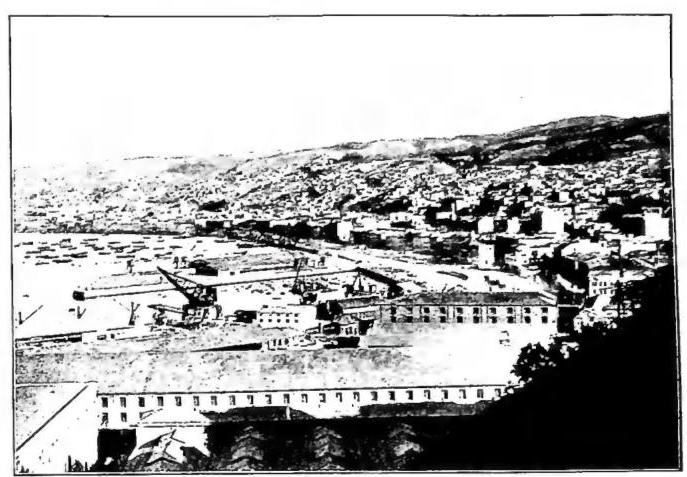
(from K. von Schumacher, *Südamerika*, Berlin 1931, pl. 327)
VALPARAISO, DIOCESE OF. – View of the city and port.
(from K. von Schumacher, *Sudamerika*, Berlin 1931, pl. 327)
VALPARAISO, DIOCESE OF. – View of the city and port.
(from K. von Schumacher, *Sudamerika*, Berlin 1931, pl. 327)
VALPAROGE, HYACINTHE DE. – Oratorian, b. on 6 Jan. 1814 at Caen, d. at Bayeux on 10 Oct. 1876.
After studying medicine he was ordained priest in 1837. Director of the minor seminary at Bayeux, then professor of philosophy at the seminary of Sommervieu, in 1852 he collaborated with Fr. Grattigny in restoring the Congregation of the Oratory and served as professor of theology, novice master and assistant general. Gifted with trenchant dialectic, he wielded his pen against scholars who sought to deny or diminish the value of Sacred Scripture. Against those who argued that Christian doctrine derived from Indian religious beliefs, he published six articles in the *Annales de philosophie chrétienne* (1839–40) under the title *Les doctrines hindoues examinées, discutées et mises en rapport avec les traditions bibliques*. He also combated that eclectic philosophy which aimed to undermine the authority of the Church’s magisterium by means of rationalist logic. In several writings later collected in a volume (*Études critiques sur le rationalisme contemporain*, Paris 1843), he criticized the philosophies of Cousin, Schelling and Hegel. In 1847, in reply to Strauss, he translated and annotated A. Thoulluch’s *Essai sur la crédibilité de l’histoire évangélique*, treating the same topic in various articles for *Le Correspondant* and the *Revue des questions historiques*; finally he wrote *La genèse des espèces. Études philosophiques et religieuses sur l’histoire naturelle et les naturalistes contemporains* (Paris 1873).