
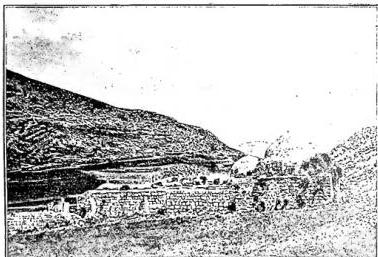
NABLUS (Arabic: Nābulus). - City in Jordan, capital of Samaria, 67 km north of Jerusalem. It was founded by Titus in the year 72 on the site of a small, unimportant village called Mabortha. It was named Flavia Neapolis, from which the present-day Arabic name Nabulus or Nabulis derives. It is situated west of ancient Shechem (v.), with which it was sometimes confused, on a plain between Mounts Ebal (v.) and Gerizim (v.). The new inhabitants were Roman legionaries, who brought great development to the city, also through the erection of public monuments such as baths, thermal establishments, temples, etc. In 244 N. became a "colonia."
In the 2nd century St. Justin (v.) was born there. In the 4th century it became an episcopal see, and the first bishop, Germanus, took part in the Councils of Ancyra (314) and of Nicaea (325). The Christians, however, often had to struggle with the Samaritans, who, among other things, once attacked them on Gerizim during a religious ceremony. Occupied by the Muslims, N. lost its importance until the Middle Ages, when the Crusaders made it a lordship, erecting beautiful churches, without however re-establishing the bishopric there. From 1152 to 1161 it was the residence of Queen Melisende. Occupied by Saladin in 1187, N. remained in Muslim hands, except for a brief interlude in 1242. The churches were converted into mosques. The earthquake of 1927 also brought down the remains of the ancient buildings that had survived, so that today almost nothing is visible in situ. Afterwards, the city began to develop on the slopes of Ebal. Since the Arab-Jewish conflict, many Arabs have taken refuge in it, so that the number of inhabitants, though fluctuating, is around 30,000. The majority are Muslims, but there is a small group of Christians and another very small one of Samaritans. Since 1950 it has been part of Jordan, not without disputes.