
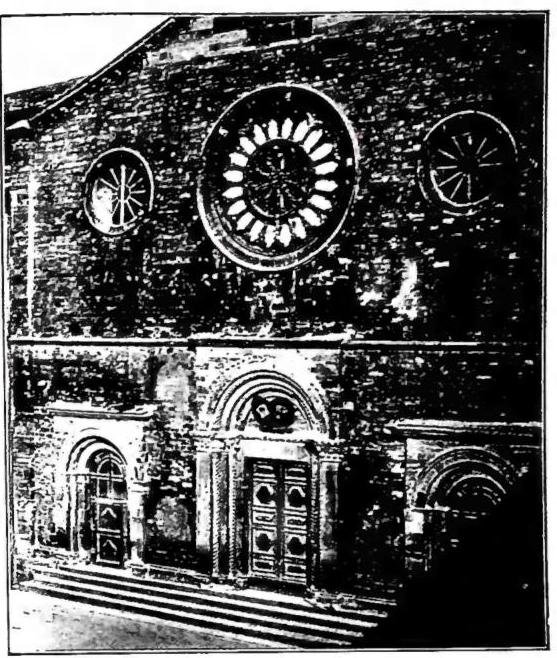
TADINO (GUALDO). - Tadinum was a Roman city on the Flaminia, in Umbria, completely destroyed in the 10th century; from its ruins the present Gualdo T. was built further north, at the foot of the mountain.
At least from the 5th century it was an episcopal see. In July 599 Pope St. Gregory wrote two letters, one to Gaudiosus bishop of Gubbio and the other to the clergy and people of T. "di sacerdoti propri regimine destitutum" so that a new bishop might be elected there (cf. Jaffé-Wattenbach, nos. 1712-13). According to tradition, St. Facondino was elected bishop at that time. The Legenda of St. Facondino, however, available today in two different redactions (the oldest in cod. Vat. lat. 7853 of the end of the 13th century and the slightly more recent one, among others, in cod. Vat. lat. 3921, from which the Bollandists transcribed it for the Acta SS. Augusti, VI, Paris 1868, p. 471 ff.) has no chronological reference. F. Lanzoni, therefore, advanced the hypothesis that the bishop Facondino of T. should be identified with the Facundinus mentioned by St. Athanasius (cf. PG 25, 340) among the fifteen Italian bishops who, although not intervening in person, approved the Synod of Sardica of the year 342. Probably the bishop Gaudentius present at the Roman Council of 499 must also be attributed to T., because the most reliable reading of the codices has: "Gaudentius episcopus Ecclesiae Tadinensis".
With the destruction of the city on the plain, the episcopal see also disappeared and its territory was annexed in 1006 to the nearby see of Nocera. The principal church of Gualdo T., the abbatial one of St. Benedict, was erected as a collegiate church on 26 May 1847 and as a cathedral "honoris tantum causa" by decree of the S. Congr. Concistoriale of 2 Jan. 1915 with the new denomination of diocese of Nocera Umbra (v.) and Gualdo T. The protector of the city is the bl. Angelo, Camaldolese hermit of the 14th century.
Bibliography2 works
Gino Sigismondi