
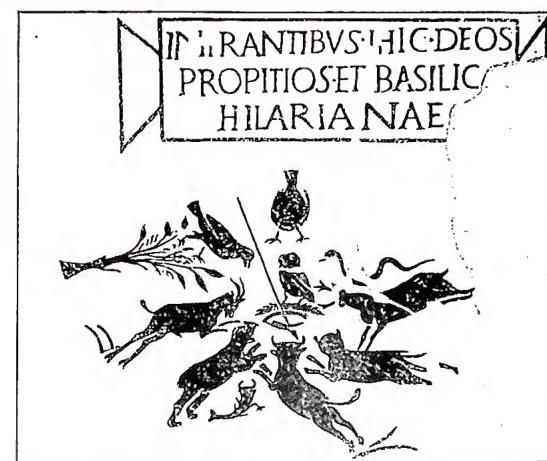
EVIL EYE. - A superstitious popular belief suggested by instinctive impression or by chance unfortunate coincidences, by which it is held that certain individuals emanate a harmful influence to the detriment of persons or things. In general the eye is considered the principal organ that casts the evil influence, whence the epithet "iettatore" (from jettare, "to cast" in the Neapolitan dialect) applied to one who casts it.
The m. can be attributed to a blameless and unfortunate deformity of the gaze or of the body, but also to the positive perfidy of the one who casts it. The Latins called it in this case invidia, from in-video, "I look against" (well known is the spell cast against the envious man, on the floor of the Taberna of the pearl-fishers of Ostia [reg. IV, insula 5]: "invidioso, ti acceco!"); the Greeks called it βάσσανοι, of unknown etymology, on which the Latin fascinum is modeled.
The m. provoked by envy can be exercised to the detriment of persons and of things. As a remedy the ancients used (and it is still used in current practice) gold, an incorruptible metal (Pliny, Nat. hist., XXXIII, 4); branches of coral (surcùli), which, being red and pointed, pierce the evil influence and annul it (ibid., XXXII, 2); amber (sicinum), capable of becoming electrified by friction (ibid., XXXVII, 3); the fascinum and the cyprea, amulets reproducing the genitals, to divert malignant gazes and to soothe them with the smile provoked by the display; these amulets, enclosed within a case (bulla), were hung around the necks of children, who moreover were under the special protection of the goddess Cunina (Tertullian, Ad nat., II, 11); rue (ibid., XIX, 27); smilax and other thorny plants, to pierce and hold back the evil influence (Dioscorides, IV, 1, 39); the ásaro (baccdr) against excessive praise, which is a stimulus to envy (Servius, Ad Ecl., VII, 27); to avert the possible harm of this praise the Latins added an adverb: prae fascine! that is, "may it be without fascinum, may no harm come of it!"
The m. against things was directed against the fields or against the neighbor's flock and was called incantesimo (from cantus), because it was performed with a modulated magic formula. The law of the Twelve Tables (tav. VIII, 1, 8, Bruns) forbids causing the fruits of a neighbor's field to pass into one's own field by this means; Virgil (Ecl. VIII, 99) alludes to the m. that fascinates lambs.
Bibliography6 works
Nicola Turchi