
LA MENNAIS, JEAN-MARIE-ROBERT de, venerable. — A distinguished educator and formidable opponent of Gallicanism, born at St-Malo (France) on 8 September 1780, died at Ploërmel in a reputation for sanctity on 26 December 1860. During the Revolution he assisted proscribed priests, and one of them, secretly sheltered in his parental home, initiated him into theological studies. Ordained in 1804, he served as assistant parish priest and professor. Having withdrawn because of illness to the country house called La Chesnaie, he directed his brother Félicité toward the study of ecclesiastical sciences.
Notable works arose from the collaboration of the two brothers: Réflexions sur l'état de l'Église en France au XVIIIᵉ siècle (1808), Guide spirituel (1809), Tradition de l'Église sur l'institution des évêques (1814). In general, the research should be attributed to Jean-Marie, and the arrangement of the material and the drafting to Félicité.
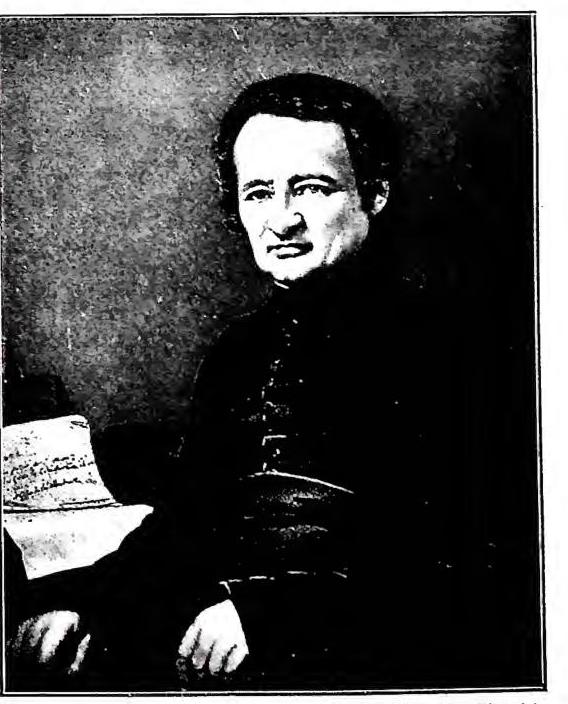
In 1814 he became secretary to Msgr. Caffarelli, bishop of St-Brieuc, and, after his death, capitular vicar. In 1816 he founded the Daughters of Providence and in 1817 the Brothers of Christian Instruction, which he united that same year with those DESHAYES, GABRIEL (v.). Forced to leave St-Brieuc shortly after the arrival of Msgr. (de la Romagère, in 1822 he was summoned to Paris as vicar general of the Grande Aumônerie. In that high position, he contributed to the appointment or transfer of some forty bishops, repeatedly refusing the episcopate for himself. Returning to Brittany in 1824, he established the center of his extensive activity at Ploermel. He founded a new institute, the Priests of St-Méen (1825), shortly afterward transformed into the Congregation of St. Peter, whose leadership he left to his brother in 1828, while retaining overall direction of the novitiate at Malestroit. Re-elected superior general after Félicité’s resignation (1833), he censured, as soon as it was published, the pamphlet Paroles d'un croyant, in a confidential letter imprudently published by Msgr. de Lesquen. His martyrdom of the heart then began. Félicité’s first condemnation (1832) had shaken the Congregation of St. Peter; the second (1834) ultimately threw it into confusion and discord. The Superior was condemned and expelled without the convocation or deliberation of the Curia of that society, which he presided over as its duly elected head. Meanwhile, Félicité turned his back on him, plunging into apostasy. Humiliated, brokenhearted, but not disheartened, Jean-Marie continued to devote himself wholeheartedly to educational work.
He endowed Brittany with schools and boarding schools; the Brothers, invited by the Minister of the Navy, crossed the seas and evangelized Black people in various French colonies, contributing substantially to the peaceful abolition of slavery in the Antilles. The cause for the beatification and canonization of L. M. was introduced on 22 May 1911.