
LANA TERZI, FRANCESCO. – Jesuit, mathematician, and physicist, born in Brescia on 10 December 1631, died there on 22 February 1687. He taught grammar at the College of Terni with such acclaim that the right of citizenship was to be granted to him and his family; he reciprocated with the sacred drama: La rappresentazione di s. Valentino martire e protettore di Terni con la coronazione di Tacito e Floriano, terniani, imperatori romani (Terni 1656). He subsequently devoted himself to the sciences and taught philosophy—which at that time also included physics and the natural sciences—for three years in Brescia, and then mathematics for six years at the University of Ferrara; he spent the remainder of his life in Brescia, occupied with his inventions and the writing of his works.
Already in Rome, under the inspiration of Fr. A. Kircher, L. T. had carried out several noteworthy experiments, which he subsequently continued and which formed the subject matter of his publications. These include, besides an essay on the natural history of the province of Brescia, in Latin (left incomplete and published in translation by C. Pilati in Saggio di storia naturale bresciana, I, Brescia 1769, pp. 13 ff.), the work: Prodromo ovvero saggio di alcune invenzioni nuove, premessa all'Arte Maestra (Brescia 1670), which is something of a prologue to the more complete and learned work: Magisterium naturae et artis (I–II, Brescia 1684–86; vol. III, posthumous, Parma 1692). In the Prodromo (chap. 6) he studies
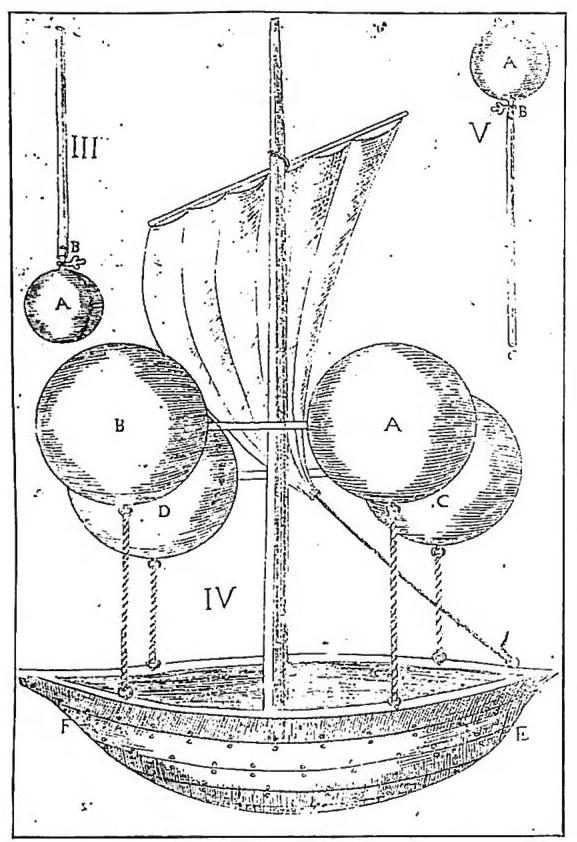
LANA TERZI, FRANCESCO - Vessel capable of maintaining itself in the air with oars and sails. A.B.C.D.: Four air-filled spheres; F-E: wooden boat with sail. Copperplate engraving - Specimen of the Biblioteca della Civiltà Cattolica.
He specifically considers the possibility of constructing “a vessel that moves through the air with oars and sails”; and he provides its figure, description, and the scientific principles on which it is based. The report aroused much admiration (Fr. B. Zamagna composed a poem about it: Navis aerea et elegiarum monobiblos [Rome 1768]) as well as objections. It is not known with certainty whether L. T. actually built his vessel, nor whether, once built, he tested it; he nevertheless retains the merit of having posed the problem and, as one of the first, sought to resolve it scientifically. Other inventions of L. T. concern a new method for reading by the blind, improvements to the microscope and telescope, etc.