
Néron, Pierre-François, Blessed

NÉRON, PIERRE-FRANÇOIS, blessed. — Of the Paris Foreign Missions, martyred in Tonkin on 3 November 1860. Born on 21 September 1818 at Bornay (Jura), he entered the Seminary of the Missions as a layman at the age of 28.

Ordained on 17 June 1848, he departed in August of the same year for Western Tonkin. Professor of philosophy and mathematics at the Seminary of Ke-vinh, he translated mathematical texts into Annamite. Captured in 1860, he was decapitated at Son-Tay, after preparing himself for martyrdom through a prodigious fast of 21 days. He was beatified by Pius X on 2 May 1909, together with other martyrs of Annam.
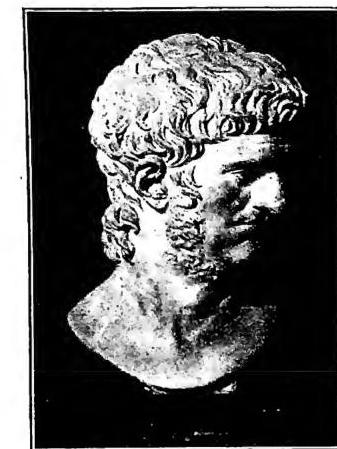
Article illustration
(Alinari photograph) NERONE, ROMAN EMPEROR — Portrait — Rome, Capitoline Museum
Proclaimed emperor in October 54, during the first five years of his reign he showed himself rather mild, merciful, and munificent; but thereafter he allowed himself to be dominated by his passions and, while professing himself a lover of poetry and Hellenistic arts, placed no restraint on his mania for spectacles, pomp, and cruelty. On the basis of mere suspicions, he had his mother, two wives, tutors, and friends killed. Hated by all, he escaped a first conspiracy in 65 by drowning it in blood; but in 68 the soldiers stationed in Spain, having rebelled, acclaimed Galba emperor, who was recognized by the senate and the praetorians. N., forced to flee, took refuge in the villa of one of his freedmen, where he killed himself.

The pretext for persecuting the Christians was the fire of Rome in July 64. The fire, which broke out near the Circus Maximus and was fanned by the wind, engulfed the entire city; of the fourteen regions into which it was divided, three were completely destroyed and seven more or less devastated. At the beginning of the fire N. was at Antium; he hastened back to Rome and, to pacify the rioting populace, had grain brought in from the neighboring cities, built shelters, and ordered public supplications to the gods. Despite this, popular hatred accused him of having caused the fire: there was, in fact, no shortage of indications to that effect. To divert the accusation from himself, N. identified the Christians as its perpetrators (Tacitus, Annales, XV, 38–43), and they were punished.

N. ordered public spectacles in his gardens near the Vatican, at which Christians were crucified, wrapped in animal skins and exposed to the bites of dogs, subjected to cruel and shameful tortures, smeared with combustible substances, and then burned alive as torches to illuminate the games at night. The emperor rode around the gardens in his chariot, enjoying the spectacle and mingling with the crowd; but the people murmured against him because they knew that such slaughter and so much blood were being shed without any public benefit, solely because of the cruelty of one man (Annales, XV, 44). The persecution under N. will be discussed in V. PERSECUZIONI.

BIBL.: C. Pascal, L'incendio di Roma e i primi cristiani, Milan 1900; G. Semeria, Il primo sangue cristiano, Rome 1900; A. Coen, La persecuzione neroniana dei cristiani, in Atene e Roma, 3 (1900), pp. 249 ff., 297 ff., 329 ff.; A. Profumo, Le fonti e i tempi dell'incendio neroniano, Rome 1905; T. Klette, Die Christenkatastrophe unter Nero nach ihren Quellen; Tübingen 1907; G. Schönsich, Die neronische Christenverfolgung, Breslau 1911; F. Grossi-Gondi, I primi allori di Roma cristiana, Rome 1921; H. Lietzmann, Petrus und Paulus in Rom, Berlin 1927; O. Marucchi, Pietro e Paolo a Roma, 4th ed., edited by C. Cecchelli, Turin 1934; For the history of N., cf. Tacitus, Annales, XIII–XVI; Suetonius, Vita Neronis; Cassius Dio, Epitomes, LXI–LXIII; and furthermore: H. Schiller, Gesch. des röm. Kaiserreichs unter Nero, Berlin 1872; B. V. HERMON, The Life and Principate of Nero, 2nd ed., London 1905; A. Bailly, Neron, Paris
BIBL.: E. Chamouton, Le bienh. P.-P. N., martyr, Lons-le-Saunier 1909; A. Launay, Mémorial, II, Paris 1919, pp. 474; Streit, Bibl., XI, p. 226. Romeo Bellotti
Cite this article

“NÉRON, PIERRE-FRANÇOIS, BEATO.” Enciclopedia Cattolica, vol. VIII (1952), p. 1037. Azione Romana digital edition, https://azioneromana.com/article/neron-pierre-francois-beato.