Machine translation of the 1948–1954 Italian original. The original text is authoritative.
OMOFORIO. – Liturgical vestment, distinctive of the bishops of the Byzantine, Armenian, Syrian, Maronite, and Coptic rites, it is a silk scarf (band, sash), 3 or 4 m. long and 0.25–0.30 m. wide, thrown freely
over the chest and shoulders so as to let one end hang in front and the other behind; among the Syrians and Maronites, however, an opening is made in the middle of the o. to allow the head to pass through, and the o. is worn like a scapular.
The o. corresponds to the Latin pallium, with the following differences: a) whereas the pallium is the distinctive vestment of the pope and archbishops and is rarely granted to a bishop, the o. is now given to all bishops of the aforesaid rites; b) whereas the existence of the pallium can be traced back to the 5th century, for the o. one goes back to the 4th century (cf. Isidoro Pelusiota: PG 78, 272) and its first representation to the 5th century; c) the form of the pallium has changed considerably, whereas the o. in the Byzantine, Armenian, and Coptic rites has preserved its ancient form. According to a new hypothesis, the origin of the o. should be sought in the large and small pallium of the monks (cf. Synod of Gangra [340–341], can. 12). – Vedi tav. VI.
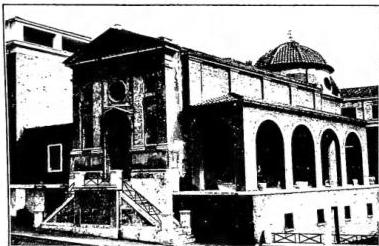
OMOBONO, santo – Church of s. O. de' sarti along the Via del Mare, built at the end of the 16th century, with subsequent restorations – Rome.
BIBL.: A. J. Butler, The ancient Coptic Churches of Egypt, II, Oxford 1884, pp. 143–62; P. Bernardakis, Les ornementes liturg. chez les Grecs, in Échos d'Orient, 3 (1902), p. 133 ff.; J. Braun, Die liturgische Gesandung, Friburgo in Br. 1907, pp. 664–74; J. Muyldermans, Le costume liturg. arménien (extract from Muséon), Lovanio 1926, pp. 286–90; A. Raes, Introd. in liturgiam orient., Roma 1947, pp. 238–40; B. Stefanides, Η τών αδραστρολογικών εὐθυμάτων τοῦ βυζαντίου ἐπιδράσις ἐπὶ τῶν ἀρχιερατικῶν ἀμσίων, in Θεολογία, 21 (Atene 1950), pp. 23–24. Alfonso Raes
Cite this article
“OMOFORIO.” Enciclopedia Cattolica, vol. IX (1952), p. 102. Azione Romana digital edition, https://azioneromana.com/article/omoforio.