
TACHARD, Guy. - Jesuit missionary, b. at Angoulême on 7 Apr. 1651; d. in Bengal on 21 Oct. 1712.
After several years of teaching in the Colleges of the Order, he accompanied Marshal d’Estrées on a long journey to the colonies of South America (1680–84); in 1685 he visited the court of Siam with the French ambassador, M. Chaumont, returning as interpreter with Siamese ambassadors whom he presented to Louis XIV and to the Pope; in 1689 he set out again for India, exercising his ministry in Bengal.
Besides several important letters inserted in the Lettres édifiantes et curieuses (II, Paris 1843, pp. 317–29; 425–37), he published: Voyages de Siam des Pères Jésuites envoyés par le Roy aux Indes et à la Chine, avec leurs observations astronomiques et remarques de physique, de géographie, d’hydrographie et d’histoire (ibid. 1686; Italian ed., Milan 1693); Second voyage du p. T. et des Jésuites, envoyés... au Royaume de Siam avec... (ibid. 1686). The two works
were conceived to save labour and materials, or for secrecy. But when the need arose to follow and preserve the words of speakers and public debates, attempts were made to replace common abbreviations with new and special writing devices: simplifications of letters, variations of signs and monogrammatic formations, from which a particular style of writing developed.
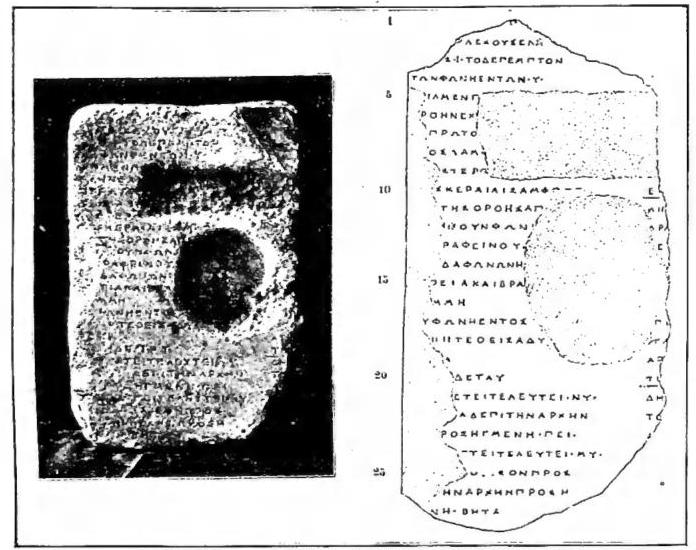
It is believed that in Greece attempts of this kind arose as early as the 4th century B.C., following the development of oratory and the dissemination of philosophy, and Xenophon (cf. Diogenes Laertius, Vita Xen., II, 48) is credited with having collected Socrates’ discourses by means of σημεία, or signs (distinct from γράμματα, or ordinary letters). There are, however, no traces of this ancient Greek tachygraphy, and it is still doubtful whether the signs on an inscription from the Acropolis (350 B.C.), now in the National Museum of Athens, and those on two tablets from the 3rd century discovered in 1894–95 among the ruins of the Temple of Apollo at Delphi belong to II. The oldest and most reliable examples of Greek tachygraphy date from the 2nd–4th centuries A.D. (the tombstone of Asterius at Salona, the Leipzig papyri, syllabaries).
More information survives regarding Latin tachygraphy. The poet Quintus Ennius is credited (Isidore, Etym., II, 22) with the first notae vulgares; Marcus Valerius Probus established a system of sigla (singulae litterae) in opposition to a truly tachygraphic one. But the best known is that which took its name from M. Tullius Tiro (100–4 B.C.), Cicero’s freedman, whose first application is said by Plutarch to have occurred on 5 Dec. 63 B.C., when, at Cicero’s direction as consul, the speech of Cato of Utica against Catiline was recorded in the Senate.
Direct knowledge of Tiro’s system is, however, lacking. The oldest surviving documents with Tironian notes (so called from the 4th century onwards) date from the 9th–10th centuries (Commentaries of Cassel, Paris, Berne, Madrid), and from these attempts have been made to reconstruct historically their formation and development. According to the most recent studies, the notae consisted primarily in the simplification of sigla and letters already in use, especially of cursive writing; they could take multiple forms and positions, be written upright or inverted, according to the meanings to be conveyed and the parts—initial or secondary—of the words to be indicated. The signs could be combined in the manner of ancient ligatures; contraction and truncation, crossing and the use of dots were widely employed, and, where necessary for distinctions, Greek or Italic signs were also used. From the 1st century, with the development of a Greek tachygraphy corresponding to the spread of Hellenic culture, reciprocal Greek-Latin influences are also noted in monogrammatic formation, with a more decisive use of two kinds of signs: the signum principale, for the essential part of the word, and signa auxiliaria (small and written like exponents) for the endings. Although it has not been possible, despite various attempts, to reconstruct a Tironian grammar, it is now certain that this tachygraphy was not merely a collection of conventional signs to be laboriously memorised.
After Tiro, others contributed to the development of Roman tachygraphy, notably Vipsanius Philargyrus, freedman of Agrippa (13 B.C.), Aquila, freedman of Maecenas (8 B.C.), and Seneca, perhaps the philosopher, who collected and organised the whole system (as attested by St Isidore) into 500 notes; its diffusion is mentioned by writers from the 1st century B.C. (Cicero, Quintilian, Horace, Ovid, Martial, Manilius, Pliny). Ausonius (q.v.) composed an ode in its honour. A new impetus came with Christianity through the notarii or exceptores, who recorded the trials of martyrs, sometimes themselves condemned (St Genesius of Arles, St Adrian of Nicomedia, St Cassian of Tangier) for having cast aside their tablets and stylus.
---
TACHYGRAPHY - TALE OF THE ACROPOLIS OF Athens (350 B.C.) - Athens, National Museum.
These works mark an important point in the history and geography of Asia.