TRONCHI, BARTOLOMEO. – Jesuit, engraver, b. at Brezzo (Florence) in 1529, d. at Rome on 23 Nov. 1604.
Having entered the Order in Rome in 1564, already an adult and skilled in his art, he spent the rest of his life moving from one Jesuit church to another, thus traversing Italy and leaving everywhere an indelible mark with his tabernacles, crucifixes, coffered ceilings, and altar ornaments. Many of these works, however, were destroyed (e.g., the tabernacles of Siena and Nola, of the Gesù in Rome, and of the Gesù in Palermo), but those of the Gesù in Perugia (with a crucifix and coffered ceiling), of S. Giovanni in Florence—a marvel to the court and foreigners—and the crucifix in the sacristy of the Gesù in Rome are still preserved. Tronchi’s artistic forms, marked by a refined and austere Tuscan taste, were soon replaced by richer and more lavish works less suited to the liturgical spirit.
TRON

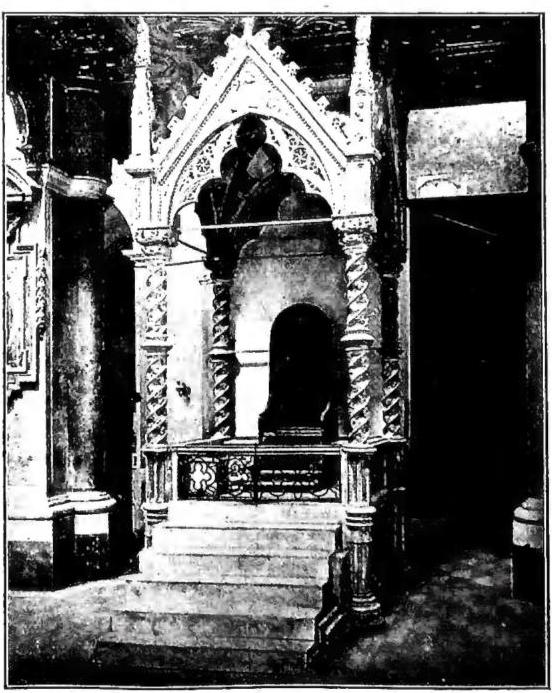
Tsonio - Episcopal throne (14th c.) - Naples, Cathedral.
O (thronus, cathedra, sedes). – It is the seat reserved for the bishop in his cathedral church for pontifical functions.
Originally it was of the type of the senatorial chair (v.), and later became not merely a doctrinal cathedra but an honorary throne on a high dais of steps with a canopy, modeled on the Byzantine imperial throne granted to imperial state officials; made of stone or marble. It was located at the back of the apse of the basilica until the 10th and 12th centuries. Already in the Carolingian period, especially since the high altar was moved to the apse, the throne was placed in front of the altar on the Gospel side (Ordo Rom. II, 2, 3; V, 21 [ed. Andrieu: II, 115, 231]). Both positions, in the apse and to the right of the altar, are also envisaged in the Caeremoniale Episcoporum (lib. I, cap. 13, and 2). The one on the side (in the Middle Ages movable and without a canopy: Durandus, Rationale, lib. II, cap. 11, 2) remained permanently in place. The seat (of wood, stone, or metal) is raised on three steps, covered with carpets, and surmounted by a canopy; it takes the form of an armchair with a back and is draped in cloth (or silk) of the color appropriate to the pontifical function; the back is adorned with the prelate’s coat of arms.
As a symbol of the supreme sacerdotal and juridical power of the diocese, the throne is reserved solely for the bishop of the diocese; the coadjutor and auxiliary bishops and other bishops must use the faldstool (v.) placed to the left of the altar, called the Epistle side; exceptions are made for the archbishop within his metropolitan territory, for whom in the cathedral church of a suffragan see the throne is set up on the Epistle side, while the Gospel side throne is reserved for the diocesan bishop; cardinals in all churches outside Rome (in their presence, out of reverence, the Ordinary uses the faldstool); nuncios in the churches of their territory, in the cathedral with the bishop’s consent. With the concession of pontifical functions, the bishop may also grant the use of the throne with canopy (CIC, can. 337, 3) to titular bishops in the cathedral itself, but never to a coadjutor or auxiliary bishop. Abbots also have the use of the throne (with two steps) with a canopy in their abbatial churches (CIC, can. 325).
The act of taking possession of the diocese is called the “intronization” of the bishop; liturgical intronization has been part of the consecration ritual since ancient times; the juridical intronization, of the “canonical provisio seu institutio” (CIC, can. 332, 1; 334, 3), is performed by presenting the apostolic letters to the Chapter of the cathedral church.
In the Greek rite a double throne is used: the older one at the back of the apse, similar to the ancient cathedra; and the more recent one with a high back and canopy in the nave of the church, similar to the episcopal throne in the West.
The small throne with canopy, also called a tabernacle or residence, prescribed for the public exposition of the Blessed Sacrament, consists of a base or pedestal, a back of white cloth or silk, and a canopy, sometimes supported by columns; it is movable, i.e., used and placed only for eucharistic exposition (Decr. auth. 4268 ad 4 of 27 May 1911). It is not permitted, outside of exposition, to place a cross upon it; nor is it fitting to place the small throne above the tabernacle.