
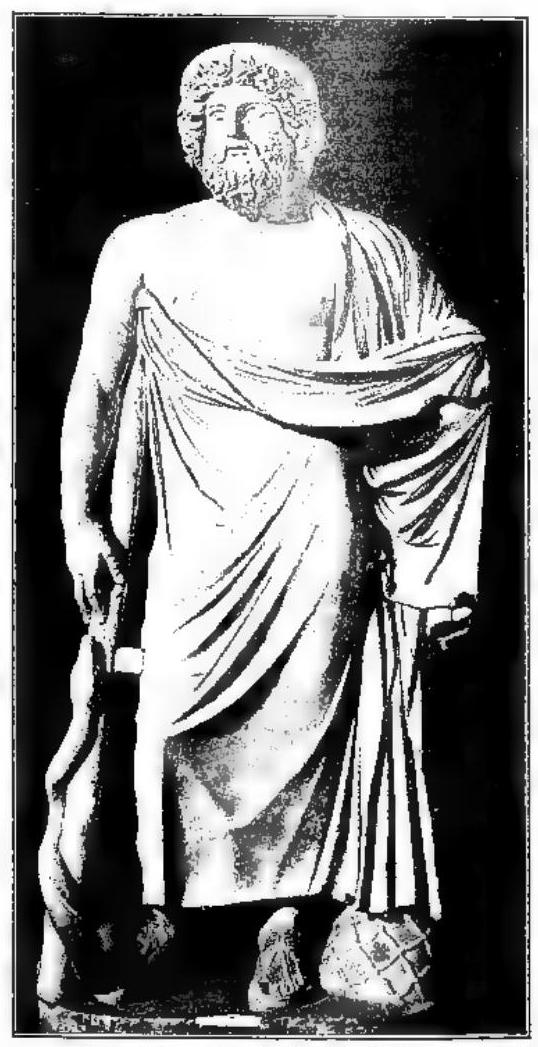
ASCLEPIUS (Ἀσκληπιός). - Greek god of medicine. Numerous etymologies have been proposed to explain his name, both from Greek and from the Semitic languages; some have also supposed a pre-Hellenic origin.
According to others, E. would have been an ancient chthonic (subterranean) god who was worshiped in a war near Tricca in Thessaly, perhaps in the form of a serpent, and there would have given oracles. Then he would have spread into Phocis and Messenia; at Delphi Apollo would have become the father of E. and, at Epidaurus the cult of E. would have acquired notable importance. Both hypotheses present difficulties. It is certain that for unknown reasons, whether they be accidental or created, as has been claimed, by the skillful propaganda of the local priests, E. became an important god at Epidaurus toward the end of the 6th century and the beginning of the 5th century B.C. and spread rapidly. Numerous branches of Epidaurus arose in Greece, in Asia Minor and in the colonies. After 480 B.C. that of Sicyon was founded; in 422 that of Aegina; in 420 that of Athens, where the sacred serpent, transported on a cart from Epidaurus, was housed in the Eleusinion until the sanctuary below the Acropolis was ready. The branch of Munichia is remembered in Aristophanes' Plutus, that of Cos seems to date back to the 4th century B.C., while the founding of the sanctuary of Pergamon, which rose to great fame in the 1st-2nd centuries A.D., is uncertain: its attribution to the 4th century is uncertain. The branches did not harm Epidaurus, which always remained the most famous location. In many places E. replaced and overshadowed pre-existing divinities: at Epidaurus, as already said, Apollo Maleatas, whom the oldest inscriptions remember together with E.; at Munichia the gods remembered in the preparatory sacrifice; at Cos Apollo. It is not known whether the replaced divinities were also healing divinities, but it seems plausible at least for Munichia.
The sanctuaries for E. were called Asclepieia. The center of the cult was the spring sacred to the god, included in the temple of which it constituted the most secret part (adytus). Near the temple were the porticoes intended for the sick and the faithful. The rite of incubation was practiced; after ablutions and sacrifices the sick person was shut in the adytus and spent the night there: the dream he had, interpreted by the priests, decided the cure, unless the sick person awoke healed. Pausanias saw at Epidaurus six stelae covered with inscriptions that recorded the dreams and the healings that had occurred; three of these and fragments of a fourth have been found: they narrate instantaneous and miraculous healings and were intended to edify and convince the faithful of the god's power. However, it is not solely a matter of suggestion, of charlatanry, or of miracle: in the Asclepieia long treatments and surgical operations were performed; they were true places of healing, often in elevated locations with woods and a healthy climate that exercised a beneficial influence on the sick. The priests were not always doctors, but in any case they were in possession of empirical cures and recipes, often effective, as, for example, at Cos those against the bite of serpents.
From Podalirius and Machaon, the two sons of E. remembered in the Iliad, descended the Asclepiads, famous in the medical art. To the Asclepiads of Cnidos belonged Hippocrates, the father of Greek medicine. Legend knows numerous sons and daughters of E., Panacea, Telesphorus, etc.; the best known is Hygieia, depicted together with her father on numerous votive reliefs.
In honor of E. the festivals called Asclepieia were celebrated; at Epidaurus the great Asclepieia had hymnic and musical contests. Among the cults of E. those of Arcadia are characteristic, with temples dedicated to E. as a child; that of Titane in the Argolid, where every medical care is lacking and serpents are an object of fear. The image of E. was clothed in a chiton and a woolen cloak, that of Hygieia was completely covered by the hair that women cut off in her honor.
Following the epidemic of 293 B.C., after consultation of the Sibylline Books, the cult of E. was introduced at Rome: the temple was on the Tiber Island and was dedicated on January 1, 189. The sacred serpent, brought from Epidaurus, would have taken refuge on the Island to indicate that the temple was to be built there. Here too incubation was in force and the sick expressed their gratitude with inscriptions and votive gifts. The cult of E. did not spread outside of Rome: votive inscriptions are rare in Italy and in the western provinces, where the healing god remained above all Apollo.
The ancients represented E. as a mature man, bearded, with a gentle and benign face, sometimes full of compassion. His attributes were the staff and the serpent.
Bibliography3 works
Luisa Banti