
BĀBAJ bar NĒSĪBNĀJĒ. — Nestorian monk of the sixth century, also called the Little One, to distinguish him from Bābaj the Great, with whom he had serious disagreements. Born in Nisibis, at the age of 22 he donned the monastic habit under the direction of Abraham of Kaškar; at the latter’s death (588), B. withdrew to a cave in the mountain of Adiabene (or Hazzah), and after many years returned to Mount Izlā, where
on the ruins of the ancient monastery of Mār Samuel he founded a new one, which bore his name. He survived this foundation by 31 years and died at the age of 75 and a half, no earlier than 630.
He wrote metrical sermons (mēmēr) on penance, and hymns for the Sundays after the Epiphany, for the fast of the Ninevites, and for the Lenten fast; these are found in various manuscripts in Mosul, Cambridge, Paris, and Berlin. The hymns for the Sundays are printed in The Book of Governors by Bugde (II, London 1893, p. 300), and in the Chaldean Breviary in Kētabā daqdam wa dēbātar (Urmia 1901). The Lenten texts are also printed in the latter two works. J. A. Maclean, East Syr. Office (London 1894), and Theologische Quartalschrift, 48, pp. 193 ff., contain translations of many hymns. Other works among those attributed to B. by 'Abdīšō' (G. S. Assemani, Bibl. Orient., III, III, Rome 1725, p. 181) are lost.
Pietro Sfair
BABELE, TORRE di. “A structure erected in Babylon (Babel) for political-religious purposes, and left unfinished (Gen. 11:1-9). The fragmentation of humanity into discordant peoples derives from a collective ‘original sin’ (cf. Ps. 2:4): it is a punishment from Jahweh, because the unity of human beings fostered their proud revolt against God. The inhabitants of Shinar (Babylonia) decided to build, with bricks and bitumen, a city dominated by a tower ‘whose top may reach the heavens; thus we shall make a monument for ourselves (šēm, as in II Sam. 8:13) and remain united’. The tribes wished to build an ‘exceedingly high’ temple tower (this means ‘up to heaven’ in Sumerian and Akkadian), in order to symbolize the unity of their pagan kingdom. Indignant at such titanic pride (cf. Is. 14:13-15), God (Jahweh throughout the passage, which O. Happel, following H. Gunkel, wrongly seeks to divide into two documents: J¹ and J²) confounds the languages—that is, the builders’ common agreement in thought—and, abandoning their ambitious undertaking, they disperse throughout the world. The name Babel evokes ‘confusion’, according to the popular etymology (bal-bēl from the verb bālal; but in reality it is Bāb-ili: ‘gate of the god’, as confirmed by the Sumerian name Ka-dingir-ra³⁴).
The biblical event must be placed either in the Neolithic period (A. Bea, in Verbum Domini, 18 [1938], p. 15) or, as the use of bricks would suggest, in the Chalcolithic period. The idioms may perhaps already have been differentiated at that time (Gen. 10:5, 20, 31); certainly languages branched out with the slow formation of peoples, as St. Gregory of Nyssa already observed (Adv. Eunom., XII: PG 45, 996 ff.). According to J. Chaine (p. 68), the biblical account would be ‘a response by Jewish folklore to the question of the origin of languages’.
No allusion has so far been found to this or a similar account in cuneiform documents. The text of Alexander Polyhistor (80-40 B.C.) in Eusebius (Chron., I, 4: PG 19, 123; Praep. Evang., IX, 14: PG 21, 701) depends on the Jewish Sibyl (III, 97 ff.), that is, on a haggadic legend. In the scant references contained in the primitive traditions of the peoples of India, Persia, and Greece, the attempt to reach heaven by means of a construction and the confusion of languages do not appear in a causal connection; the legends concerning this matter in Central America and Korea are due to Christian influences (P. Heinisch, Das Buch Genesis, Bonn 1930, p. 201). The Greek myth of the construction by the Titans rebelling against heaven (Virgil, Georg., I, 281) is adapted to the t. of B. by Dante (Inf., XXXI, 77 ff.; De Vulg. Eloq., I, 7-8), who consistently cites Nemrod (‘Nembrōt’: Purg., XII, 34-36; Par., XXVI, 124-26) as its author. P. Della Valle calls it the ‘Tower of Nembrotto’.
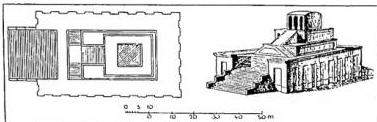
from C. Brzald, Ninive und Babylon, (a ed. Leipzig 1930)