BELLUGA Y MONCADA, LUIS ANTONIO

BELLUGA Y MONCADA, LUIS ANTONIO. — Spanish cardinal and theologian, b. at Motril in 1662, d. at Rome in 1743. He founded at Cordova the Congregation of the Oratory. Bishop of Cartagena (1705), captain-general and viceroy of Valencia, he armed a battalion of 4000 men to fight against the rebels of Murcia.
BELLUGA Y MONCADA, LUIS ANTONIO. — Spanish cardinal and theologian, born at Motril in 1662, died at Rome in 1743. He founded at Córdoba the Congregation of the Oratory. Bishop of Cartagena (1705), captain general and viceroy of Valencia, he armed a battalion of 4,000 men to fight against the rebels of Murcia.
BELLUGA Y MONCADA, LUIS ANTONIO. — Spanish cardinal and theologian, b. at Motril in 1662, d. at Rome in 1743. He founded at Cordova the Congregation of the Oratory. Bishop of Cartagena (1705), captain-general and viceroy of Valencia, he armed a battalion of 4,000 men to fight against the rebels of Murcia.
BELLUGA Y MONCADA, LUIS ANTONIO. — Spanish cardinal and theologian, b. at Motril in 1662, d. at Rome in 1743. He founded at Córdoba the Congregation of the Oratory. Bishop of Cartagena (1705), captain-general and viceroy of Valencia, he armed a battalion of 4,000 men to fight against the rebels of Murcia.
BELLUGA Y MONCADA, LUIS ANTONIO. — Spanish cardinal and theologian, b. at Motril in 1662, d. at Rome in 1743. He founded at Cordova the Congregation of the Oratory. Bishop of Cartagena (1705), captain-general and viceroy of Valencia, he armed a battalion of 4,000 men to fight against the rebels of Murcia.
BELLUGA Y MONCADA, LUIS ANTONIO. — Spanish cardinal and theologian, born at Motril in 1662, died at Rome in 1743. He founded at Cordova the Congregation of the Oratory. Bishop of Cartagena (1705), captain general and viceroy of Valencia, he armed a battalion of 4,000 men to fight against the rebels of Murcia.
BELLUGA Y MONCADA, LUIS ANTONIO. — Spanish cardinal and theologian, b. at Motril in 1662, d. at Rome in 1743. He founded at Cordova the Congregation of the Oratory. Bishop of Cartagena (1705), captain-general and viceroy of Valencia, he armed a battalion of 4,000 men to fight against the rebels of Murcia.
BELLUGA Y MONCADA, LUIS ANTONIO. — Spanish cardinal and theologian, born at Motril in 1662, died at Rome in 1743. He founded at Córdoba the Congregation of the Oratory. Bishop of Cartagena (1705), captain-general and viceroy of Valencia, he armed a battalion of 4,000 men to fight against the rebels of Murcia.
BELLUGA Y MONCADA, LUIS ANTONIO. — Spanish cardinal and theologian, b. at Motril in 1662, d. at Rome in 1743. He founded at Córdoba the Congregation of the Oratory. Bishop of Cartagena (1705), captain general and viceroy of Valencia, he armed a battalion of 4,000 men to fight against the rebels of Murcia.

BELLUGA Y MONCADA, LUIS ANTONIO. — Spanish cardinal and theologian, b. at Motril in 1662, d. at Rome in 1743. He founded at Córdoba the Congregation of the Oratory. Bishop of Cartagena (1705), captain general and viceroy of Valencia, he armed a battalion of 4,000 men to fight against the rebels of Murcia.
BELLUGA Y MONCADA, LUIS ANTONIO. — Spanish cardinal and theologian, born in Motril in 1662, died in Rome in 1743. He founded the Congregation of the Oratory in Córdoba. Bishop of Cartagena (1705), captain general and viceroy of Valencia, he armed a battalion of 4,000 men to fight against the rebels of Murcia.
BELLUGA Y MONCADA, LUIS ANTONIO. — Spanish cardinal and theologian, born in Motril in 1662, died in Rome in 1743. He founded the Congregation of the Oratory in Córdoba. Bishop of Cartagena (1705), captain general and viceroy of Valencia, he raised a battalion of 4,000 men to fight against the rebels of Murcia.
BELLUGA Y MONCADA, LUIS ANTONIO. — Spanish cardinal and theologian, b. at Motril in 1662, d. at Rome in 1743. He founded at Córdoba the Congregation of the Oratory. Bishop of Cartagena (1705), captain-general and viceroy of Valencia, he armed a battalion of 4,000 men to fight against the rebels of Murcia.
BELLUGA Y MONCADA, LUIS ANTONIO. — Spanish cardinal and theologian, b. at Motril in 1662, d. at Rome in 1743. He founded at Cordova the Congregation of the Oratory. Bishop of Cartagena (1705), captain-general and viceroy of Valencia, he armed a battalion of 4000 men to fight against the rebels of Murcia.
BELLUGA Y MONCADA, LUIS ANTONIO. — Spanish cardinal and theologian, b. at Motril in 1662, d. at Rome in 1743. He founded at Córdoba the Congregation of the Oratory. Bishop of Cartagena (1705), captain-general and viceroy of Valencia, he armed a battalion of 4,000 men to fight against the rebels of Murcia.
BELLUGA Y MONCADA, LUIS ANTONIO. — Spanish cardinal and theologian, b. at Motril in 1662, d. at Rome in 1743. He founded at Cordova the Congregation of the Oratory. Bishop of Cartagena (1705), captain-general and viceroy of Valencia, he armed a battalion of 4,000 men to fight against the rebels of Murcia.
BELLUGA Y MONCADA, LUIS ANTONIO. — Spanish cardinal and theologian, born at Motril in 1662, died at Rome in 1743. He founded at Cordova the Congregation of the Oratory. Bishop of Cartagena (1705), captain general and viceroy of Valencia, he armed a battalion of 4,000 men to fight against the rebels of Murcia.
BELLUGA Y MONCADA, LUIS ANTONIO. — Spanish cardinal and theologian, born in Motril in 1662, died in Rome in 1743. He founded the Congregation of the Oratory in Córdoba. Bishop of Cartagena (1705), captain general and viceroy of Valencia, he armed a battalion of 4,000 men to fight against the rebels of Murcia.
BELLUGA Y MONCADA, LUIS ANTONIO. — Spanish cardinal and theologian, born at Motril in 1662, died at Rome in 1743. He founded at Córdoba the Congregation of the Oratory. Bishop of Cartagena (1705), captain general and viceroy of Valencia, he armed a battalion of 4,000 men to fight against the rebels of Murcia.
BELLUGA Y MONCADA, LUIS ANTONIO. — Spanish cardinal and theologian, b. at Motril in 1662, d. at Rome in 1743. He founded at Cordova the Congregation of the Oratory. Bishop of Cartagena (1705), captain-general and viceroy of Valencia, he armed a battalion of 4,000 men to fight against the rebels of Murcia.
BELLUGA Y MONCADA, LUIS ANTONIO. — Spanish cardinal and theologian, born at Motril in 1662, died at Rome in 1743. He founded at Cordova the Congregation of the Oratory. Bishop of Cartagena (1705), captain general and viceroy of Valencia, he armed a battalion of 4,000 men to fight against the rebels of Murcia.
BELLUGA Y MONCADA, LUIS ANTONIO. — Spanish cardinal and theologian, b. at Motril in 1662, d. at Rome in 1743. He founded at Córdoba the Congregation of the Oratory. Bishop of Cartagena (1705), captain general and viceroy of Valencia, he armed a battalion of 4,000 men to fight against the rebels of Murcia.
BELLUGA Y MONCADA, LUIS ANTONIO. — Spanish cardinal and theologian, b. at Motril in 1662, d. at Rome in 1743. He founded at Cordova the Congregation of the Oratory. Bishop of Cartagena (1705), captain general and viceroy of Valencia, he raised a battalion of 4,000 men to fight against the rebels of Murcia.
BELLUGA Y MONCADA, LUIS ANTONIO. — Cardinal and Spanish theologian, b. at Motril in 1662, d. at Rome in 1743. He founded at Cordova the Congregation of the Oratory. Bishop of Cartagena (1705), captain-general and viceroy of Valencia, he armed a battalion of 4000 men to fight against the rebels of Murcia.
BELLUGA Y MONCADA, LUIS ANTONIO. — Spanish cardinal and theologian, b. at Motril in 1662, d. at Rome in 1743. He founded at Cordova the Congregation of the Oratory. Bishop of Cartagena (1705), captain-general and viceroy of Valencia, he armed a battalion of 4,000 men to fight against the rebels of Murcia.
BELLUGA Y MONCADA, LUIS ANTONIO. — Spanish cardinal and theologian, born in Motril in 1662, died in Rome in 1743. He founded the Congregation of the Oratory in Córdoba. Bishop of Cartagena (1705), captain general and viceroy of Valencia, he raised a battalion of 4,000 men to fight against the rebels of Murcia.
BELLUGA Y MONCADA, LUIS ANTONIO. — Spanish cardinal and theologian, b. at Motril in 1662, d. at Rome in 1743. He founded at Córdoba the Congregation of the Oratory. Bishop of Cartagena (1705), captain-general and viceroy of Valencia, he raised a battalion of 4,000 men to fight against the rebels of Murcia.
BELLUGA Y MONCADA, LUIS ANTONIO. — Spanish cardinal and theologian, born in Motril in 1662, died in Rome in 1743. He established the Congregation of the Oratory in Córdoba. Bishop of Cartagena (1705), captain general and viceroy of Valencia, he armed a battalion of 4,000 men to fight against the rebels of Murcia.
BELLUGA Y MONCADA, LUIS ANTONIO. — Spanish cardinal and theologian, b. at Motril in 1662, d. at Rome in 1743. He founded at Córdoba the Congregation of the Oratory. Bishop of Cartagena (1705), captain-general and viceroy of Valencia, he armed a battalion of 4,000 men to fight against the rebels of Murcia.
BELLUGA Y MONCADA, LUIS ANTONIO. — Spanish cardinal and theologian, born at Motril in 1662, died at Rome in 1743. He founded at Córdoba the Congregation of the Oratory. Bishop of Cartagena (1705), captain-general and viceroy of Valencia, he armed a battalion of 4,000 men to fight against the rebels of Murcia.
BELLUGA Y MONCADA, LUIS ANTONIO. — Spanish cardinal and theologian, b. at Motril in 1662, d. at Rome in 1743. He founded at Cordova the Congregation of the Oratory. Bishop of Cartagena (1705), captain general and viceroy of Valencia, he armed a battalion of 4000 men to fight against the rebels of Murcia.
BELLUGA Y MONCADA, LUIS ANTONIO. — Spanish cardinal and theologian, b. at Motril in 1662, d. at Rome in 1743. He founded at Cordova the Congregation of the Oratory. Bishop of Cartagena (1705), captain general and viceroy of Valencia, he armed a battalion of 4,000 men to fight against the rebels of Murcia.
BELLUGA Y MONCADA, LUIS ANTONIO. — Spanish cardinal and theologian, born at Motril in 1662, died at Rome in 1743. He founded at Córdoba the Congregation of the Oratory. Bishop of Cartagena (1705), captain general and viceroy of Valencia, he armed a battalion of 4,000 men to fight against the rebels of Murcia.
BELLUGA Y MONCADA, LUIS ANTONIO. — Spanish cardinal and theologian, born at Motril in 1662, died at Rome in 1743. He founded at Córdoba the Congregation of the Oratory. Bishop of Cartagena (1705), captain-general and viceroy of Valencia, he raised a battalion of 4,000 men to fight against the rebels of Murcia.
BELLUGA Y MONCADA, LUIS ANTONIO. — Spanish cardinal and theologian, born at Motril in 1662, died at Rome in 1743. He founded at Córdoba the Congregation of the Oratory. Bishop of Cartagena (1705), captain general and viceroy of Valencia, he armed a battalion of 4,000 men to fight against the rebels of Murcia.
BELLUGA Y MONCADA, LUIS ANTONIO. — Spanish cardinal and theologian, b. at Motril in 1662, d. at Rome in 1743. He founded at Cordova the Congregation of the Oratory. Bishop of Cartagena (1705), captain-general and viceroy of Valencia, he armed a battalion of 4,000 men to fight against the rebels of Murcia.
BELLUGA Y MONCADA, LUIS ANTONIO. — Spanish cardinal and theologian, born at Motril in 1662, died at Rome in 1743. He founded at Córdoba the Congregation of the Oratory. Bishop of Cartagena (1705), captain general and viceroy of Valencia, he armed a battalion of 4,000 men to fight against the rebels of Murcia.
BELLUGA Y MONCADA, LUIS ANTONIO. — Spanish cardinal and theologian, born in Motril in 1662, died in Rome in 1743. He founded the Congregation of the Oratory in Córdoba. Bishop of Cartagena (1705), captain general and viceroy of Valencia, he armed a battalion of 4,000 men to fight against the rebels of Murcia.
BELLUGA Y MONCADA, LUIS ANTONIO. — Spanish cardinal and theologian, b. at Motril in 1662, d. at Rome in 1743. He founded at Cordova the Congregation of the Oratory. Bishop of Cartagena (1705), captain-general and viceroy of Valencia, he armed a battalion of 4000 men to fight against the rebels of Murcia.
BELLUGA Y MONCADA, LUIS ANTONIO. — Spanish cardinal and theologian, born in Motril in 1662, died in Rome in 1743. He founded the Congregation of the Oratory in Córdoba. Bishop of Cartagena (1705), captain general and viceroy of Valencia, he armed a battalion of 4,000 men to fight against the rebels of Murcia.
BELLUGA Y MONCADA, LUIS ANTONIO. — Spanish cardinal and theologian, born at Motril in 1662, died at Rome in 1743. He founded at Cordova the Congregation of the Oratory. Bishop of Cartagena (1705), captain-general and viceroy of Valencia, he armed a battalion of 4,000 men to fight against the rebels of Murcia.
BELLUGA Y MONCADA, LUIS ANTONIO. — Spanish cardinal and theologian, b. at Motril in 1662, d. at Rome in 1743. He founded at Cordova the Congregation of the Oratory. Bishop of Cartagena (1705), captain-general and viceroy of Valencia, he armed a battalion of 4,000 men to fight against the rebels of Murcia.
BELLUGA Y MONCADA, LUIS ANTONIO. — Spanish cardinal and theologian, born at Motril in 1662, died at Rome in 1743. He founded at Córdoba the Congregation of the Oratory. Bishop of Cartagena (1705), captain-general and viceroy of Valencia, he armed a battalion of 4,000 men to fight against the rebels of Murcia.
BELLUGA Y MONCADA, LUIS ANTONIO. — Spanish cardinal and theologian, b. at Motril in 1662, d. at Rome in 1743. He founded at Cordova the Congregation of the Oratory. Bishop of Cartagena (1705), captain-general and viceroy of Valencia, he armed a battalion of 4,000 men to fight against the rebels of Murcia.
BELLUGA Y MONCADA, LUIS ANTONIO. - Cardinal and Spanish theologian, b. at Motril in 1662, d. at Rome in 1743. He founded at Cordova the Congregation of the Oratory. Bishop of Cartagena (1705), captain general and viceroy of Valencia, he armed a fleet

Article illustration

BELLUNO E FELTRE. - Ancient dioceses of the Veneto. The first bishop of B. of whom we have certain knowledge is San Giovanni vescovo di Belluno (587-600), who took part in the Roman Council of 595. The first bishop of F. is San Osvaldo (813-827), who was present at the Council of Mantua in 827. Lucio III on 29 Oct. 1184 confirmed to the bishop of F. the possessions which he enjoyed, and on 18 Oct. 1185 did the same for the bishop of B. Reduced to critical conditions because of enmities with the commune of Treviso, the two dioceses were united under a single bishop, while their territories remained distinct, by Pope Celestino III in 1197, in the person of Drudo da Camino, bishop of F. The union lasted until 7 June 1460, when Pius II decreed that the two dioceses should be divided at the first vacancy. When in fact Francesco di Legname, bishop of F., died on 11 Jan. 1462, Teodoro Lelli obtained F. on 15 Febr., and Lodovico Donato B. on 2 Apr.; and the dioceses remained thus divided until 1 May 1818, when, by agreements made with the Emperor of Austria Francis I, Pius VII reunited them once more under a single prelate, while keeping their territories distinct and imposing the obligation of residence alternately in both; this obligation was removed in recent years, fixing the see at B. On this occasion they were reunited with the other Venetian dioceses under the jurisdiction of the patriarchate of Venice, whereas previously they had been dependent on the patriarchate of Aquileia and, after 1751, on the archbishop of Udine. At that time their diocesan boundaries were also modified. Pope Gregory XVI, who was b. at B., on 30 Apr. 1846 detached the territory of Cadore from the diocese of Udine and incorporated it into that of B., to which it was much closer. The diocese of B. and F. comprises 120 parishes with 193,863 souls, 211 secular priests and 56 regulars (1948).

Among the most illustrious bishops of B. are remembered Cardinal Gaspare Contarini (1536-42) and Alvise Lollino, a celebrated scholar; among the bishops of F., Cardinal Lorenzo Campeggio (1512-20) and his brother Tommaso (1520-46).

BIBL.: Besides the numerous local bibliography of recent years, cf. Ughelli, V, pp. 145 ff., 369 ff.; Cappelletti, X, p. 105 ff.; P. Fr. Kehr, Italia pontificia, VII, Berlin 1923, p. 89 ff.; Lanzoni, p. 905.
THE ART IN B. — The very ancient origin is attested by a prehistoric necropolis (at the foot of Monte Serva). While Roman remains in the vicinity are rather numerous, the Middle Ages left few traces in the suburban churches of S. Fermo and S. Sebastiano.

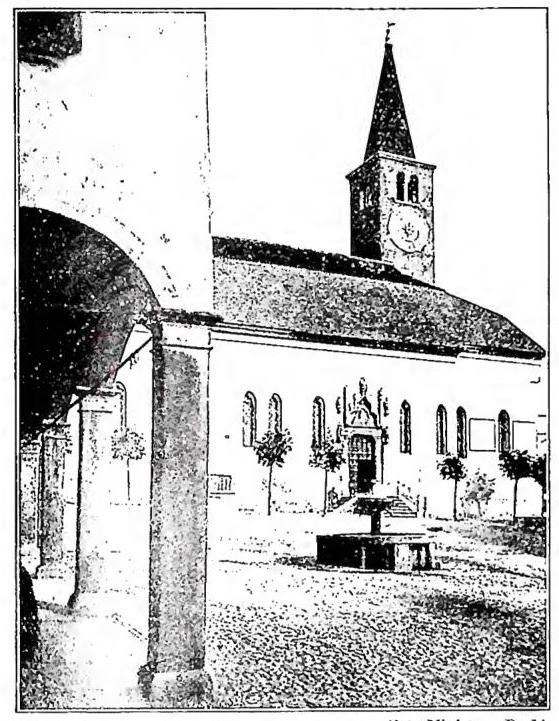
The cathedral, a work by Tullio Lombardo, completed only internally (1517–60), was built in place of a smaller 15th-century church. The interior, with three naves, harmonious in the proportions of its very tall pillars and in the sequence of its seven lateral round arches, is enriched by 17th-century altars of multicolored marbles flanked by statues of saints and surmounted by canvases by Schiavone, Jacopo da Ponte, Palma the Younger, and Cesare Vecchio (of these, the *S. Sebastiano* of 1584 is by the latter). The apse rises above a bastion of the ancient walls. In the underground sacristy is preserved a polyptych by Simone da Cusighe (1397), *The Life of St. Martin*, which rests upon a magnificent 14th-century marble and porphyry ark.

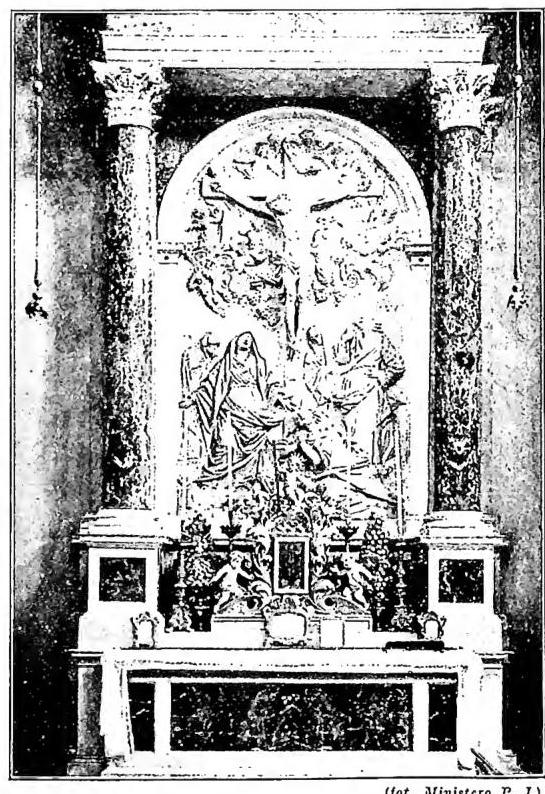
On the south side of the cathedral stands the bell tower (1732–43), surmounted by a bronze angel by Juvarra. Before it is the baptistery in the little church of the Madonna delle Grazie (1520): the baptismal font in brecciated marble is adorned with wooden sculptures and surmounted by the small statue of the Baptist by Brustolon. Also worthy of note are the church of S. Stefano in Italian Gothic forms, with three naves (second half of the 15th century), featuring a gilded wooden altar that reproduces in carving an altarpiece by Alvise Vivarini, executed by Andrea di Foro (15th century), and the 18th-century church of S. Pietro with notable Baroque altars, two large carved wooden panels, *Crucifixion* and *Death of St. Francis Xavier*, masterpieces by Brustolon, and frescoes by Sebastiano Ricci.

Numerous are the civil buildings of artistic interest, among which the most important is the Palazzo dei Rettori. Begun in 1491 in place of another dating to 1409, it was the work either of a nephew of Ghiberti or of the Venetian Candi. The bell tower is the only remnant of the ancient palace of the Count-Bishop, beside which stands the civic museum, formerly the seat of the college of doctors, where are preserved canvases by Giorgione, Palma the Younger, and works by Cellini.

Characteristic for their projecting first floors are the numerous patrician houses of the 17th and 18th centuries, adorned with Roman antiquities in their doorways.

The municipal palace in neo-Gothic forms (1838) by Segusini, of which the third story is also neoclassical, has preserved some elements of the ancient palace of the council of nobles, unfortunately demolished last century to make way for the present tribunal.

Article illustration

Porta Rugo (1522) preserves the Venetian tower of the 15th century; Porta Dojona, with its central arch surmounted by the Venetian lion, was built in 1553 in place of a 13th-century gate, of which it retains the original wooden leaves (1200).

BIBL.: M. Guggenheim, *Il palazzo dei rettori di B.* Venice 1894; F. Pellegrini, *Appunti sulla cattedrale di B.* Belluno 1908; E. Ricci, *La città del Piave*, Milan 1928; V. Dolcioni, *B. medievale*, Belluno 1934; id., *Le quattro stagioni, affresco di Cesare Vecellio*, Padua 1937; N. Deorassi, *Un sarcofago romano di B.* in *Bull. della comm. archeol. del governo romano di Roma*, 68 (1940), pp. 17–34; A. Callegari, *Bronzi del museo civico di B.*, Rome 1941.