
ARABIC NUMERALS. — The system now in use for indicating numbers, known by the name of Arabic numerals, in fact originated with the Indians and, according to the most common theory, consists of the initial letters of the name of each numeral in Sanskrit. Their knowledge reached Europe, however, through the Arabs, who were already acquainted with them in the 8th century.
The treatise of Abū Ġa'far Muhammad b. Mūsā al-Hwarizmi, which has come down to us in a Latin version, dates from the caliphate of al-Ma'mūn (813–33). In the Latin codices, the earliest mention is found in two Spanish manuscripts of Isidore’s Etymologiae seu Origini, one from 976, originating in the monastery of Albelda (cod. Escorial d. I, 2), and the other from 992, written at S. Millán della Cogolla (cod. Escorial d. I, 1). There, at the beginning of Book III, a gloss attributes the use of Arabic numerals to the Indians and gives the numbers in reverse order, from 9 to 1—that is, excluding zero: a circumstance sufficient to demonstrate that they had not yet been applied in the decimal system.
From Spain, knowledge of Arabic numerals spread to France, England, Germany, and then Italy,
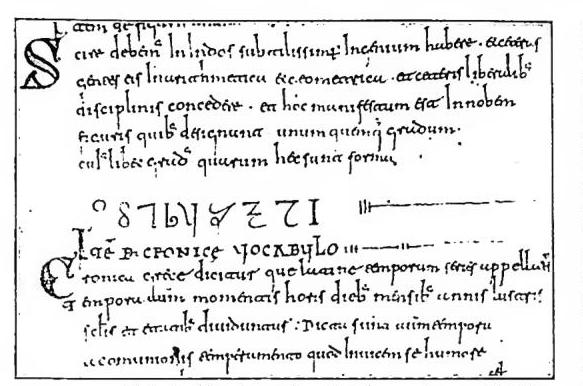
CIFRE ARABICHE - Primo esempio di c. a. Codice Vigiliano (a. 976) contenente le Etymologie di Isidoro di Siviglia - Madrid, biblioteca dell'Escuriale, d. 1., 2, f. 12.
non senza opposizioni, se nel 1299 gli Statuti dell'arte del cambio di Firenze imponevano di scrivere i numeri in tutte lettere, ad evitare facili alterazioni. Ma già nel 1202 il Liber abaci di Leonardo Fibonacci (Alina Bonacci) da Pisa, che aveva appreso il sistema nelle colonie pisane del Nord-Africa, era venuto a dimostrarne la praticità, divulgando l'uso delle quattro operazioni. Dal sec. xv le c. a. entrano nella pratica generale e si incontrano, tranne qualche lieve eccezione per il 3 e per il 4, nella stessa forma presso tutti i paesi.