
CLIPEATA, IMMAGINE. - By the expression « imago clipeata », which is already found in Macrobius (Saturn., II, 3), one customarily designates the figure or, more often, the bust of a person sculpted in relief or painted on a surface in the shape of
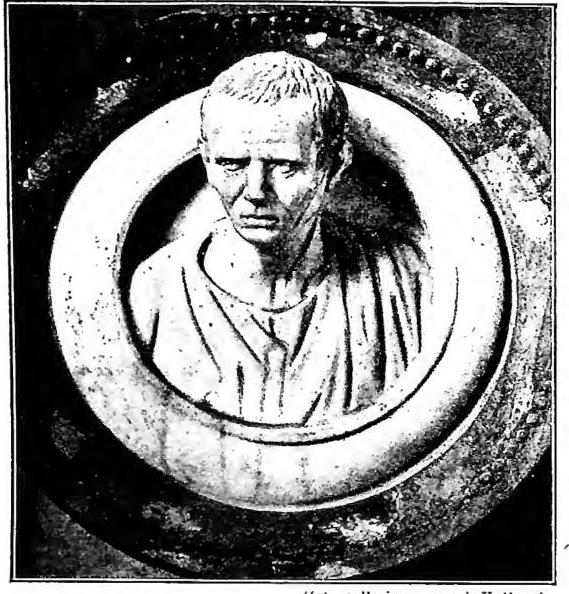
Particularly interesting are a relief in the Vatican Museum and a painted sarcophagus from Kertsch because they show, respectively, the one a sculptor's workshop with a marble worker intent on finishing a clipeus portrait of a Roman woman, the other a painter's studio who, after hanging two clipei with half-length portraits on the wall, sits before an easel. Roman sarcophagus i. c. begin to become very frequent starting from the Antonine age, and Christians also adopted them widely. On sarcophagi, however, the bust or busts of the deceased are generally not sculpted on a convex surface with a circular contour like that of a clipeus, but inside a hemispherical cavity carved most often in the center of the chest or less frequently on the lid, or even, but exceptionally, on one of the sides, as seen in a Christian sarcophagus from Toulouse. Often the clipeus takes the shape of a shell, thus acquiring a greater aesthetic sense due to the highly decorative motif of the flutings and given that the volute near the hinge of the shell provides a graceful support for the bust or busts of the deceased. However, the transformation of the clipeus into a shell is not always entirely accomplished; sometimes, in fact, the characteristic volute remains at the bottom, but the cavity is devoid of flutings. At other times the clipei with the busts of the deceased are supported by genii, flying erotes, victories, etc., but much more frequent are those not supported by any figure, that is, embedded in the center of the sarcophagus chest both in the case that this is strigillated and in the case that it is decorated with a continuous frieze. When the front of the sarcophagus is divided into two horizontal zones, the clipeus is usually located in the upper regis-
ter, though often encroaching, at least in part, upon the lower one as well. Since two triangular spaces are formed to the right and left at the point where the terminal molding of the sarcophagus chest meets the upper part of the clipeus, Christian sculptors very ingeniously thought of filling these corners with low-volume figures that could find a justifiable place in the upper part of the represented scenes; since the figure of the hand of God protruding from the clouds to stop Abraham's arm or to hand the tablets of the Law to Moses served the purpose well, these two scenes from the Old Testament are almost constantly found on the sides of the clipei: the sacrifice of Abraham and the revelation of Sinai. Christian art also used i. c. in catacomb paintings to frequently depict the bust of Christ (as seen, for example, in the vault of Celerina's arcosolium in the cemetery of Praetextatus); in basilica paintings to insert the busts of saints or (as at St. Paul's Outside the Walls) the busts of pontiffs; in mosaics to make the hieratic bust of the Pantocrator stand out (as frequently seen in the center of Byzantine domes).