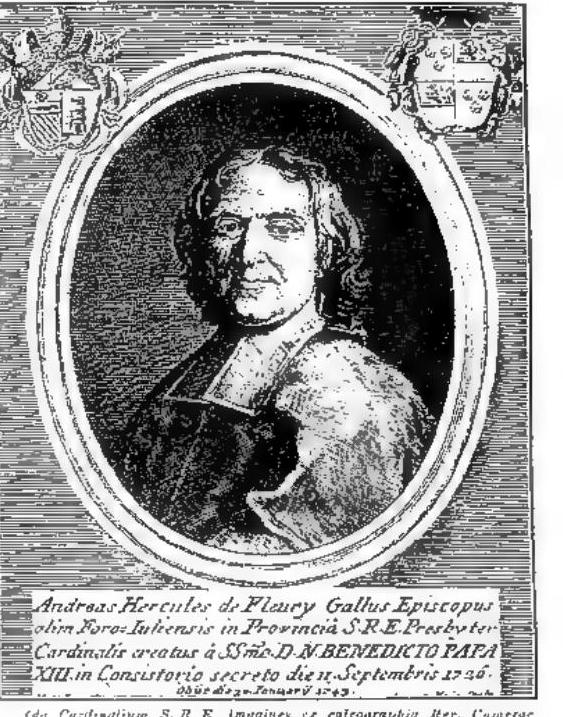
FLEURY, ANDRÉ-HERCULE de. — Cardinal and statesman, born at Lovède on 26 June 1653, died in Paris on 29 January 1743. Appointed almoner to Queen Maria Teresa (1679), and subsequently to Louis XIV (1683), he was bishop of Fréjus from 1698. Having become tutor to Louis XV in 1715, he succeeded in winning his complete confidence. When the duke of Orléans died (1723), he had the duke of Bourbon appointed first minister, but, having him exiled in 1726, he became de facto first minister and obtained the cardinal’s hat.
Domestically, he promoted the development of commerce and the navy, achieved monetary stability and financial equilibrium, reduced the taille taxes, while restoring the royal corvées and favoring the fermes and the clergy’s tax exemptions. He was hostile to Jansenists and Protestants, also for absolutist purposes. In foreign policy he was a pacifist, an architect of the Congress of Soissons (1728) and of the Peace of Seville (1729), in which Spain renounced Gibraltar and England recognized Charles of Bourbon’s rights to the duchies of Parma and Piacenza and to Tuscany. Favorable to a