
GIOVANNI da MILANO. — Giovanni di Jacopo di Guido da Caverzaio (today Caversaggio), in the territory of Como, painter; in 1350 he was in Florence, where he was registered as a foreigner in the Guild of Painters. In 1363 he became a member of the Guild of Physicians and Apothecaries. Two years later he had already been engaged for some time in painting the frescoes of the Rinuccini Chapel in S. Croce and obtained an extension for their completion.
(pct. Annuri)
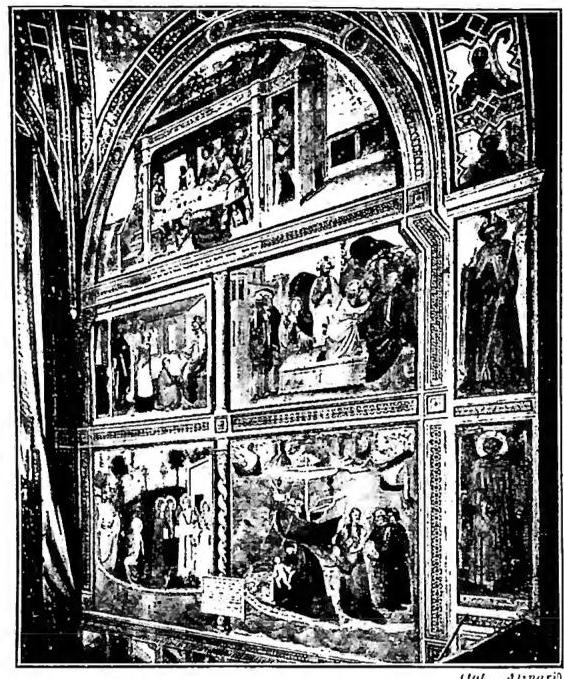
GIOVANNI DA MILANO – The Magdalene pours balm on Christ’s feet: Mary and Mary; The Raising of Lazarus. The two lower scenes (Noli me tangere and A Miracle of Mary Magdalene) are the work of the “Master of the Rinuccini Chapel.” Frescoes in the church of S. Croce – Florence.
It appears with the greatest clarity in his earliest work, the signed and dated polyptych of 1354 in the Gallery of Prato, where the images, constructed with crystalline precision of outline, have their volumes decisively revealed through strong accents of a soft, pasty sfumato bearing a distinctly Lombard imprint. These characteristics, although evidently compromised by contacts with Florentine art and Sienese chromaticism, recur in the frescoes of the Rinuccini Chapel, which are regarded as his major work. Other works of his include certain parts of a polyptych and a very beautiful Pietà of 1365 in the Uffizi, an Annunciation in the Gallery of Pisa, and a small multi-panel painting in the Museo di Palazzo Venezia in Rome.