Machine translation of the 1948–1954 Italian original. The original text is authoritative.
GUIDO da PISA. - Carmelite writer from Caprona (Pisa). The year of birth and death is unknown: a chronological indication is provided by his dedication of some works on Dante to the Genoese Lucano Spinola, whose name appears in the years 1323-47. Despite the apparent naivety of his writings, G. was a man not unversed in literary and hermeneutic experiences.
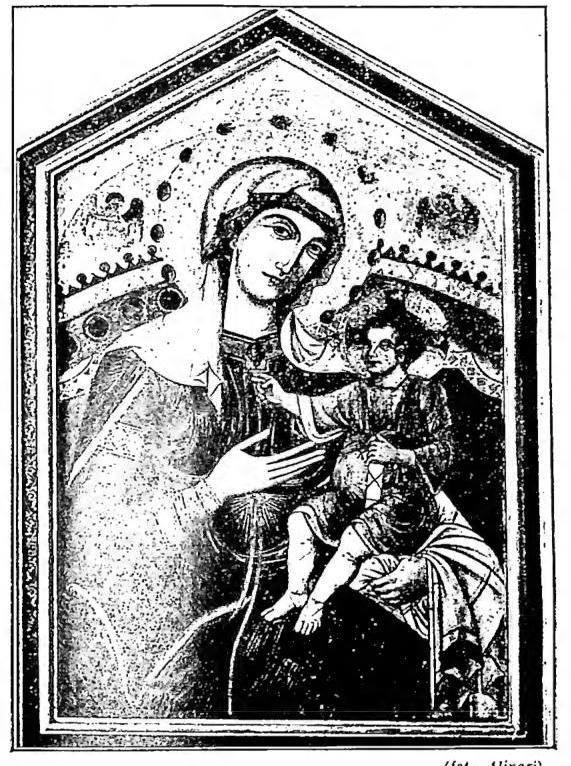
GUIDO DA SIENA - Madonna con Bambino - Siena, Pinacoteca.With didactic intentions, by translating or reworking various sources (Bibbia, Eneide, Commedia, the Cronica of Villani, etc.), he compiled a historical-mythological work titled Il fiore d'Italia, of which the first two books of the seven announced in the proem have survived. In them, «mixing and inserting for each era even the history of divine scripture», he recounted, with freshness of language and style and with a nearly giullaresco movement, Roman prehistory from the mythical Latin kings to the adventures of Aeneas. The work, among the most significant of minor fourteenth-century literature, was perhaps never completed. Two detached sections of it, I fatti d'Enea and Il fiore di mitologia, enjoyed popularity in schools. Notable for the history of Dante's reception is G.'s love for the Commedia: besides frequently quoting it in the Fiore, he dedicated to the Inferno an exposition in 8 cantos of tercets and a Latin commentary.
BIBL.: Editions: Il fiore d'Italia, Bologna 1490, reprinted there in 1839; Il fiore di mitologia, ibid. 1845; I fatti d'Enea, Firenze 1868 (ed. with introd. and commentary by A. Marenduzzo, Milano 1906); the proem to the Commento all'Inferno was published by G. Vandelli in Bull. soc. dant. ital., 8 (1909), p. 150 ff.; the part relating to cantos 29 and 34 by F. P. Luiso in Miscell. Mazzoni, I, Firenze 1907, p. 79 ff.; the Dichiarazione poetica dell'Inferno, by F. Roediger in Propagatore, nuova serie, 1 (1888), pp. 62 ff., 326 ff. Studies: P. Caioli, Frater G. pisanna carmelita, in Analecta Ordinis Carmelitarum, 1 (1909), p. 357 ff.; C. Fedeli, G. da P., in Ann. Univ. tosc., 29 (1910), pp. 1-24; G. Livi, G. da P. dove scrisse il suo commento dantesco?, in Rivista delle biblioteche e degli archivi, 26 (1915), pp. 1-5; N. Sapegno, Il Trecento, Milano 1938, p. 616 ff. (with bibl. on p. 628).
Cite this article
“GUIDO DA PISA.” Enciclopedia Cattolica, vol. VI (1951), p. 766. Azione Romana digital edition, https://azioneromana.com/article/guido-da-pisa.