
OBITUARY. - A register for para-liturgical use, very widespread in the Middle Ages and perpetuated down to the present day, containing the date of death, the name and the dignity of the deceased whose commemoration is made in religious communities (chapters, monasteries, collegiate churches, parishes) on the anniversary day. For this purpose the entry was for the most part limited to indicating the name and the day of the passing, disregarding the year; in more recent times, to the aforesaid schematic data there were added notices concerning the life and merits of the deceased.
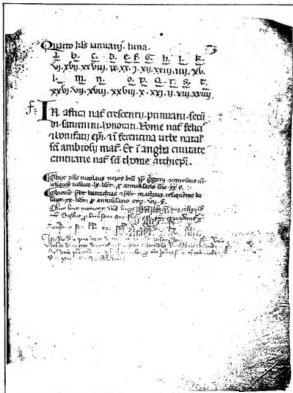
The use of suffrages for the dead, attested from the earliest times of the Church, had one of its liturgical manifestations in the daily reading of the diptychs (v.), which, however, were disappearing toward the 5th century. From the immediately following age there are no documents, but it is logical to suppose that the diptychs were replaced by similar lists. Later one finds Sacramentaries that bear in the margin and in the interlinear spaces of the Canon certain obituary notes, whose number increased gradually as the commemoration was extended to other deceased. This circumstance had already led, toward the middle of the 8th century, to transforming the collective commemorations, made by then almost always without the reading of the names, into individual commemorations, distributed according to the anniversary days. From that time began the practice (prolonged for a very long time: cf. as a characteristic example the Martyrology of Sts. Cyriacus and Nicholas in Via Lata in Rome [Bibl. Vallicelliana, ms. F. 85: beginning of the 11th century; obituary notes down to the beginning of the 15th century]) of adding the obituary notes either in the Martyrologies (v.), often giving rise to interpolations perpetuated from copy to copy, or in the calendars. Finally, toward the 9th century the need was felt to create special books for the lists of the dead, true and proper obituaries, which took, like the Martyrologies of which they for the most part constituted a supplement, the form of calendars.
The term obituary, which prevailed in the modern era together with "necrology," is rather rare in the Middle Ages: more often one finds liber obituum, necrologium, liber defunctorum, or even, though improperly, martyrologium, kalendarium; the designation liber regular is also common, owing to the fact that in monasteries the martyrology and the obituary were read during the recitation of "prime" together with a chapter of the rule. It seems instead improbable that the term liber vitae refers to an obituary (cf. the one added to the Sublacense Sacramentary of the 11th century: Rome, Bibl. Vallicelliana, ms. B. 24), which must rather have designated, like the libri confraternitatis, a list of the living.
The nominal lists of obituaries included, alongside the illustrious personages (ecclesiastical and political authorities) and the deceased members of the community, the benefactors, and often also members of other communities, bound to the first by a system of spiritual association whereby they mutually communicated (through the literae confraternitatis) the names of the deceased confreres, with the aim of extending the suffrage to them. This practice, already in use in the 8th century, spread especially from the 10th century onward. Mainly from the 12th century, in order to integrate the lists already transmitted, monasteries adopted the so-called "death rolls," which a monk (rotularius or also baiulus, tabellarius, etc.) carried around to the confederated monasteries. The rolls bore at the top the notice of the death; thereafter the person in charge of each monastery marked the date on which he received the communication and often added a prayer or a brief eulogy of the deceased (cf. M. Schrott, De confraternitatibus a canonia Neocellenis cum aliis monasteriis initiis, in Ordo canonicus, I [1946], pp. 117-41). The lists of benefactors were instead tied to the numerous donations pro anima, made with the precise purpose of obtaining suffrages.
The obituaries, very many of which are still unpublished, constitute a documentary source of the first order for local history, the development of religious communities, topography, chronology, and the dating of liturgical codices.
Bibliography10 works
Alessandro Pratesi