
PRADO, JERÓNIMO de. – Jesuit, b. at Baeza (Andalusia) in 1547, d. at Rome on 13 Jan. 1595.
Having entered the Society of Jesus in 1572, he was professor of exegesis at the college of Córdoba for sixteen years.
There he composed commentaries on *Isaiah, Zechariah, Malachi*, the Epistle to the *Hebrews* (unpublished), and the commentary on *Ezekiel* up to chapter 26. Fr General C. Aquaviva had called him to Rome in 1591, together with his pupil J. B. Villalpando, to complete this great work, which he was not able to finish. Villalpando (b. at Córdoba in 1552, Jesuit in 1565, d. at Rome on 22 May 1608) assisted him by explaining the passages of *Ezekiel* dealing with Hebrew weights and measures; he himself added the commentary on chapters 27–42 and selected passages from chapters 43–48, as well as the drawings of the Temple in the grand vision of the final chapters (40–48). Moreover, with substantial assistance from Philip II, he published in three volumes the work: *Hieronymi Prati et I. B. Villalpandi a S. I. in Ezechielem explanationes et apparatus urbis et templi Hierosolymitani commentariis et imaginibus illustrati* (Rome 1596–1604). This work, most diligent and rich in ancient, classical, and patristic learning, is of great importance for the history of exegesis. The two authors examine even Greek and rabbinic chains on the Prophet, explaining especially Hebrew words. Yet V. Villalpando, most erudite in classical architecture, imagined a marvel of architecture without equal; despite the praise of his contemporaries, his attempt must be judged fanciful, given the simple, linear, and rough character of the true model of the Ezekielian Temple. He also prepared an edition of the *Explanationes epistolarum b. Pauli Apostoli* (Rome 1598) by Remigius of Auxerre, mistakenly attributing it to Remigius of Reims.
**
**Pradt, Dominique Dufour de.** – French prelate, b. on 23 Apr. 1759 at Allanche, d. on 18 Mar. 1837 at Paris. Deputy of the clergy to the Estates-General in 1789, he voted against the Civil Constitution of the Clergy and left France in 1792.
He published anonymously two pamphlets against French policy (*Antidote au Congrès de Rastadt*, of 1798, and *La Prusse et sa neutralité*, of 1800). Later aligning himself with Napoleon, he became in 1805 bishop of Poitiers and the following year accompanied the Emperor to Milan, where he crowned him king of Italy. In 1808 he negotiated at Bayonne with Spanish ministers and contributed to the dethronement of the Bourbons. Named in 1809 by Napoleon archbishop of Mechelen, he was not formally recognized by the Holy See because the papal bull of appointment, drawn up *motu proprio*, was withheld by the Emperor; nonetheless he administered the archdiocese of Mechelen until 1813, except for the second half of 1812, which he spent in Warsaw as ambassador. In 1812 he was among the promoters of the National Council of Paris and served on the commission sent to Savona to secure the approval of Pius VII for the decrees of the Council. After Napoleon’s fall, he first sided with the Bourbons but then moved to liberal opposition. His attempts to regain Mechelen proved fruitless, and he retired to a property near Allanche, where he began a feverish career as a publicist. The following works by him were placed on the Index: *Les quatre concordats, suivis de considérations sur le gouvernement de l'Église en général et sur l'Église de France en particulier depuis 1515* (decr. 27 Nov. 1820); *Concordat de l'Amérique avec Rome* (decr. 11 June 1827); and *Congrès de Panama* (decr. 18 Aug. 1828).
**
**Praecepta de Chartis Perditis: v.**
**Appennes.**
«Praeclara Custos Virginum». – Hymn of Matins for the feast of the Immaculate Conception, composed in the 17th century and introduced into the Breviary in 1845. The author is unknown.
In this inspired composition the poet addresses the Immaculate Virgin with the most beautiful titles, entreating her to guide men through the reefs of this stormy sea.
**
**Praedestinators.** – Anonymous and apocryphal work to which the first editor, J. Sirmond, gave this title.
Book I attacks ninety heresies, the penultimate being the *haeresis Praedestinatorum*. The author draws on the book *De haeresibus* by St Augustine, adding false and fantastic information. Book II purports to be a treatise on predestination wrongly attributed to St Augustine, which the author refutes in Book III. The pseudo-Augustinian treatise is likewise a forgery, composed by a Roman Pelagian, probably in the first half of the 5th century. There are linguistic and theological affinities with the *Commentary on the Psalms* by Arnobius the Younger. Whether he is the author of P. remains doubtful.
**
**PRAETORIUS, Michael.** – Composer and music theorist, b. on 15 Feb. 1571 at Kreuzburg (Thuringia), d. on 15 Feb. 1621 at Wolfenbüttel (Brunswick). He served as organist (from 1604), Kapellmeister, and secretary to the Duke of Brunswick at Lüneburg and held the title of prior of Ringelheim.
He published numerous collections of compositions (notably the nine parts of *Musae Sioniae*, 1,244 songs [Wolfenbüttel 1605–10]); but his principal work is the treatise *Syntagma musicum* in three volumes. The first, in two parts (I, Wolfenbüttel 1614; II, Wittenberg 1615), written in Latin with interpolations in German, contains a historical excursus on ancient music, including secular instruments, and on ecclesiastical music. The second, also in two parts (I, Wolfenbüttel 1619; II, ibid. 1620), written in German, is the most important repertory for the history of musical instruments of his time, enriched moreover by 42 valuable plates reproducing the instruments by groups and families (reprinted in facsimile with an introduction by W. Gurlitt [Kassel 1929] as vol. XIII of the *Gesellschaft für Musikforschung*). The third (Wolfenbüttel 1619) contains theories and examples of musical composition, valuable for the history of psalmody, notation (ligatures, proportions) on the *tactus*, thoroughbass, etc. (reprinted by E. Bernoulli in 1916).
**
**PRAGUE, Archdiocese of.** – The capital city of Czechoslovakia and an archdiocese situated in central Bohemia on the banks of the Moldau, built upon seven hills. On account of its position and the great number of churches it is called the “Rome of the North”; for its many towers, the “city of a hundred spires”; and for its natural and artistic beauty, the “golden city.”
The archdiocese covers 15,000 sq. km. with a population of 2,943,868, of whom 2,052,154 are Catholics, distributed among 604 parishes served by 607 diocesan priests and 314 regular clergy; it has 43 male and 127 female religious communities (1949 statistics: *Ann. Pont.*, 1952, p. 328).
**P., erected a diocese in 973 by Benedict VI, was raised to an archdiocese in 1344 by Clement VI. Its principal patrons are St Wenceslaus and St John of Nepomuk. Suffragan dioceses: Hradec Králové, Budějovice and Litoměřice. In 1950 the Communists confined all religious in concentration convents. After the suppression of all seminaries and theological faculties in August 1950, the Communists established at P. a general seminary for Bohemia and Moravia under their control.**
The archbishop of P. has long enjoyed special privileges: he bears the title of *Dux et Princeps S. Romani Imperii*, of perpetual legate of the Apostolic See to the illustrious dioceses of Bamberg, Meissen and Ratisbon (1365), and perpetual chancellor of Charles University (1384), and once had the right to crown the king of Bohemia. The metropolitan chapter of St Vitus bears the title “always faithful,” and its canons wear pontifical vestments (1390).
Notable bishops include: St Adalbert the martyr (982–97), counsellor to Emperor Otto III and founder of the first Benedictine abbey at P. Břevnov (993); Andrew (1214–24), champion of clerical liberty against noble oppression. Among the archbishops stand out: Ernest of Pardubice (1343–64), co-founder of the University of Prague, counsellor to Emperor Charles IV and first archbishop of Prague; John Očko of Vlašim (1364–79), created the first Czech cardinal for his loyalty to the Holy See; John of Jenštejn (1379–1400), defender of papal ecclesiastical rights; Cardinal Friedrich Joseph Schwarzenberg (1849–85), distinguished member of the First Vatican Council; Josef Beran, elected in 1946, defender of Church rights, expelled from his diocese and interned in 1951.
Religious life centres on the Marian pilgrimage shrines of Svatá Hora near Příbram and Stará Boleslav, with the miraculous picture of the Madonna called the Palladium of the Czech lands, and on the 17th-century Church of Our Lady of Victory in Prague, where the Infant Jesus of Prague is venerated.
The city grew between the castles of Vyšehrad and Prague, traditionally founded in the 8th century by Princess Libuše. The earliest document mentioning Prague dates to 928, when St Wenceslaus, murdered in 929 at Boleslav by his brother Boleslaus the Cruel, laid the first stone of the rotunda of St Vitus. After the union of the Czech tribes, Prague became in the 10th century the capital of Bohemia and a destination for merchants—especially Jews—pilgrims to St Wenceslaus’s tomb and students for its ecclesiastical schools. In the 13th century King Wenceslaus I (1230–53) encircled it with walls, built churches and invited German colonists. The city reached its zenith under Charles IV and Wenceslaus IV, becoming the centre of the Holy Roman Empire (1346–1400). Charles IV, Holy Roman Emperor, obtained its elevation to an archdiocese (1344), was crowned king of Bohemia there (1347) and founded the New Town with the university (1348), the first in central Europe, intended for Czechs and citizens of three foreign nations: Saxons, Bavarians and Poles. During his reign the first stone of the new cathedral of St Vitus was laid (1344) and many churches were erected. In 1393, during the conflict between Wenceslaus IV and Archbishop John of Jenštejn, the general vicar St John of Nepomuk was drowned in the Moldau for refusing to betray the secrecy of the confessional to the king. In Prague the reform movement began with the preaching of Master John Hus in the Bethlehem Chapel. After Hus was burned at Constance in 1415, unrest in Prague culminated in 1419 with the expulsion of Catholic councillors from the town hall. The Hussites then attacked and burned convents and churches, driving out the monks. In 1421 the archbishop of Prague, Conrad of Vechta, went to the rebels; only in 1436 did Emperor Sigismund gain control, but after his death in 1437 confusion long continued. Opposition to Catholicism persisted under the reign of Ferdinand I of Habsburg (1526–64). In 1561 an archbishop was again appointed after 140 years of sede vacante, during which the archdiocese had been governed by administrators maintained by the Holy See. Utraquists and Lutherans had their own consistory called the Lower Consistory. Prague’s non-Catholics gravitated toward Lutheranism, and the Habsburgs launched a thorough Catholic reform. St Ignatius, at their request, sent the Jesuits to Prague under St Peter Canisius (1555), and many other Italian and Spanish religious came. Italian builders erected an Italian hospital in the Lesser Town in 1573 and founded the “Italian Fraternity” in 1602. Rudolf II (1576–1611) restored Prague as an artistic and commercial centre, but in 1611 it was sacked by Passau’s citizens. In 1618
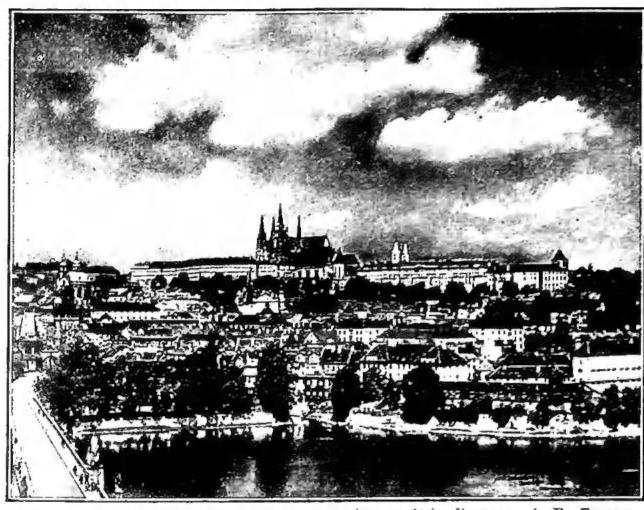
PRAGUE, ARCHDIOCESE OF – Church of St Nicholas (17th c.), architect Kilian Ignaz Dientzenhofer.