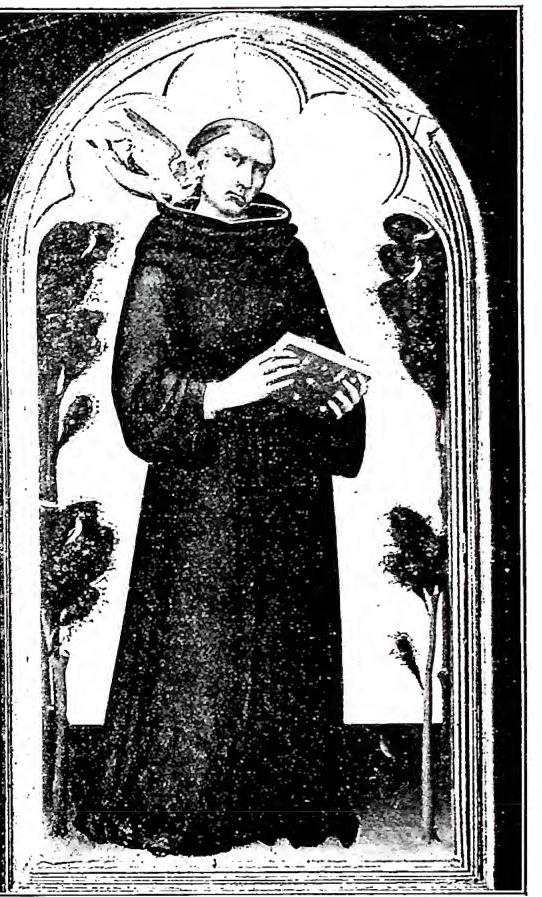
AGOSTINO DETTO NOVELLO, Blessed. - B. at Tarano in Sabina, d. May 19, 1309. He completed his studies of law at Bologna. Having risen to great fame, he was taken up by King Manfred as prefect of his Curia. When this king was defeated by Charles I of Anjou, A. took refuge in Sicily, where he became an Augustinian. Concealing his learning, he wished to be numbered among the lay brothers. Having learned that hermitages of the Order flourished in Tuscany, he asked to be transferred there, where he led a humble and retired life. Because of a brief writing in defense of the convent of Rosia (Siena), he was recognized by the jurist Giacomo Pagliaresi, who recommended him to his superiors. Brought to Rome by the blessed Clement of S. Elpidio, prior general, and raised to the priesthood, he became his counselor in the revision of the constitutions of the Order. Nicholas IV wished him as his confessor and appointed him pontifical penitentiary. In the General Chapter of Milan of 1298 he was elected prior general and confirmed by Boniface VIII. He, however, did not complete the three-year term of governance; having convoked a new Chapter at Naples (1300), he renounced the generalate, refusing to be re-elected. He then retired to the hermitage of S. Leonardo near Siena, where he lived in great penance and charity toward the sick, dictating the constitutions for the friars of the hospital of S. Maria della Scala. He shone by many miracles and had a public cult confirmed by Clement XIII on July 11, 1759. His relics are preserved in the church of S. Agostino in Siena.
AGOSTINO NOVELLO, blessed - Detail of the polyptych by Simone Martini (1st half of the 14th century) - Siena, Church of S. Agostino.(phot. A. A. A. A.)Bibliography8 worksHenricus de Alemannia, De origine et progressus ordinis fr. heremit. 1. Augustini, in Analecta Augusti, IV, Rome 1911-1912, p. 326; Jordanus
BIBL.: Henricus de Alemannia, De origine et progressus ordinis fr. heremit. 1. Augustini, in Analecta Augusti, IV, Rome 1911-1912, p. 326; Jordanus de Saxonia, Liber qui dicitur Vitus fratrum, Rome 1587, pp. 69, 75, 81 ff.; T. de Herrera, Alphabetum Augusti, I, Madrid 1644, p. 6; Acta SS. Maii, IV, Venice 1740, pp. 614-26; L. Banchi, Statuti Senesi scritti in volgare nei secoli XIII e XIV, III; Statuto dello Spedale di Siena, Bologna 1877, p. 169; Analecta Augusti, VI, Rome 1915-16, pp. 120-33; A. Corrao, Sopra la Patria del B. Agost. Novello, 3rd ed., Palermo 1922.
Cambiaso, Vittorio. “Agostino Detto Novello, beato.” In Enciclopedia Cattolica, vol. I, coll. 517–518. Città del Vaticano: Ente per l’Enciclopedia Cattolica e per il Libro Cattolico, 1948. https://azioneromana.com/article/agostino-detto-novello-beato.
MLA
Cambiaso, Vittorio. “Agostino Detto Novello, beato.” Enciclopedia Cattolica, vol. I, Ente per l’Enciclopedia Cattolica e per il Libro Cattolico, 1948, coll. 517–518. Azione Romana, https://azioneromana.com/article/agostino-detto-novello-beato.
BibTeX
@incollection{ec1_agostino_detto_novello_beato,
  author    = {Cambiaso, Vittorio},
  title     = {Agostino Detto Novello, beato},
  booktitle = {Enciclopedia Cattolica},
  volume    = {I},
  pages     = {517--518},
  note      = {Cited by column},
  publisher = {Ente per l’Enciclopedia Cattolica e per il Libro Cattolico},
  address   = {Città del Vaticano},
  year      = {1948},
  url       = {https://azioneromana.com/article/agostino-detto-novello-beato}
}
One of some 20,000 entries brought back from the twelve printed volumes (1948–54). Spotted something? Help us improve it.
Click or scroll to zoom · drag to pan · Esc to close