TERUEL, Diocese of. - Diocese and capital city of the province of the same name in Spain. It has an area of 6,200 sq km with a population of 85,650 inhabitants, almost all Catholics, distributed among 117 parishes, served by 146 diocesan priests and 20 regulars; it has a seminary, 6 male religious communities and 15 female ones (Ann. Pont. 1953, p. 422).
The city of T. rises at an elevation of 911 m on the left bank of the Turia, at the confluence of the Alfambra. Founded by the Iberians and called Turba, it was devastated by the Romans, after Hannibal had destroyed Saguntum. The Arabs rebuilt the city and are said to have given it the name of T. from a statue of a bull found among the ruins. Although it was reconquered by Alfonso II in 1171, the last mosque was not demolished until 1502. Peter IV had visited the city in 1348 and conferred on it the title of exenta (exempt). Gregory XIII granted the petitions of Philip II and on 31 July 1577 the diocese of T. was created; J. Pérez de Artieda was appointed its first bishop; but the first to reside there was A. Santos, transferred there from Saragossa in 1579. T. was occupied by the French in 1808 and ravaged by the civil war in 1936, in which its monuments were heavily damaged.
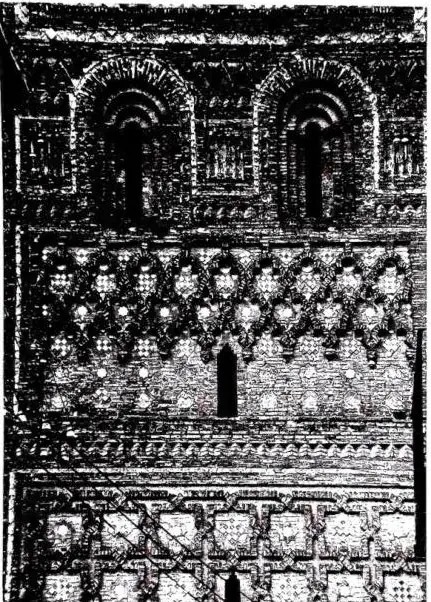
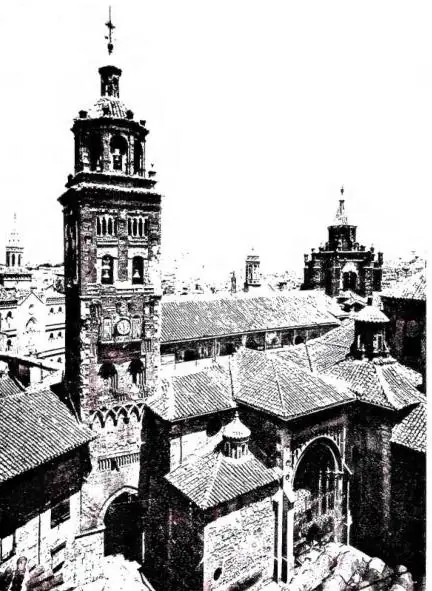
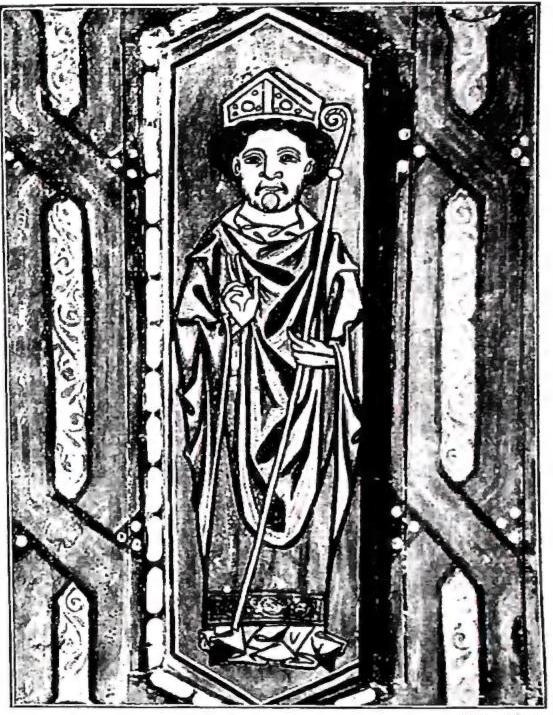
The Cathedral dedicated to the Assumption was built in the 16th century, but disfigured by restorations in 1685. The interior has three naves with a high altar in chased silver (1750) and a retable with the Assumption by Gabriele Joli (1535). The wooden ceiling in Moorish style has painted decorations and Gothic corbels; it was executed in 1335 by Domingo Peñaflor. In the 15th century the two smaller naves were added; the dome with colored tiles was erected in 1538. In the Treasury of the sacristy is preserved a silver monstrance about 3 m high, carved in Cordova by B. García de los Reyes (1742). Other notable churches are: that of the Salvador, of 1186, transformed in the Churrigueresque style, in which an image of Christ in wood of the 16th century is venerated, and de los tres manos v. of St. Peter in Gothic style of the 13th century with a square tower and an adjoining cloister of the 14th century, restored in the interior in 1741; that of St. Andrew with the tomb of Gil Sanchez Muñoz, bishop of Majorca; that of St. Teresa, with a stucco dome of the 18th century; that of St. Martin, with a tower of the 12th century restored in 1549; that of St. Michael of the 17th century, with polychrome wooden sculptures; that of St. Francis, erected at the end of the 15th century, with a single nave, in Gothic style, with a polygonal apse.
The see of T., suffragan of Saragossa, has since 1851 had the administration of the diocese of Albarracin, founded in the 12th century and situated at an elevation of 1,182 m. Albarracin was the capital of an Arab kingdom, then of an independent state, annexed to Aragon. In the ancient cathedral of the 14th century six notable Brussels tapestries of the 16th century are preserved. - See plate CXLIV.