
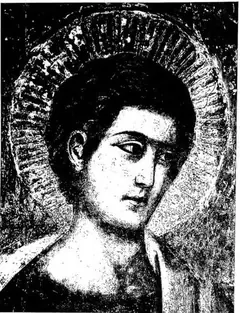
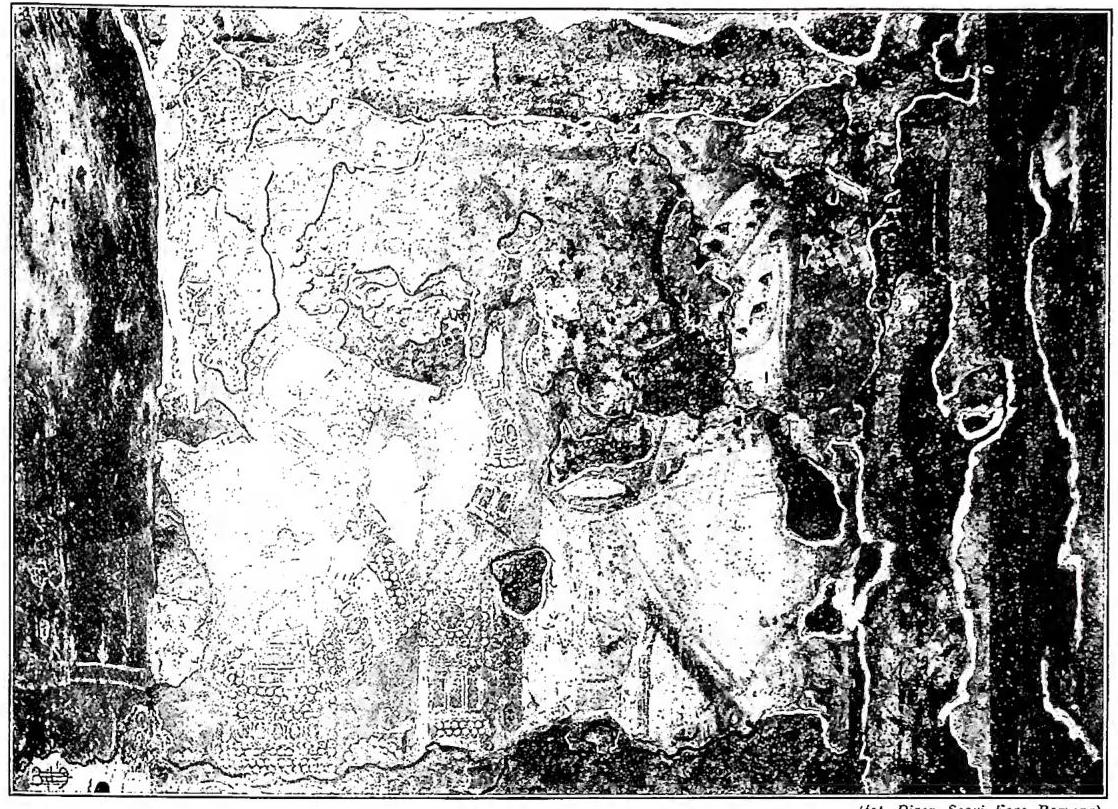
FRESCO. - This is the name given to any wall painting executed with colors dissolved in water on a thin layer of still "fresh" plaster, generally superimposed on another, much thicker and rougher layer called the arricciato. In the process of transformation of calcium hydroxide into carbonate, the color becomes incorporated with the plaster, and the painting therefore acquires a durability which cannot be achieved with other techniques. The fresco, therefore, is supremely suited to large monumental decoration. Since it must be executed while the plaster is still wet, it requires on the painter's part a sure intuition of spatial relationships, immediacy of touch and rapidity without second thoughts. Until the fourteenth century, the space to be decorated was calculated with skillful and complex divisions; later the composition was drawn on a cartoon and then transferred to the plaster by tracing its outlines. According to the age and the intentions of each artist, the technique, while remaining the same in its fundamental characteristics, underwent notable variations.
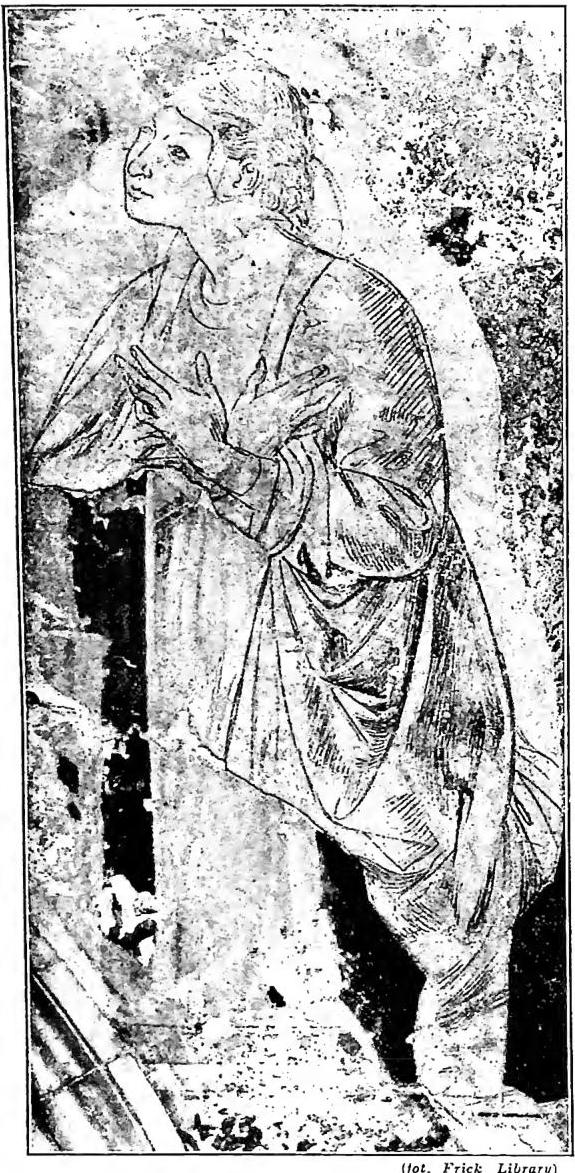
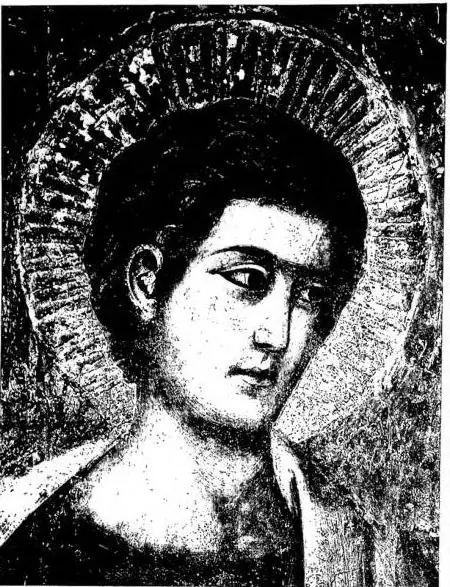
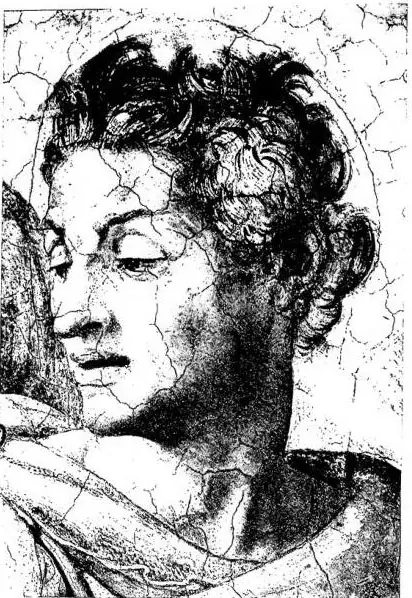
The frescoes of the catacombs appear to have been executed with a dense mixture of color, rapid juxtapositions of tints and without outlines, in a manner that the ancients called compendiaria, very similar to our impressionism. Subsequently the outlines became accentuated, defining areas that were filled with flat color. As long as the Byzantine influence prevailed, that is, until the 13th century, it was customary to apply the darkest tone on the plaster and to bring out the half-tones and lights in light or white while the layer was still wet. Dry highlights are very rare; in any case the final glazes are quite stable since they are applied with very dense color. Through Cennini we know the technique of the fourteenth-century fresco painters, who used to prepare in green earth and first seek out the modeling by hatching the shadows and lights and then finish with the flesh tones and with black outlines. This manner, which makes it possible to achieve the luminous transparency of so many fourteenth-century works or the subtle chromatic gradations of International Gothic, was greatly simplified by the major masters. Giotto used dense mixtures of color directly, and Simone Martini broad, barely varied applications. Equally immediate and rapid was the technique used by Masaccio, while P. Uccello returned to the traditional preparation in green earth and Baldovinetti finished largely in tempera. Leonardo's Last Supper is in reality, more than a true fresco, a painting executed with tempera colors on waxy stucco; hence its incurable ills. Of surprising vigor is Michelangelo's technique, which uses very complex mixtures directly and then glazes irregularly. Admirable is Raphael's, which joins the body of the color with very liquid tints to which the transparency of the tones is entrusted. Correggio, on the other hand, blocks in solidly and then applies various glazes so as to obtain atmospheric vibrations. Veronese finishes with brilliant brushstrokes and draws luminosity from the juxtaposition with blacks. In the seventeenth century the previously established practice of finishing in tempera, censured by Vasari, spreads with the aim of finding, through a dense and impenetrable, and consequently opaque, body of color, effects similar to the luminism of oil painting; the Neapolitan examples of Battistello or the Roman ones of Cortona, Pozzo or of Baciccio. The chalky clarity of the 18th century could not do without the same completion, since it enriched the elementary simplicity of the palette. In Tiepolo the opaque sketches contrast singularly with the limpid and luminous glazes, like those of Veronese. In the 19th century the fortune of fresco in church decoration was rather scant, whereas it has enjoyed a notable revival in recent decades, also in relation to changed architectural forms; besides true fresco proper, with or without tempera retouching, colors are often dissolved with casein, obtaining an even more stable paint with vast possibilities of effects.
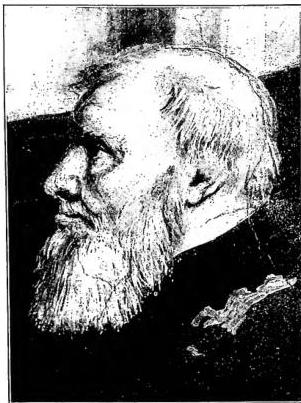
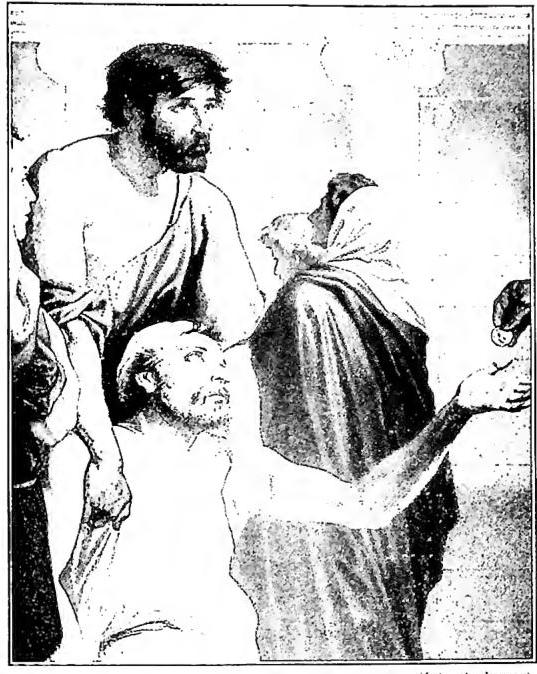
For the diseases of ancient frescoes, the methods of restoration and transfers onto canvas or metal mesh, v. RESTAURO. - See Pl. XXVI.
Bibliography10 works
Guglielmo Matthiae